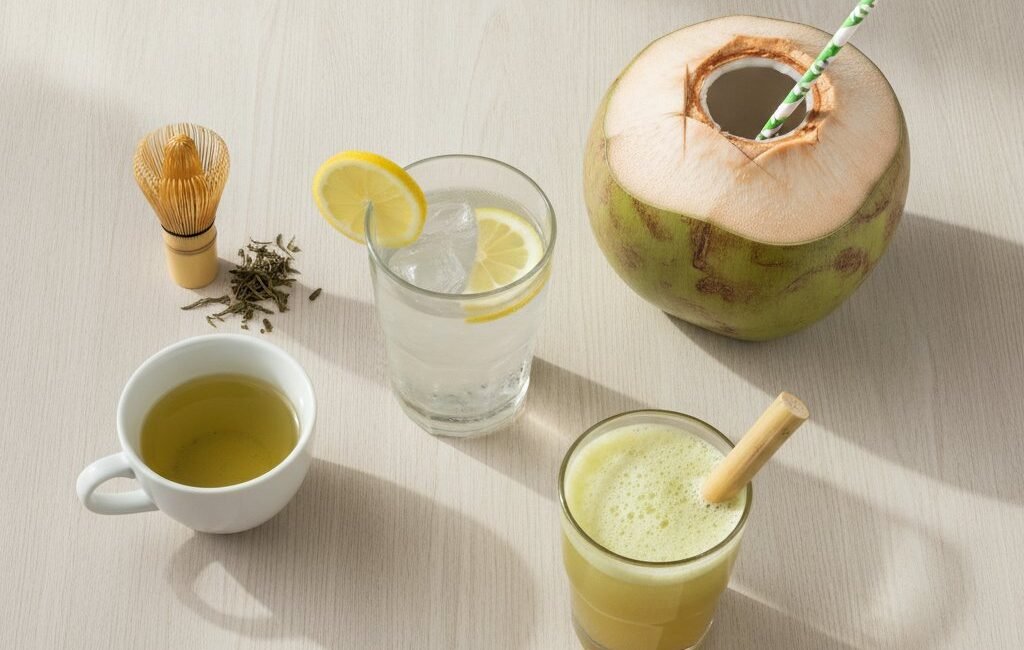
Most diet advice is about food, yet what you drink can add hundreds of calories and several teaspoons of sugar a day without you feeling any fuller. This site has more than a dozen posts on individual drinks, including sugarcane juice, coconut water, green tea, green coffee, masala chai, blue tea, hot water and milkshakes. Each one looks at a single drink. This guide asks the bigger question: across everything you drink in a day, what does the evidence actually support, and what should you limit?
This is general information drawn from published research and public health guidelines. It is not medical advice. If you have diabetes, kidney disease, heart failure, are pregnant, or have been told to restrict fluids, sugar or caffeine, follow your doctor’s guidance.
Why Drinks Matter More Than You’d Think
The World Health Organization’s 2015 sugars guideline gives a strong recommendation that adults and children keep free sugars below 10% of their total daily energy. It adds a conditional suggestion to go below 5%, which is roughly 25 grams or about six teaspoons a day. “Free sugars” means sugars added by manufacturers, cooks or you, plus the sugars naturally present in honey, syrups and fruit juices. Sugars inside whole fruit, vegetables and milk don’t count.
That definition is the key to this whole guide. A glass of juice, a sweetened iced tea or a can of soft drink can use up most of a day’s free-sugar allowance in one go, and liquid sugar doesn’t fill you up the way the same calories from food do. Drinks are one of the easiest places to make a big change with little effort.
Water: The Default Drink
Plain water has no sugar, no calories and no caffeine, which is why every major guideline treats it as the baseline. How much you need varies with body size, activity, climate and diet. The European Food Safety Authority’s adequate intake is about 2.0 litres of total water a day for women and 2.5 litres for men. “Total water” includes the water in food, so drinks provide roughly 80% of it rather than all of it.
You don’t need to force down eight glasses on a schedule. Thirst, and pale-yellow urine, are reasonable everyday guides for most healthy adults. Older adults are an exception, because thirst becomes less reliable with age. For the full evidence on how much water you need, and what mild dehydration does to energy and mood, see our guide to dehydration and tiredness. If you prefer it warm, hot water hydrates you just as well.
Sugary Drinks: The Clearest Evidence of Harm
Sugar-sweetened beverages are soft drinks, sweetened iced teas, energy drinks, sweetened coffee drinks and fruit “drinks”. Among drinks, these have the most consistent evidence against them.
- A 2010 meta-analysis in Diabetes Care by Malik and colleagues pooled 11 studies with more than 300,000 participants. People who drank one to two sugary drinks a day had about a 26% higher risk of type 2 diabetes than those who drank fewer than one a month.
- A larger 2015 meta-analysis in The BMJ by Imamura and colleagues covered 17 cohorts and more than 38,000 cases of type 2 diabetes. Each extra daily serving of a sugary drink was linked to an 18% higher incidence of type 2 diabetes. After accounting for body weight the figure was still 13% per daily serving, so the link isn’t explained by weight gain alone.
Both are observational studies, so they show association rather than proof of cause. Still, the results are consistent across many populations, there’s a plausible mechanism, and they line up with the WHO sugar limits above. If you drink sugary drinks every day, cutting them back is probably the single most useful change in this guide.
Fruit Juice: Not the Same as Fruit
Juice has a healthy image, but nutritionally it sits closer to a sugary drink than to whole fruit. Juicing removes most of the fibre and concentrates the sugar, which is why WHO counts juice sugars as free sugars.
The clearest illustration comes from a 2013 BMJ study by Muraki and colleagues, which followed more than 187,000 American nurses and health professionals for up to 24 years. Eating more of certain whole fruits was linked to a lower risk of type 2 diabetes. Three servings a week of blueberries was associated with a 26% lower risk, grapes and raisins with 12% lower, and apples and pears with 7% lower. The same increase in fruit juice was associated with an 8% higher risk. In the 2015 Imamura analysis, fruit juice was also linked to a slightly higher diabetes risk, although the authors cautioned that this result was weaker and may have been affected by publication bias.
The practical takeaway is simple: eat fruit rather than drinking it. If you enjoy juice, treat a small glass as an occasional drink, not a daily health habit.
What about sugarcane juice and coconut water?
The same rule applies to traditional drinks. Fresh sugarcane juice is refreshing, but it is essentially plant sugar dissolved in water, so it counts towards free sugars like any other juice. That makes it an occasional treat, not a health drink, especially if you have diabetes or are watching your weight. Coconut water (nariyal pani) is lower in sugar than most juices and naturally contains potassium. That makes it a reasonable alternative to soft drinks, but for everyday hydration it doesn’t do anything plain water can’t.
Diet Drinks and Sweeteners: A Stepping Stone, Not a Solution
Swapping a sugary drink for a diet one removes the sugar, but the evidence for long-term benefit is weaker than you might expect.
- In May 2023 the WHO released a guideline recommending against using non-sugar sweeteners for weight control or to reduce the risk of chronic disease. It covers aspartame, sucralose, saccharin, acesulfame K and stevia. The systematic review behind it found no long-term reduction in body fat, and some possible long-term undesirable effects. The guideline does not apply to people who already have diabetes.
- In July 2023 the WHO’s cancer agency (IARC) classified aspartame as “possibly carcinogenic to humans” (Group 2B), based on limited evidence. At the same time, the WHO/FAO expert committee (JECFA) kept the acceptable daily intake at 40 mg per kilogram of body weight. In WHO’s own example, a 70 kg adult would need to drink more than 9 to 14 cans of diet soft drink a day to exceed that, assuming no other sources.
In practice, a diet drink is better than a full-sugar one if it helps you stop drinking sugar every day. The WHO’s own suggestion, though, is to move towards unsweetened drinks and to get used to less sweetness overall, rather than simply replacing sugar with a sweetener.
Tea and Coffee: Mostly Good News
Unsweetened tea and coffee come out well in the research. A 2017 umbrella review in The BMJ by Poole and colleagues pulled together more than 200 meta-analyses on coffee. It found that coffee was more often linked to benefit than to harm. The largest reductions in all-cause mortality, cardiovascular death and cardiovascular disease were seen at about three to four cups a day, compared with none. The authors stressed that the evidence was mostly observational. The main exception was pregnancy, where higher coffee intake was linked to harms, so pregnant women should follow their doctor’s caffeine advice.
Two things matter more than the drink itself:
- What you add. Sugar, syrups, whipped cream and sweetened creamers can turn a near-zero-calorie drink into a dessert. The same goes for heavily sweetened chai.
- When you drink it. Caffeine lingers for hours and can disrupt sleep even when you don’t notice it. See our guide to caffeine timing and energy for how late is too late, and how much is too much.
Green tea has a reputation as a weight-loss drink. We look at that claim in green tea vs green coffee for weight loss, and at the downsides of drinking too much tea in side effects of tea.
Milk and Plant Milks
Plain milk isn’t counted as free sugar, and it provides protein and calcium. Flavoured milks and milkshakes are a different story, because added sugar puts them closer to the sugary-drinks category. Plant milks (soy, almond, oat and others) vary widely in protein and in whether they are fortified with calcium and vitamins. If you use one instead of dairy, choose an unsweetened, fortified version and check the label. Many almond and oat milks contain far less protein than cow’s or soy milk. For the full protein, calcium and fortification comparison, see plant milk vs cow milk.
Alcohol: The Evidence Has Shifted
For years, the idea that “a glass of red wine is good for your heart” was treated as settled. More recent work has challenged it.
- In January 2023 the WHO published a statement in The Lancet Public Health concluding that current evidence cannot identify a safe level of alcohol consumption, because no threshold has been found below which its cancer-causing effects don’t apply. Alcohol is a Group 1 carcinogen and causes at least seven types of cancer, including bowel cancer and female breast cancer.
- A 2023 meta-analysis in JAMA Network Open by Zhao and colleagues pooled 107 cohort studies with about 4.8 million participants. It specifically corrected for a flaw in older studies, which often counted former drinkers who had quit for health reasons as “non-drinkers”. Once that was done, low-volume drinking (under about 25 g of alcohol a day) was not linked to lower mortality compared with lifelong non-drinkers. Higher intakes (25 g or more a day for women, 45 g or more for men) were linked to a significantly higher risk of death.
Nobody needs to panic over an occasional drink. However, the evidence no longer supports drinking for your health. If you don’t drink, there’s no health reason to start. If you do, less is better. For more on heart risk factors, see our evidence-based heart health guide.
A Simple Healthy-Drinks Checklist
- Make water your default drink, and let thirst and urine colour guide you.
- Cut sugary drinks first. Daily soft drinks, energy drinks and sweetened iced teas have the strongest evidence of harm.
- Eat fruit, don’t drink it. Treat juice, sugarcane juice and smoothies as occasional.
- Use diet drinks as a bridge away from sugar, not a permanent fix.
- Enjoy tea and coffee unsweetened, and keep caffeine away from bedtime.
- Choose plain or unsweetened, fortified milks.
- Drink less alcohol, or none at all.
Frequently Asked Questions
What is the healthiest drink?
For most people, plain water. It hydrates you without sugar, calories or caffeine. Unsweetened tea, coffee and plain milk are also reasonable everyday choices for most healthy adults.
Is fruit juice healthy?
Not as healthy as its image suggests. WHO counts the sugar in fruit juice as free sugar, the same category as added sugar. A large 2013 BMJ study linked higher juice intake to a slightly higher risk of type 2 diabetes, while eating more of certain whole fruits was linked to a lower risk. Eat whole fruit and keep juice occasional.
Are diet sodas better than regular sodas?
They avoid the sugar, which makes them a useful stepping stone if you drink sugary soda every day. But a 2023 WHO guideline advises against relying on non-sugar sweeteners for weight control, because the evidence shows no long-term fat-loss benefit. Unsweetened drinks are the better long-term goal.
How many cups of coffee a day is healthy?
A 2017 BMJ umbrella review found the largest associated benefits at about three to four cups a day, though the evidence was mostly observational. Pregnant women and people sensitive to caffeine should drink less, and what you add to your coffee matters as much as the coffee.
Is a glass of red wine good for your heart?
The evidence no longer supports this. A 2023 meta-analysis of 107 studies found that light drinking wasn’t linked to living longer once the flaws in older studies were corrected. The WHO says no level of alcohol has been shown to be safe.