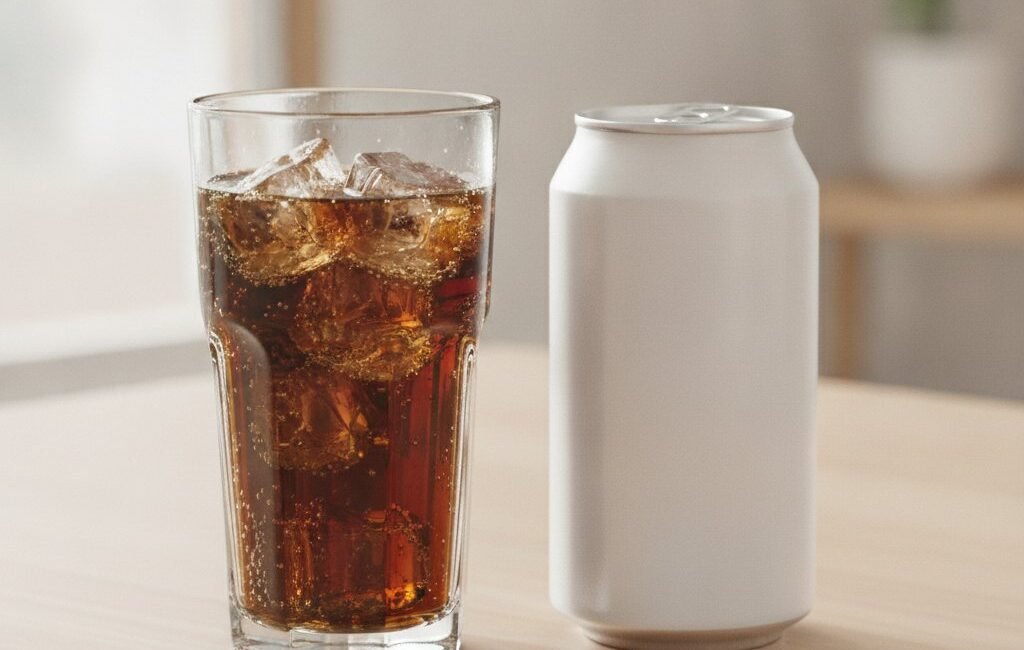
Diet soda sounds like an easy fix: the taste of a soft drink with almost no sugar. But in 2023 aspartame was labelled “possibly carcinogenic”, the World Health Organization advised against sweeteners for weight control, and erythritol was linked to heart attacks. So is diet soda bad for you? The honest answer depends on what you compare it with.
This article is part of our evidence-based guide to healthy drinks. Below we look at what WHO and the cancer agencies actually said, what the research on weight, diabetes and the heart shows, and how much weight you should give each scare. It is general information, not medical advice.
What Is in Diet Soda?
Diet and “zero sugar” soft drinks replace sugar with non-sugar sweeteners, which are many times sweeter than sugar, so only tiny amounts are needed. The most common ones in drinks are:
- Aspartame, often combined with acesulfame potassium (ace-K)
- Sucralose
- Saccharin
- Stevia (steviol glycosides), which comes from a plant but is still a non-sugar sweetener
Some “natural” or low-sugar drinks also use sugar alcohols (polyols) such as erythritol. These are a different group, and they matter for the heart story below.
Most diet sodas still contain acids, flavourings and often caffeine, so taking the sugar out removes the biggest problem, but not every problem.
What the WHO Actually Said in 2023
In May 2023, the World Health Organization published a guideline on non-sugar sweeteners. It suggests that non-sugar sweeteners not be used as a way to control weight or to reduce the risk of noncommunicable diseases such as type 2 diabetes and heart disease. The guideline covers aspartame, sucralose, saccharin, acesulfame K, stevia and others, but not sugar alcohols.
Headlines often missed three details:
- It is a “conditional” recommendation, not a “strong” one. WHO used that label because the evidence was rated low certainty overall and the balance of benefits and harms was uncertain.
- It doesn’t apply to people who already have diabetes. They were outside the guideline’s scope.
- It is not a safety warning. It says sweeteners don’t appear to help with long-term weight control. It doesn’t say they are toxic at normal intakes.
The guideline drew on a WHO-commissioned review of 283 studies, which found short-term weight benefits in trials but no evidence of a long-term benefit in adults or children.
Critics argued it leaned too heavily on observational studies, which can’t separate cause from effect, a limitation that comes up again and again with diet soda.
Aspartame and Cancer: “Possibly Carcinogenic” Explained
In July 2023, two WHO-linked bodies looked at aspartame at the same time and reached conclusions that sounded contradictory but weren’t.
IARC: a hazard rating
The International Agency for Research on Cancer (IARC) classified aspartame as “possibly carcinogenic to humans” (Group 2B). This was based on limited evidence in humans, specifically for a type of liver cancer called hepatocellular carcinoma. Group 2B is the third of IARC’s four levels, and it means IARC can’t rule out a link, not that it has found one.
JECFA: a risk assessment
The Joint FAO/WHO Expert Committee on Food Additives (JECFA) then asked the practical question: how much is safe? It found the evidence linking aspartame to cancer in humans “not convincing” and kept the acceptable daily intake (ADI) at 0–40 mg per kg of body weight.
WHO’s own example makes this concrete. If a can of diet soft drink contains 200 or 300 mg of aspartame, a 70 kg adult would need to drink more than 9 to 14 cans a day to go over the ADI, assuming no aspartame from anything else. In the US, the FDA uses a slightly higher ADI of 50 mg/kg.
In short, IARC asks whether something could cause cancer; JECFA asks whether normal intake is a concern. For aspartame, JECFA’s answer was no.
The French cohort study
Much of the public worry came from the NutriNet-Santé study, published in PLOS Medicine in 2022 by Charlotte Debras and colleagues. It followed 102,865 French adults for a median of 7.8 years. People with the highest intake of artificial sweeteners had a 13% higher risk of cancer overall than non-consumers, and aspartame and acesulfame-K were the sweeteners most strongly linked.
This is an observational study, and heavy diet soda drinkers may differ in ways that can’t be fully adjusted for. The authors called for the results to be checked in other large studies.
Does Diet Soda Help You Lose Weight?
This is where the trials and the observational studies disagree most.
The trials say it helps a little, if it replaces sugar. A 2021 review in the International Journal of Obesity by Peter Rogers and Katherine Appleton pooled 29 parallel-group trials with 2,267 participants. Body weight was on average about 1 kg lower with low-calorie sweeteners than with sugar, and the effect was larger when more sugar was replaced.
Observational studies often link diet drinks with higher weight, but partly because people already gaining weight are more likely to switch to them.
So diet soda isn’t a weight-loss tool by itself, but replacing regular soda with it removes a real source of sugar. As we explain in our article on sugary drinks and type 2 diabetes, a single 330 ml can of cola contains about 35 g of sugar, and liquid calories don’t fill you up the way food does.
Diet Soda, Blood Sugar and Diabetes
Sweeteners themselves barely raise blood sugar. But two lines of research make the picture less simple.
Observational links to type 2 diabetes
A 2015 BMJ meta-analysis led by Fumiaki Imamura pooled 17 cohort studies. Each daily serving of artificially sweetened drinks was linked to an 8% higher incidence of type 2 diabetes after adjusting for body fat. But the authors also found signs of publication bias and residual confounding for these drinks, and said the finding was likely to involve bias. They still concluded that neither diet drinks nor fruit juice were likely to be healthy alternatives to sugary drinks for preventing diabetes. Water and unsweetened drinks are the better swap. (For more on juice, see is fruit juice healthy?)
Sweeteners and gut bacteria
A 2022 randomised trial in Cell by Jotham Suez, Eran Elinav and colleagues gave 120 healthy adults saccharin, sucralose, aspartame or stevia for two weeks, at doses below the ADI. All four changed participants’ gut and mouth bacteria. Saccharin and sucralose also made blood sugar responses to a glucose drink worse on average. When the researchers moved gut bacteria from the strongest responders into germ-free mice, the mice developed similar blood sugar changes.
But it lasted two weeks, effects varied a lot between people, and the long-term significance is unknown.
If you have diabetes, diet drinks can help you avoid sugar spikes; talk to your doctor or dietitian about what suits you. Our article on controlling diabetes naturally covers lifestyle steps more broadly.
Diet Soda and Your Heart: The Erythritol Question
The most striking recent headlines were about erythritol, a sugar alcohol used in some “keto” products, stevia blends and low-sugar drinks (check the ingredients list).
In a 2023 Nature Medicine study, Marco Witkowski, Stanley Hazen and colleagues at the Cleveland Clinic measured erythritol in the blood of people being assessed for heart disease. In the first group of 1,157 patients, those with the highest levels had about three times the risk of a heart attack, stroke or death over three years. The link held up, at smaller sizes, in two further groups in the US and Europe. In lab tests, erythritol made platelets more likely to clump.
A 2024 follow-up in Arteriosclerosis, Thrombosis, and Vascular Biology gave 20 healthy volunteers a drink containing 30 g of either erythritol or glucose. Platelet reactivity rose after erythritol but not after glucose.
Both studies have limits: the 2023 patients already had high rates of heart disease, and 30 g is far more than a typical serving. The findings justify caution if you have heart disease, but don’t prove erythritol causes heart attacks.
A 2019 Circulation study by Vasanti Malik and colleagues followed more than 118,000 US adults for decades. Four or more diet drinks a day was linked to slightly higher death rates in women but not men, which the authors said needs confirming. Importantly, replacing sugary drinks with diet drinks was linked to a moderately lower risk of early death. Our heart health guide covers what matters most for your heart.
Other Things to Consider
- Teeth: diet sodas are still acidic, so sipping them all day can wear tooth enamel even without sugar.
- Caffeine: many diet colas contain caffeine, which can affect sleep later in the day. See our guide to caffeine timing.
- Phenylketonuria (PKU): people with this rare genetic condition must avoid aspartame, which is why it carries a phenylalanine warning.
- Pregnancy: WHO noted limited evidence of a possible link between sweetener use in pregnancy and preterm birth, so keeping diet drinks occasional is sensible.
So, Is Diet Soda Bad for You?
- Compared with regular soda, diet soda is the better choice. It removes a large dose of free sugar.
- Compared with water, it isn’t a health drink. It isn’t a proven route to long-term weight control or disease prevention.
- The cancer scare is overstated at normal intakes.
- Some questions are still open: gut bacteria, erythritol and heavy daily use.
Use diet soda as a stepping stone away from sugary drinks rather than a permanent habit, and make water, sparkling water and unsweetened tea or coffee your everyday drinks.
Frequently Asked Questions
Is diet soda worse than regular soda?
No. For most people, diet soda is the better of the two because it contains almost no sugar. Long-term studies link replacing sugary drinks with diet drinks to lower risk of early death. Water and unsweetened drinks are better than both.
Does aspartame cause cancer?
The evidence isn’t convincing. IARC rated aspartame “possibly carcinogenic” (Group 2B) based on limited evidence, but JECFA kept its safe limit at 40 mg per kg of body weight a day. That’s more than 9 to 14 cans a day for a 70 kg adult.
Why does WHO advise against sweeteners?
WHO’s 2023 guideline says sweeteners don’t appear to help with long-term weight control or disease prevention. It’s a conditional recommendation based on low-certainty evidence, it doesn’t apply to people with diabetes, and it isn’t a statement that sweeteners are toxic.
How many diet sodas a day is too many?
There’s no exact cut-off. Staying within the acceptable daily intake is easy for most people, but heavy daily use (four or more drinks a day) has been weakly linked to worse outcomes in some studies. One a day or less, with water as your main drink, is a sensible approach.
This article is for general information and is not medical advice. If you have diabetes, heart disease, PKU or are pregnant, speak to a doctor or registered dietitian about what’s right for you.
Sources
- World Health Organization. Use of non-sugar sweeteners: WHO guideline. Geneva: WHO, 2023.
- International Agency for Research on Cancer and Joint FAO/WHO Expert Committee on Food Additives. Aspartame hazard and risk assessment results released (press release and summary of findings), 14 July 2023.
- US Food and Drug Administration. Aspartame and other sweeteners in food (fda.gov).
- Debras C, et al. Artificial sweeteners and cancer risk: results from the NutriNet-Santé population-based cohort study. PLOS Medicine, 2022;19(3):e1003950.
- Rogers PJ, Appleton KM. The effects of low-calorie sweeteners on energy intake and body weight: a systematic review and meta-analyses of sustained intervention studies. International Journal of Obesity, 2021;45:464–478.
- Imamura F, et al. Consumption of sugar sweetened beverages, artificially sweetened beverages, and fruit juice and incidence of type 2 diabetes. BMJ, 2015;351:h3576.
- Suez J, et al. Personalized microbiome-driven effects of non-nutritive sweeteners on human glucose tolerance. Cell, 2022;185(18):3307–3328.
- Witkowski M, et al. The artificial sweetener erythritol and cardiovascular event risk. Nature Medicine, 2023;29(3):710–718.
- Witkowski M, et al. Ingestion of the non-nutritive sweetener erythritol, but not glucose, enhances platelet reactivity and thrombosis potential in healthy volunteers. Arteriosclerosis, Thrombosis, and Vascular Biology, 2024.
- Malik VS, et al. Long-term consumption of sugar-sweetened and artificially sweetened beverages and risk of mortality in US adults. Circulation, 2019;139(18):2113–2125.