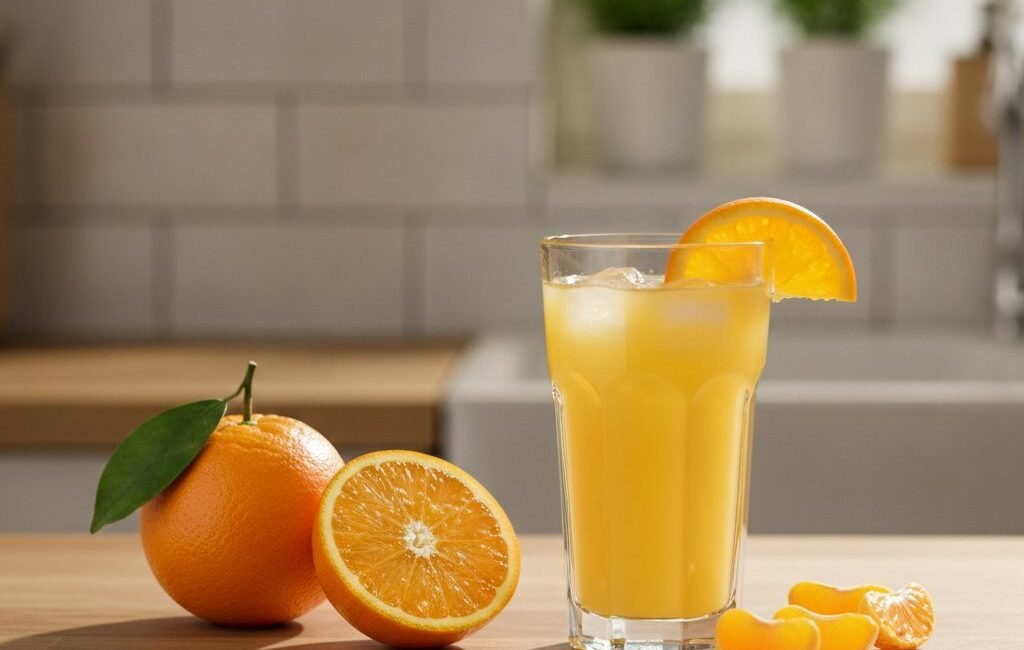
A glass of orange juice with breakfast looks like a healthy habit. It’s made from fruit, it has vitamin C, and the carton often says “100% juice, no added sugar”. So is fruit juice healthy? The short answer is that it’s less healthy than its image suggests. Juice is not the same as the fruit it came from, and large studies show that the difference matters for your blood sugar, your weight and possibly your long-term health.
This article is part of our evidence-based guide to healthy drinks, which covers everything from water and tea to sugary drinks and alcohol. Here we focus on one question: what happens when you drink fruit instead of eating it, and how much juice, if any, is reasonable? It is general information, not medical advice.
What Happens When Fruit Becomes Juice
When you juice a fruit, you keep the water, the sugar and some of the vitamins, but you lose most of the structure. The fibre-rich pulp, skin and membranes are mostly left behind, and the sugar that was locked inside the fruit’s cells is now free in liquid form.
That changes three things:
- Sugar becomes “free sugar”. The World Health Organization’s 2015 sugars guideline counts the sugars naturally present in fruit juice as free sugars, the same category as sugar added to soft drinks and sweets. Sugars inside whole fruit don’t count. WHO strongly recommends keeping free sugars below 10% of daily energy, and conditionally suggests going below 5%, which is about 25 grams (roughly six teaspoons) a day for an adult.
- Fibre mostly disappears. According to USDA nutrient data, chilled orange juice contains about 0.3 g of fibre per 100 g, so a glass contains very little. A whole orange keeps its fibre in the pulp and membranes, which slows how quickly its sugar is absorbed.
- It’s easy to drink a lot. The same USDA data puts orange juice at around 8 g of sugar per 100 g. A 250 ml glass therefore contains roughly 20 grams of sugar, about five teaspoons and most of WHO’s lower free-sugar limit. That glass might take three or four oranges to make, and few people would eat four oranges in one sitting.
Juice Doesn’t Fill You Up Like Fruit Does
One of the clearest experiments on this comes from Penn State. In a 2009 study in the journal Appetite, Julie Flood-Obbagy and Barbara Rolls gave 58 adults a snack 15 minutes before lunch, once a week for five weeks. The snack was either a whole apple, applesauce, apple juice, apple juice with added fibre, or nothing. Every apple snack had the same weight and the same 125 calories.
The whole apple was the most filling. People who ate it went on to eat about 15% fewer calories at lunch than when they had no snack, and they ate less than after the applesauce or either juice. Fullness ratings fell in order: whole apple, then applesauce, then the juices. Interestingly, adding fibre back into the juice didn’t make it more filling. The physical form of the fruit, which you have to chew, seemed to matter as much as its fibre content.
That’s the general problem with calories you drink: you don’t tend to eat less later to make up for them.
What Large Studies Show: Diabetes
Whole fruit lowers risk, juice doesn’t
The most useful study on this question was published in The BMJ in 2013 by Isao Muraki and colleagues at Harvard. They followed more than 187,000 nurses and health professionals in three large US cohorts for up to 24 years and looked at how different fruits, and fruit juice, related to the risk of developing type 2 diabetes.
For every three extra servings a week:
- blueberries were linked to a 26% lower risk,
- grapes and raisins to a 12% lower risk,
- apples and pears to a 7% lower risk, and
- fruit juice to an 8% higher risk.
Same people, same follow-up, yet whole fruit and juice pointed in opposite directions. It’s an observational study, so it can’t prove cause and effect, but the split is hard to explain if fruit and juice were equivalent.
The 2015 meta-analysis
A 2015 systematic review and meta-analysis in The BMJ by Fumiaki Imamura and colleagues pooled 17 cohort studies on sweetened drinks and type 2 diabetes. Sugar-sweetened drinks showed the strongest link. Fruit juice showed a smaller positive association, around 7% higher risk per daily serving. The authors were cautious about this figure: the juice result was weaker, wasn’t significant in studies that diagnosed diabetes objectively, and may have been affected by bias. Even so, they concluded that neither fruit juice nor artificially sweetened drinks were likely to be healthy alternatives to sugary drinks for preventing diabetes.
Taken together, the evidence doesn’t say juice is as harmful as cola. It says juice doesn’t share the protective association seen with whole fruit, and it may add a little risk.
What About Weight and Mortality?
Weight in children and adults
A 2024 meta-analysis in JAMA Pediatrics by Michael Nguyen and colleagues pooled 42 studies, 17 in children and 25 in adults. In children, each extra daily serving of 100% fruit juice was linked to a small increase in BMI over time, with a larger effect in younger children. In adults, the results depended on how the studies were analysed: studies that didn’t adjust for total calorie intake showed weight gain, while those that did showed little effect. That suggests juice’s impact on weight comes mostly through the extra calories it adds. The effect is small, but it builds up when juice is a daily habit.
The mortality study that got headlines
In 2019, a study in JAMA Network Open by Lindsey Collin and colleagues followed 13,440 US adults aged 45 and over for an average of six years. Each extra 12-ounce (about 350 ml) daily serving of 100% fruit juice was associated with a 24% higher risk of death from any cause, compared with 11% for each extra serving of sugary drinks generally.
Treat that 24% figure with care. It comes from one observational study, the people drinking the most juice may differ in other ways, and the researchers found no matching link with deaths from coronary heart disease. It’s a reason not to treat juice as a health drink, not proof that juice shortens your life.
But Doesn’t Juice Have Vitamins?
It does. Orange juice is a good source of vitamin C, and 100% juice contains some potassium and plant compounds. That’s why many guidelines still let a small glass count towards your fruit intake. In the UK, the NHS says a 150 ml glass of unsweetened fruit juice, vegetable juice or smoothie can count as one of your five a day, but only one, however much you drink.
But whole fruit gives you the same vitamins plus the fibre, and keeps you fuller.
How Much Juice Is Reasonable?
For adults
The NHS advises limiting fruit juice, vegetable juice and smoothies to a combined total of 150 ml a day, about one small glass, and drinking them with meals to reduce the risk of tooth decay. That’s a sensible ceiling. If you have diabetes or are trying to lose weight, less (or none) is better.
For children
In 2017, the American Academy of Pediatrics updated its advice on juice for children:
- Under 1 year: no fruit juice unless a doctor specifically advises it.
- Ages 1 to 3: no more than 4 ounces (about 120 ml) a day.
- Ages 4 to 6: 4 to 6 ounces (about 120–175 ml) a day.
- Ages 7 to 18: no more than 8 ounces (one cup, about 240 ml) a day.
The AAP also advises against giving toddlers juice in bottles or sippy cups they carry around all day, or at bedtime, because of the risk to their teeth. Whole fruit is the preferred choice.
What About Smoothies, “Fresh-Pressed” and Traditional Juices?
Smoothies are better than clear juice because they keep more of the fibre, but blending still breaks down the fruit’s structure, and a large smoothie can contain several pieces of fruit. That’s why the NHS puts them under the same 150 ml limit as juice.
Fresh-pressed and cold-pressed juices are no different in the way that matters: the sugar is still free sugar and the fibre is mostly gone.
Traditional juices follow the same rules. Fresh sugarcane juice is refreshing on a hot day, but it’s essentially plant sugar in water, so it’s an occasional treat rather than a health drink. Coconut water (nariyal pani) is lower in sugar than most fruit juices and is a better swap for a soft drink, though plain water does the job of hydration just as well. If you mainly reach for juice because you’re thirsty, our guide to how much water you actually need is a better place to start.
Practical Ways to Cut Back on Juice
- Eat the fruit instead. Keep a bowl of fruit where you used to keep the juice carton.
- Use a small glass. If you enjoy juice at breakfast, pour about 150 ml, not a tall tumbler.
- Dilute it. Half juice, half water (or sparkling water) halves the sugar and still tastes of fruit.
- Drink it with food. Having juice with a meal is easier on your teeth than sipping it through the day.
- Read the label. “Juice drink” or “nectar” often means added sugar on top of the fruit sugar.
Frequently Asked Questions
Is fruit juice healthy?
In small amounts it’s fine, but it’s not a health drink. WHO counts the sugar in fruit juice as free sugar, the same as added sugar. Large studies link whole fruit to a lower risk of type 2 diabetes, while juice shows no such benefit and may slightly increase risk. Whole fruit is the better choice.
Is 100% fruit juice better than soda?
It has vitamins and some potassium that soda lacks, but the sugar content per glass is often similar. In the 2015 BMJ meta-analysis, juice’s link with diabetes was weaker than soda’s, but the authors still concluded that juice isn’t a healthy alternative to sugary drinks.
How much fruit juice per day is OK?
The NHS advises no more than 150 ml a day in total of fruit juice, vegetable juice and smoothies combined, ideally with a meal. For children, the American Academy of Pediatrics recommends no juice under age 1 and set daily limits from about 120 ml for toddlers to 240 ml for teenagers.
Is fresh orange juice good for you?
Fresh orange juice provides vitamin C, but a 250 ml glass contains roughly 20 grams of sugar and very little fibre. A whole orange gives you the vitamin C plus fibre and keeps you fuller, so eating the orange is the better habit.
This article is for general information and is not medical advice. If you have diabetes, are managing your weight or have questions about your child’s diet, speak to a doctor or registered dietitian about what’s right for you.
Sources
- World Health Organization. Guideline: Sugars intake for adults and children. Geneva: WHO, 2015.
- Muraki I, et al. Fruit consumption and risk of type 2 diabetes: results from three prospective longitudinal cohort studies. BMJ, 2013;347:f5001.
- Imamura F, et al. Consumption of sugar sweetened beverages, artificially sweetened beverages, and fruit juice and incidence of type 2 diabetes: systematic review, meta-analysis, and estimation of population attributable fraction. BMJ, 2015;351:h3576.
- Flood-Obbagy JE, Rolls BJ. The effect of fruit in different forms on energy intake and satiety at a meal. Appetite, 2009.
- Nguyen M, et al. Consumption of 100% fruit juice and body weight in children and adults: a systematic review and meta-analysis. JAMA Pediatrics, 2024. doi:10.1001/jamapediatrics.2023.6124.
- Collin LJ, et al. Association of sugary beverage consumption with mortality risk in US adults: a secondary analysis of data from the REGARDS study. JAMA Network Open, 2019;2(5):e193121.
- Heyman MB, Abrams SA; Section on Gastroenterology, Hepatology, and Nutrition; Committee on Nutrition. Fruit juice in infants, children, and adolescents: current recommendations. Pediatrics, 2017;139(6):e20170967.
- NHS. 5 A Day: what counts? and Sugar: the facts (nhs.uk).
- USDA FoodData Central. Orange juice, chilled, includes from concentrate.