Most of what people call “aging skin” isn’t aging at all in the biological sense — it’s cumulative sun damage, a process dermatologists call photoaging. Our complete evidence-based guide to anti-aging covers this briefly as the single biggest lever in skin aging; this article goes deeper into the mechanism, the actual clinical trial evidence, and how to protect against it correctly rather than just “wearing sunscreen sometimes.”
Photoaging vs. intrinsic aging: two very different processes
Dermatology separates skin aging into two categories. Intrinsic aging is the slow, genetically programmed process that happens regardless of environment — collagen production naturally slows a small amount every year after your mid-20s. Photoaging is damage caused specifically by ultraviolet (UV) radiation, and it’s the dominant driver of what we actually notice: wrinkles, uneven pigmentation, broken capillaries, and loss of skin elasticity. A 2017 review of the “skin aging exposome” (the sum of environmental exposures that affect skin over a lifetime) identifies UV exposure as the single largest external contributor to visible skin aging, ahead of pollution, smoking, and diet combined (Krutmann et al., Journal of Dermatological Science, 2017).
This distinction matters practically: intrinsic aging can be slowed marginally through general health measures, but photoaging is largely preventable. Two people of the same age can look a decade apart in visible skin aging purely based on cumulative sun exposure.
UVA vs. UVB: why “some sun protection” isn’t enough
Not all UV radiation ages skin the same way, which is why the label “broad spectrum” matters more than the SPF number alone:
- UVA penetrates deep into the dermis, where it breaks down collagen and elastin directly and generates free radicals. It’s present at consistent intensity throughout daylight hours, all year round, and passes through cloud cover and ordinary window glass. UVA is the primary driver of photoaging specifically.
- UVB is the ray responsible for sunburn. It’s more intense at midday and in summer, and doesn’t penetrate glass as easily. UVB causes more acute, visible damage and is the main driver of skin cancer risk, but contributes less to the slow accumulation of wrinkles than UVA.
A sunscreen labeled “SPF 50” but not “broad spectrum” may block UVB well while doing little against UVA — meaning it can prevent sunburn while still allowing the collagen-damaging exposure that drives photoaging to continue.
The clinical trial evidence: sunscreen actually slows visible aging
The strongest evidence for sunscreen’s anti-aging effect comes from a randomized controlled trial, not an observational study. Hughes et al. (Annals of Internal Medicine, 2013) ran a community-based trial in Nambour, Australia — a high-UV location — following 903 adults under 55 for 4.5 years (read the study). Participants were randomly assigned to either daily broad-spectrum sunscreen application or their usual discretionary use.
The result: adults assigned to daily sunscreen use showed 24% less photoaging, measured objectively via skin-surface microtopography casts, than the discretionary-use group. This is one of the few anti-aging interventions with genuine randomized trial evidence behind it, rather than correlational studies or manufacturer-funded testing — and it measured prevention of new damage, not reversal of existing damage. The trial did not find that sunscreen reversed photoaging that had already occurred; the benefit was in slowing the rate of further visible change.
How to actually get the protection the research is measuring
The trial’s daily-use protocol is more consistent than how most people actually apply sunscreen. To match it:
- Use broad-spectrum SPF 30 or higher every day, regardless of weather or whether you’re spending time outdoors — UVA exposure through windows and on cloudy days is enough to contribute to cumulative photoaging over years.
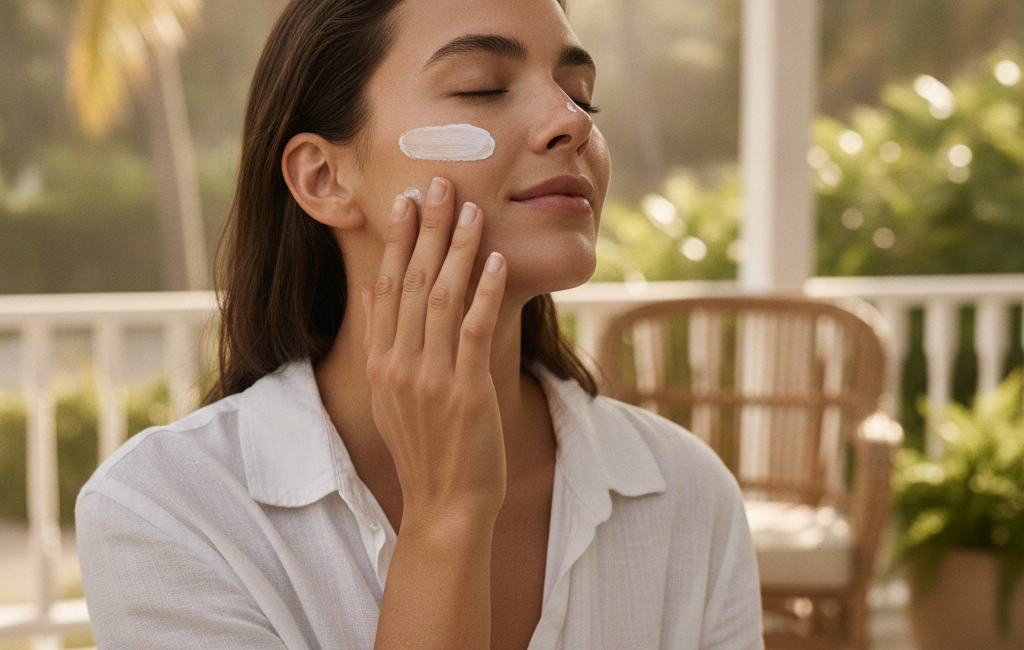
- Apply enough of it. Most people apply 25-50% of the amount used in SPF testing, which cuts the effective protection well below the labeled number. A face-and-neck application should be roughly a nickel-sized dollop, more than most people instinctively use.
- Reapply during direct sun exposure — roughly every two hours, and immediately after swimming or heavy sweating, since both compromise the protective film.
- Don’t skip it because of makeup or a moisturizer with SPF built in — layering under makeup often reduces the effective applied amount below what’s needed for full protection; a dedicated sunscreen step first is more reliable.
Beyond sunscreen: the other half of photoprotection
Sunscreen is necessary but not sufficient on its own, especially for people who spend meaningful time outdoors:
- Physical barriers — a wide-brimmed hat, UV-blocking sunglasses, and lightweight long sleeves reduce cumulative exposure more reliably than sunscreen alone, since they don’t depend on correct reapplication.
- Seeking shade during peak UV hours (roughly 11am–3pm in most of India) meaningfully cuts total dose on high-exposure days like outdoor commutes or exercise.
- Topical antioxidants (vitamin C serums) don’t block UV directly but help neutralize the free radicals UV exposure generates, adding a modest additional layer of protection when used alongside — not instead of — sunscreen.
What photoaging actually looks like as it accumulates
Because photoaging builds gradually, it’s easy to underestimate until the damage is already visible. The earliest signs tend to show up in areas that get disproportionate sun exposure relative to how often they’re protected: the backs of hands, the neck and décolletage, and the outer corners of the eyes. Fine crepey texture and small brown spots (solar lentigines) typically appear years before deeper wrinkling does, which is why dermatologists treat early pigment changes as a warning sign to tighten up sun habits rather than a purely cosmetic nuisance. Comparing the skin on the underside of your forearm — rarely sun-exposed — to the back of your hand on the same arm is a rough but genuinely informative way to see your own cumulative UV exposure, since both areas share the same age and genetics but very different sun histories.
Frequently Asked Questions
Is a higher SPF number always better?
Not proportionally. SPF 30 blocks about 97% of UVB rays, while SPF 50 blocks about 98% — a small incremental gain. The bigger factors are broad-spectrum coverage (UVA protection), applying enough product, and reapplying consistently. A correctly applied SPF 30 outperforms an under-applied SPF 50 in practice.
Does darker skin need sunscreen for anti-aging purposes?
Yes. Higher melanin content provides some natural UV filtering and lowers skin cancer risk, but it doesn’t eliminate UVA penetration or the collagen breakdown that drives photoaging. Photoaging shows up somewhat differently on darker skin (more uneven pigmentation, less visible fine-line wrinkling) but the underlying mechanism and the benefit of daily sunscreen still apply.
Can existing sun damage be reversed?
Partially. Sunscreen itself only prevents further damage — it doesn’t undo it. Retinoids have clinical trial evidence for improving existing photodamage over months of consistent use (covered in our anti-aging skincare routine guide), and some in-office dermatological treatments can address deeper pigmentation and texture changes. But daily sun protection is what determines whether damage keeps accumulating in the meantime.
Does sleep or diet affect how skin handles sun exposure?
Indirectly, yes. Well-rested skin recovers faster from UV-induced redness and barrier disruption, as shown in the sleep research covered in our deep dive on sleep and skin aging. Diet plays a smaller supporting role — some nutrients with antioxidant properties offer modest additional protection, discussed in our article on foods that boost collagen naturally — but neither substitutes for sunscreen and physical protection.
The bottom line
Photoaging, not the passage of time itself, is responsible for most of what people try to fix with anti-aging products. The Nambour trial is rare in this space: an actual randomized controlled trial showing that a simple, low-cost daily habit measurably slows visible skin aging. No serum or supplement in this guide has evidence anywhere near as strong. If you’re only going to do one thing consistently, this is it.
This article is for general information and isn’t medical advice. If you have specific concerns about skin cancer risk or existing sun damage, consult a dermatologist.