Search “anti-aging skincare” and you’ll get a thousand products promising to erase decades in a jar. The reality is less dramatic but more useful: dermatology research has converged on a small set of ingredients and habits that actually slow visible skin aging, and most of the rest is marketing. This guide walks through what’s backed by real evidence, how to build a routine around it, and where the science is still catching up to the hype.
This is part of our complete evidence-based guide to anti-aging, which also covers diet, sleep, and supplements.
This article is for general wellness information only and is not a substitute for advice from a dermatologist or physician, especially if you have a skin condition or are pregnant or breastfeeding.
Why skin ages in the first place
Skin aging comes from two overlapping processes. Intrinsic aging is the natural, genetically programmed slowdown in collagen and elastin production that happens to everyone over time. Extrinsic aging is damage from outside forces — primarily ultraviolet (UV) light, but also pollution, smoking, and repeated facial movement. Dermatologists generally agree that extrinsic aging, and UV exposure specifically, accounts for the large majority of visible skin aging: fine lines, wrinkles, uneven pigmentation, and loss of firmness. That’s the single most important fact in this entire topic, because it means the most powerful anti-aging product isn’t a serum — it’s sunscreen.
The four ingredients with the strongest evidence
1. Sunscreen (broad-spectrum SPF)
Daily broad-spectrum sunscreen is the best-studied anti-aging intervention there is. Long-term trials have found that people who use sunscreen daily show significantly less visible skin aging over several years compared to those who use it occasionally. It protects against both UVA (which penetrates deep and breaks down collagen) and UVB (which causes burning and DNA damage). An SPF of 30 or higher, applied every morning — yes, even on cloudy days and indoors near windows — is the baseline of any routine that claims to be “anti-aging.”
2. Retinoids (retinol and prescription tretinoin)
Retinoids are vitamin A derivatives and remain the most extensively studied topical ingredient for reducing fine lines and improving skin texture. They work by speeding up cell turnover and stimulating collagen production. Prescription-strength tretinoin has the deepest evidence base; over-the-counter retinol is weaker but still effective with consistent use over months, not days. Retinoids can cause irritation and increased sun sensitivity when you start, so most dermatologists recommend introducing them gradually (two to three nights a week) and always pairing them with daytime SPF.
3. Vitamin C (topical antioxidant)
Topical vitamin C (usually as L-ascorbic acid) is an antioxidant that helps neutralize free radicals generated by UV and pollution exposure, and there’s reasonable evidence it supports collagen synthesis and helps brighten uneven pigmentation. It’s commonly used as a morning layer underneath sunscreen, partly because the two ingredients complement each other — antioxidant protection during the day, when free-radical exposure is highest.
4. Moisturizers and barrier support
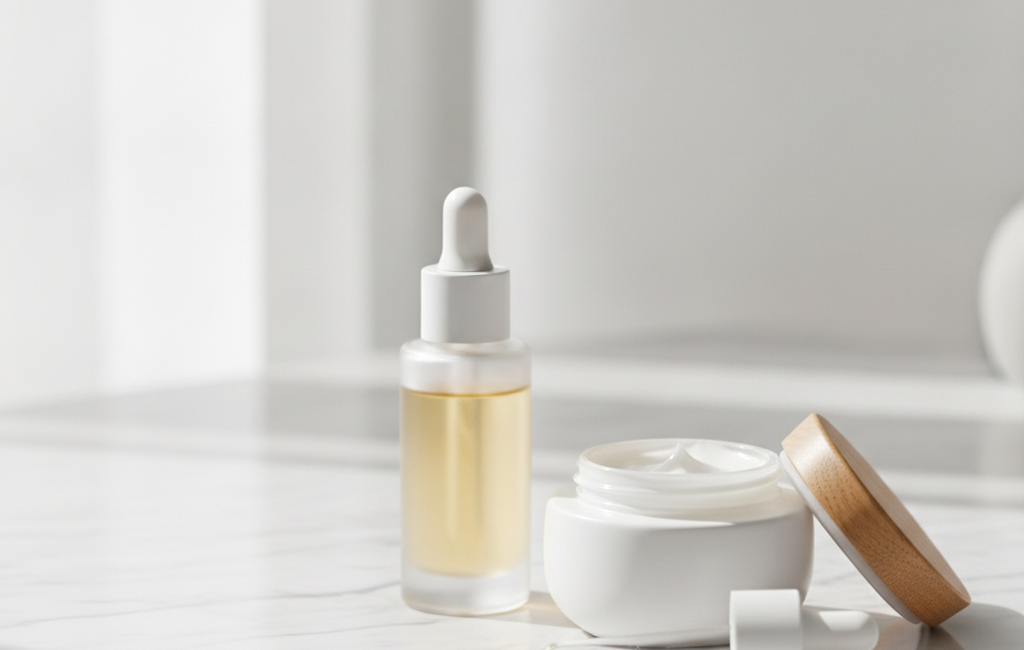
As skin ages, the outer barrier — the layer that keeps water in and irritants out — naturally weakens, leading to dryness that can make fine lines more visible. Ingredients like ceramides, hyaluronic acid, and glycerin help maintain that barrier and keep skin hydrated. This won’t reverse aging on its own, but a compromised barrier makes every other product in a routine less effective and skin look duller, so it’s foundational rather than optional.
A simple, evidence-based daily routine
Morning
- Gentle cleanser
- Vitamin C serum (optional, but well-supported)
- Moisturizer
- Broad-spectrum SPF 30+ (non-negotiable)
Evening
- Gentle cleanser (to remove sunscreen, makeup, and pollution buildup)
- Retinoid, 2-3 nights per week to start, increasing frequency as tolerated
- Moisturizer to counter the dryness retinoids can cause
That’s it. Dermatology research doesn’t support the idea that more steps or more expensive products produce meaningfully better results once these four categories are covered. A twelve-step routine isn’t wrong, but the marginal benefit beyond sunscreen, a retinoid, an antioxidant, and a moisturizer is small and not well-documented.
Where the evidence gets thinner
Plenty of trending ingredients — peptides, niacinamide, bakuchiol (a plant-based retinol alternative), and “skin longevity” formulations built around microbiome or cellular-senescence science — have promising early research but a much smaller and less consistent evidence base than the four above. They’re reasonable to try, especially if retinoids irritate your skin and you want a gentler alternative like bakuchiol, but it’s worth being skeptical of dramatic before-and-after marketing claims tied to any single trendy ingredient. If a claim sounds too specific or too fast (“visible results in 3 days”), treat it as advertising rather than science.
Lifestyle factors that matter as much as products
Topical products address only part of the picture. Research consistently links these habits to slower visible skin aging:
- Not smoking — smoking accelerates collagen breakdown and is one of the strongest documented causes of premature skin aging.
- Limiting sun exposure during peak hours and wearing protective clothing or hats, since sunscreen alone doesn’t block 100% of UV.
- Sleep — skin repair processes are more active during sleep, and chronic sleep deprivation has been associated with slower barrier recovery.
- Diet — a diet rich in antioxidants and healthy fats supports skin from the inside; see our related guide on anti-inflammatory foods that slow aging for specifics.
Building your routine around your skin, not the trend cycle
The honest summary: sunscreen and a retinoid, used consistently for months to years, do more for visible skin aging than nearly anything else on the market. Everything else — vitamin C, moisturizer, barrier ingredients — supports that foundation rather than replacing it. If you’re mostly starting from scratch, add one new active at a time so you can tell what’s working and what’s irritating your skin, and expect to wait 8-12 weeks before judging whether a new product is doing anything.
For more on how nutrition ties into skin and aging more broadly, see our guides on foods that promote anti-aging and simple, effective skin-brightening tips.
Not medical advice. If you have a specific skin condition, are on other medications, or are pregnant or breastfeeding, talk to a dermatologist before starting retinoids or other active ingredients.