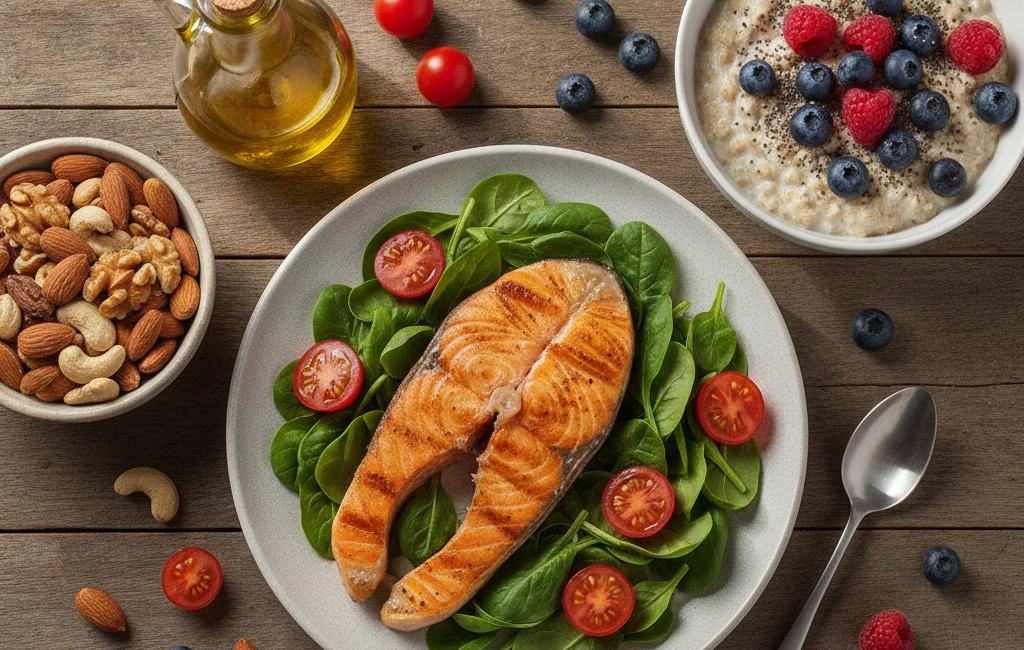
Search “foods for a healthy heart” and you’ll get dozens of lists: oats, salmon, berries, dark chocolate, red wine, coconut oil, the latest “superfood.” Some of these are well supported by evidence. Some are mostly marketing. A few are the opposite of what the list claims. This guide sorts them using large randomised trials, big meta-analyses, and the American Heart Association’s latest dietary guidance.
It’s part of our complete, evidence-based guide to heart health, which covers all eight of the American Heart Association’s cardiovascular health measures. This article goes deeper on one of them: diet.
This is general information, not medical advice. If you have a heart condition, kidney disease, diabetes, or take medication such as blood thinners or blood pressure drugs, talk to your doctor or a dietitian before making major changes to your diet. That includes switching to potassium-based salt substitutes.
The Big Picture: Patterns Beat Individual Foods
The most important finding in heart nutrition is not about any single food. It’s that your overall eating pattern matters far more than any one ingredient. That’s why the American Heart Association’s 2026 scientific statement on dietary guidance, published in Circulation, is organised around nine features of a heart-healthy pattern, not a list of “heart foods”:
- Balance how much you eat with how active you are
- Eat a variety of vegetables and fruits every day
- Choose whole grains over refined grains
- Choose heart-healthy protein sources
- Replace saturated fats with unsaturated fats
- Minimise ultraprocessed foods
- Limit added sugars
- Reduce sodium
- Avoid alcohol, or strictly limit it
Notice what isn’t on the list: no superfood, no supplement, no single “miracle” ingredient. Keep that in mind as we go through the evidence.
What the Evidence Strongly Supports
1. A Mediterranean-style diet with olive oil and nuts
The strongest trial evidence for any eating pattern comes from PREDIMED, a Spanish trial of 7,447 people aged 55 to 80 at high cardiovascular risk. Participants were randomly assigned to a Mediterranean diet supplemented with extra-virgin olive oil, a Mediterranean diet supplemented with mixed nuts, or a control diet in which they were advised to cut down on fat.
There’s an important caveat to state plainly. The original 2013 paper in the New England Journal of Medicine was retracted in 2018 after the researchers found problems with how some participants had been randomised. For example, some members of the same household had been assigned together. The team re-analysed the data, accounting for those errors, and republished it in the same journal in 2018.
The republished results were very close to the originals. Compared with the control diet, the risk of major cardiovascular events (heart attack, stroke, or cardiovascular death) was about 31% lower in the olive oil group (hazard ratio 0.69) and 28% lower in the nut group (hazard ratio 0.72). The retraction makes the evidence somewhat weaker than a flawless trial would be. Even so, it’s still one of the best dietary trials we have, and its findings are consistent with a large body of observational research.
2. Lots of fruit and vegetables
Low fruit and vegetable intake is one of the nine modifiable risk factors identified in INTERHEART, the 52-country study of heart attack risk discussed in our pillar guide. The dose matters too. A 2017 meta-analysis by Dagfinn Aune and colleagues in the International Journal of Epidemiology found that each extra 200 g a day of fruit and vegetables was linked to an 8% lower risk of coronary heart disease and a 16% lower risk of stroke.
The benefits kept increasing up to about 800 g a day, roughly ten portions of 80 g each. At that level, cardiovascular disease risk was about a quarter lower than in people who ate very little. You don’t need to hit 800 g to benefit. Every extra portion counts. This is observational data, though, so part of the effect may come from fruit-and-vegetable eaters having healthier habits in general.
3. Nuts
Beyond PREDIMED, a 2016 meta-analysis in BMC Medicine, also led by Aune, pooled prospective studies on nut intake. Each 28 g a day of nuts, roughly a small handful, was linked to a 29% lower risk of coronary heart disease and a 21% lower risk of cardiovascular disease. Choose unsalted, unsweetened nuts. Honey-roasted or heavily salted versions undo part of the point.
4. Whole grains instead of refined ones
A 2016 BMJ meta-analysis of 45 studies found that eating more whole grains, up to about 90 g a day (around three servings), was linked to a lower risk of coronary heart disease and cardiovascular disease. Practically, that means oats, brown rice, whole-wheat bread and atta, barley, and millets in place of white bread, white rice, and refined flour. Part of the benefit likely comes from fibre. Our article on why fibre is having a moment covers that in more detail.
5. Unsaturated fats instead of saturated fat
This is one of the more debated areas, so here are the most careful numbers. A 2020 Cochrane review by Lee Hooper and colleagues pooled long-term randomised trials. It found that cutting saturated fat reduced the risk of combined cardiovascular events by 17% (risk ratio 0.83, 12 trials with 53,758 participants, moderate-quality evidence). It found little or no effect on overall or cardiovascular death, though.
The review also found that the bigger the drop in blood cholesterol, the bigger the benefit. And what you replace saturated fat with matters: the evidence favours swapping it for unsaturated fats, such as olive, canola, sunflower, and other vegetable oils, nuts, seeds, and oily fish, rather than for refined carbohydrates and sugar.
6. Less salt, more potassium
Two trials make the case for salt. In the DASH-Sodium trial (412 participants, NEJM 2001), the DASH diet (rich in fruit, vegetables, and low-fat dairy) combined with low sodium lowered systolic blood pressure by an average of 7.1 mmHg in people without hypertension and 11.5 mmHg in people with hypertension, compared with a typical American diet high in sodium. Each change helped on its own, and the combination worked best.
The Salt Substitute and Stroke Study (SSaSS, NEJM 2021) went further and measured outcomes, not just blood pressure. Nearly 21,000 people in rural China with a history of stroke or high blood pressure (mean age 65) were randomised to a salt substitute (part sodium chloride, part potassium chloride) or regular salt. Over about 4.7 years, the substitute group had a 14% lower stroke rate (rate ratio 0.86) and a 13% lower rate of major cardiovascular events.
Important safety note: potassium-based salt substitutes can be dangerous for people with kidney disease or those taking certain medications that raise potassium, including some blood pressure drugs. Check with your doctor before switching. Most dietary sodium also comes from packaged and restaurant food, not the salt shaker, so cooking more at home is often the bigger lever.
7. Fish, beans, and lentils as main protein sources
The AHA’s guidance favours plant proteins (beans, lentils, chickpeas, tofu, nuts) and fish over red and processed meat. Oily fish such as salmon, sardines, and mackerel is the usual recommendation. Tinned fish is an affordable way to get it, as we cover in our piece on tinned fish as a budget superfood.
What’s Overhyped (or Misunderstood)
Omega-3 fish oil supplements
Eating fish is not the same as taking fish oil capsules. The VITAL trial (NEJM, 2019) randomised 25,871 adults to 1 g a day of marine omega-3 or placebo for a median of 5.3 years. The supplement did not significantly reduce major cardiovascular events (hazard ratio 0.92, which was not statistically significant).
There were some hints of benefit in secondary analyses. Heart attacks were lower, and the effect appeared stronger in people who ate little fish. But those results are less reliable than the main one. For a healthy person, a fish oil capsule is not a substitute for eating fish, and prescription omega-3 drugs for specific conditions are a separate decision to make with your doctor.
Coconut oil
Coconut oil is often marketed as heart-healthy. The evidence points the other way. A 2020 meta-analysis in Circulation (Neelakantan and colleagues, 16 trials) found that, compared with non-tropical vegetable oils, coconut oil raised LDL (“bad”) cholesterol by about 10.5 mg/dL. It did raise HDL a little too, but it had no measurable benefit on blood sugar, inflammation, or body fat. Coconut oil is mostly saturated fat. Use it occasionally for flavour, not as your everyday cooking oil.
Single “superfoods”
Garlic, turmeric, beetroot, green tea, dark chocolate, berries: many of these are healthy foods that fit well into a good diet. The problem is the framing. Most claims about a single food protecting your heart rest on small, short-term studies of markers like blood pressure or cholesterol, not on long-term trials showing fewer heart attacks. A sprinkle of turmeric won’t offset a diet high in ultraprocessed food and salt. Our look at turmeric, ginger, and garlic covers this in more detail.
Red wine
The idea that a glass of red wine a day protects your heart has been popular for decades. The AHA’s 2026 guidance now says to avoid alcohol or strictly limit it. If you don’t drink, there’s no heart-health reason to start.
Putting It on a Plate
Here’s what a heart-healthy day can look like, without exotic ingredients:
- Breakfast: oats cooked with milk or a fortified plant milk, topped with fruit and a spoonful of chopped nuts or seeds
- Lunch: a whole-grain wrap or brown rice with dal, beans, or chickpeas, plus a big portion of vegetables
- Snack: a handful (about 28 g) of unsalted nuts and a piece of fruit
- Dinner: oily fish or tofu cooked in olive or canola oil, with vegetables and a whole grain such as barley, millet, or whole-wheat roti
- Drinks: mostly water, tea, or coffee without added sugar
Diet works alongside other habits. Pair it with regular activity, as covered in our guide to the best exercise for heart health. And if you have a family history of heart disease, read our story of a father’s heart emergency. It shows why regular check-ups matter as much as what’s on your plate.
Frequently Asked Questions
What is the single best food for heart health?
There isn’t one. The strongest evidence supports an overall pattern: plenty of vegetables, fruit, whole grains, nuts, legumes, and fish, with unsaturated oils such as olive oil in place of saturated fat, and little salt, added sugar, or ultraprocessed food. The American Heart Association’s 2026 guidance focuses on these patterns rather than individual “superfoods.”
Is the Mediterranean diet proven to protect the heart?
It has the strongest trial evidence of any eating pattern. In the PREDIMED trial of 7,447 high-risk adults, a Mediterranean diet with extra-virgin olive oil or nuts was linked to about 28–31% fewer major cardiovascular events than a reduced-fat control diet. The original 2013 paper was retracted over randomisation errors, but the 2018 re-analysis found nearly identical results.
Do fish oil supplements prevent heart attacks?
Not reliably, for most healthy people. The VITAL trial of 25,871 adults found that 1 g a day of omega-3 supplements did not significantly reduce major cardiovascular events over about five years. Eating oily fish as part of a balanced diet is still recommended.
Is coconut oil good for your heart?
The evidence suggests it isn’t a heart-healthy choice. A 2020 meta-analysis of 16 trials found coconut oil raised LDL cholesterol by about 10.5 mg/dL compared with non-tropical vegetable oils, such as olive, canola, or sunflower oil. Those oils are a better default for everyday cooking.
How much does cutting salt help?
Quite a lot, especially if your blood pressure is high. In the DASH-Sodium trial, the DASH diet with low sodium lowered systolic blood pressure by about 11.5 mmHg in people with hypertension. In a 2021 trial of nearly 21,000 people, a potassium-enriched salt substitute cut stroke rates by 14%. Check with your doctor before using potassium salt substitutes if you have kidney problems or take blood pressure medication.