My grandmother never measured her haldi. She added it to everything — dal, sabzi, milk, even the turmeric-and-salt paste she pressed on any cut or bruise. She lived to 91, moved without assistance until her late 80s, and had no history of heart disease or dementia.
I do not want to claim a causal relationship between her haldi habit and her longevity — that would be precisely the kind of oversimplification that makes health writing unreliable. But there is now genuine scientific interest in the anti-inflammatory properties of these three staples of Indian cooking, and the research is interesting enough to be worth examining carefully — alongside its limitations.
What Is Inflammaging — And Why These Spices Matter
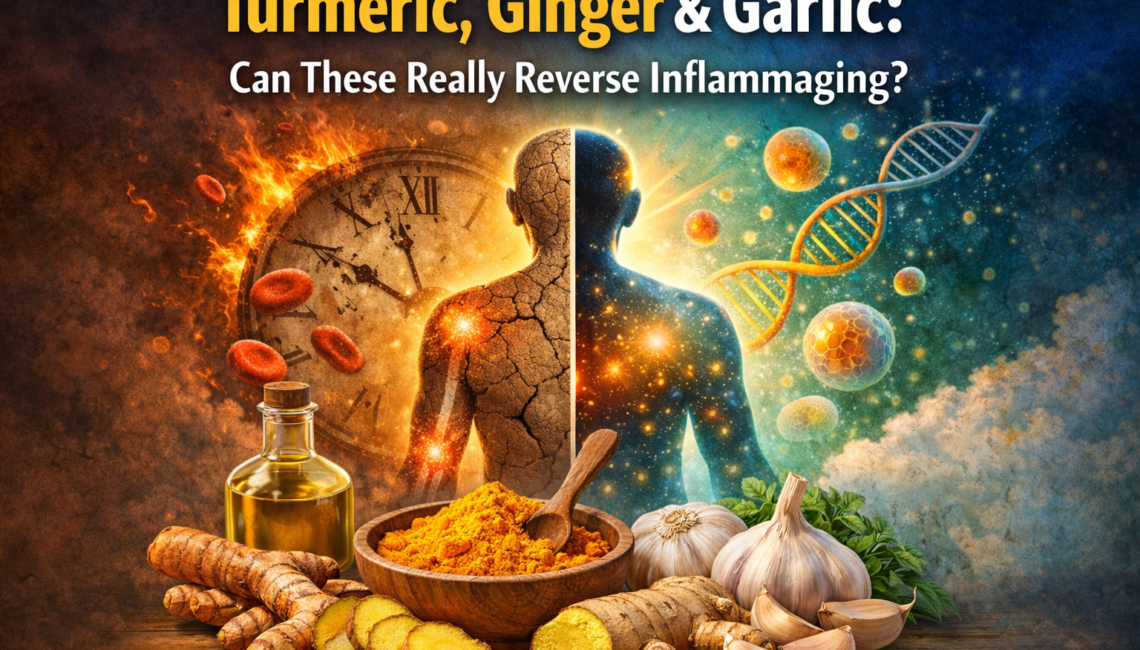
Inflammaging — a portmanteau of inflammation and ageing coined by Italian gerontologist Claudio Franceschi — refers to the chronic, low-grade systemic inflammation that increases with age and drives most age-related diseases: heart disease, type 2 diabetes, cancer, neurodegeneration, and sarcopenia (muscle loss).
The key molecular driver is a protein called NF-κB (nuclear factor kappa-light-chain-enhancer of activated B cells) — a transcription factor that, when chronically activated, promotes the production of inflammatory cytokines. Much of the pharmaceutical interest in anti-inflammatory drugs targets NF-κB pathways.
What makes turmeric, ginger, and garlic scientifically interesting is that all three contain compounds that modulate NF-κB activity. The question is whether culinary amounts have meaningful effects — or whether you need doses that go beyond what you would put in food.
Turmeric and Curcumin: The Most Studied
Curcumin is the active polyphenol in turmeric responsible for its yellow colour and most of its studied biological effects. The research on curcumin is extensive — over 2,000 published studies — and spans anti-inflammatory, antioxidant, anti-cancer, and neuroprotective effects.
A 2017 meta-analysis in the Journal of Medicinal Food analysed 8 randomised controlled trials and found that curcumin supplementation significantly reduced CRP (C-reactive protein) and IL-6 — both key inflammatory markers. A separate analysis in Frontiers in Pharmacology confirmed anti-inflammatory effects comparable to ibuprofen in some models.
The critical limitation: curcumin has notoriously poor bioavailability. The body absorbs and uses very little of it as typically consumed. This is where the food-versus-supplement distinction becomes important.
Two things dramatically improve curcumin absorption:
- Black pepper (piperine): A compound in black pepper increases curcumin absorption by up to 2,000% by inhibiting its rapid metabolism. Adding a pinch of black pepper to any turmeric dish or drink is not a wellness trend — it is basic pharmacology.
- Fat: Curcumin is fat-soluble. Consuming it with a fat-containing meal (ghee, coconut oil, full-fat milk) significantly increases uptake. This is why the traditional Indian combination of haldi in warm milk with ghee is actually more bioavailable than a plain turmeric capsule.
As a food, regular turmeric in cooking — with black pepper and fat present — provides modest but real anti-inflammatory benefit over time. As a supplement, standardised curcumin extracts (with piperine) at doses of 500–1,000 mg daily show more consistent clinical effects in trials.
Ginger: Anti-Inflammatory and Genuinely Underrated
Ginger contains gingerols and shogaols — compounds that inhibit the same COX-2 enzyme pathway targeted by NSAIDs like ibuprofen. A 2015 systematic review in Osteoarthritis and Cartilage found that ginger supplementation significantly reduced pain and inflammation in knee osteoarthritis compared to placebo.
For digestive inflammation specifically — which is a significant contributor to systemic inflammaging — ginger is particularly well-studied. It accelerates gastric emptying, reduces intestinal inflammation, and has prebiotic effects on the gut microbiome.
Indian adrak chai — ginger tea — is genuinely therapeutic in this context, not just warming. Fresh ginger is more potent than dried (gingerols degrade to less active compounds when dried and stored). A 2–3 cm piece of fresh ginger in water or tea daily represents a meaningful dose in the context of existing research.
Garlic: The Allicin Evidence
Allicin — the sulphur compound responsible for garlic’s pungent smell — forms when garlic is crushed or chopped and the enzyme alliinase is activated. It is responsible for most of garlic’s studied effects, including its anti-inflammatory, antimicrobial, and cardiovascular properties.
A 2012 meta-analysis in the Journal of Nutrition found that garlic supplementation significantly reduced LDL cholesterol and blood pressure — both of which are linked to vascular inflammation. A 2016 Cochrane review confirmed blood pressure reduction effects in hypertensive patients.
The critical point for cooking: crushing or finely chopping garlic and letting it rest for 10 minutes before cooking allows allicin to form. Adding it immediately to a hot pan deactivates the alliinase enzyme before allicin can form. This is why raw or lightly cooked garlic is more potent than garlic added early in a high-heat dish.
The cultural Indian habit of a clove of raw garlic first thing in the morning — still practiced in many households — turns out to be well-supported by the chemistry.
Can These Reverse Inflammaging — The Honest Answer
“Reverse” is too strong a word. Ageing is a complex biological process influenced by genetics, cumulative environmental exposures, and decades of lifestyle factors. No spice reverses that.
What the evidence supports more accurately: regular consumption of these three foods, used correctly, modulates inflammatory pathways in ways that may slow the progression of inflammaging and reduce the risk of inflammation-driven diseases. Over decades of consistent use, in a diet that is otherwise not pro-inflammatory, the contribution is meaningful.
Think of them as part of an anti-inflammatory dietary pattern — not as cures or treatments, but as functional foods that do what the research says they do when used as your grandmother used them: consistently, in food, alongside everything else in a whole-diet approach.
Frequently Asked Questions
Should I take curcumin supplements or just eat turmeric in food?
If you cook with turmeric regularly — with black pepper and fat present — the contribution to inflammation reduction is real but modest. For people with established inflammatory conditions (arthritis, high CRP, metabolic syndrome), standardised curcumin extract with piperine at 500–1,000 mg daily is what clinical trials have used to show significant effects. Food alone may not reach therapeutic doses. Both are worth having — food as baseline, supplement if indicated.
Is too much turmeric harmful?
At food amounts, no. At high supplement doses (above 8 grams of curcumin daily), some studies report gastrointestinal discomfort and potential interactions with blood-thinning medications. Standard supplement doses of 500–1,000 mg are considered safe for most adults. Those on warfarin or other anticoagulants should consult their doctor before supplementing.
How long before I see any measurable effects?
In clinical trials, reductions in inflammatory markers (CRP, IL-6) from curcumin supplementation typically appear within 8–12 weeks. Ginger’s effects on pain and joint inflammation are seen within 4–6 weeks in studies. These are not quick-fix timelines — they require consistent, daily use.
The Bottom Line
My grandmother’s haldi was not magic, but it was also not nothing. The science gives us a more precise understanding of what she was doing intuitively — and, crucially, how to do it more effectively. Black pepper with the turmeric. Fresh ginger rather than dried. Raw garlic crushed and rested before cooking.
These details matter. The kitchen has always been a place where health happened in India. Understanding the chemistry just helps us use it better.
This article is for informational purposes only. Please consult a healthcare professional before using supplements, particularly if you have existing health conditions or take medications.