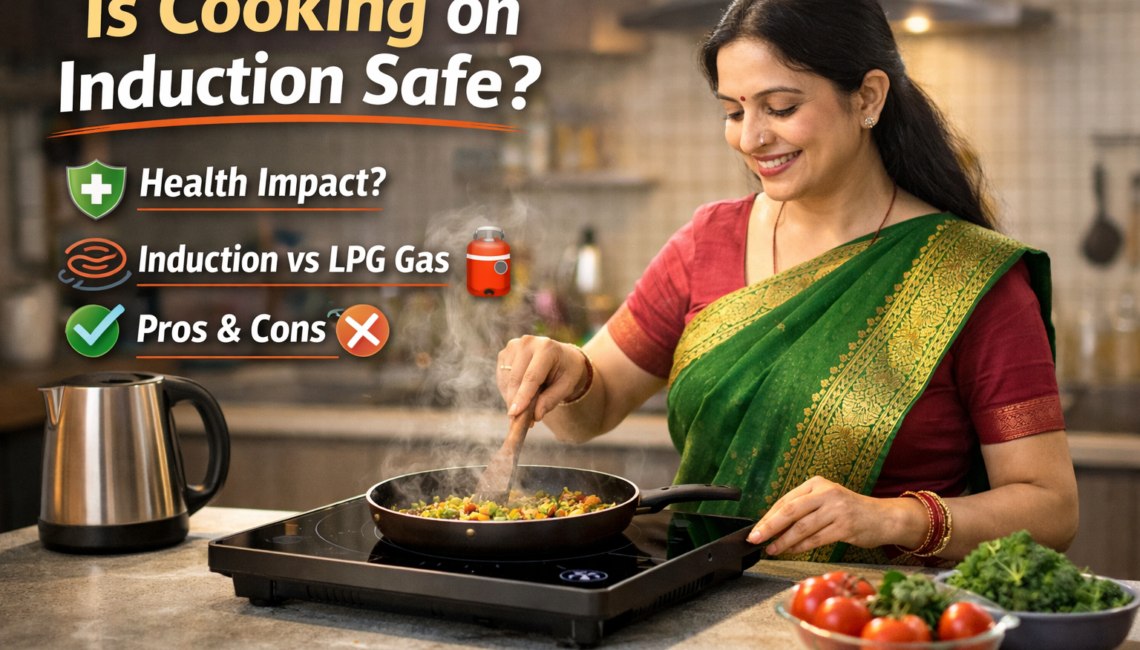
When the LPG shortage hit our neighbourhood last winter, my mother — who has cooked on a gas flame her entire life — reluctantly agreed to try an induction cooktop I had bought months earlier and left unused in a cupboard. Her first reaction after making dal on it: “It tastes the same. But is it safe?”
That question — is it safe? — is the one I hear most often about induction cooking in India. And it deserves a more careful answer than the marketing material gives you, because the concerns people have are not all baseless — they just need to be understood in context.
How Induction Cooking Actually Works
A traditional gas or electric coil stove heats the cookware by heating the air around it. Induction works differently — it uses electromagnetic energy to create an electrical current directly inside the metal of the cookware itself. The cookware heats up; the cooktop surface around it stays relatively cool.
This is why induction requires magnetic cookware (iron, stainless steel with a magnetic base). Aluminium, copper, and most traditional Indian vessels like kansa or brass do not work unless they have an induction-compatible base.
Understanding this mechanism matters for evaluating the health questions people ask.
The EMF Question — Addressed Honestly
The most common concern is electromagnetic field (EMF) exposure. Induction cooktops do generate EMFs — this is how they function. The question is whether the level of exposure during normal cooking is harmful.
Here is what the research actually shows: induction cooktops generate EMFs in the extremely low frequency (ELF) range — similar to the type emitted by household appliances like refrigerators, washing machines, and hairdryers. The World Health Organisation has reviewed the evidence extensively and has not classified ELF-EMFs from household appliances as a proven health risk for the general population.
One specific study worth noting: a 2018 study in the International Journal of Environmental Research and Public Health measured EMF exposure during induction cooking at various distances. At 30 cm from the cooktop (roughly the distance your hands are when stirring), levels were well within international safety guidelines. At 1 metre, exposure was negligible.
The practical takeaway: Don’t lean over the cooktop while cooking — maintain normal cooking posture and distance. This applies to any cooking method, honestly.
One real exception: People with implanted cardiac devices (pacemakers, defibrillators) should consult their cardiologist before using induction. The electromagnetic field can interfere with some older device models at close range.
Does Induction Cooking Affect Nutritional Value?
This concern comes from a reasonable place: does the method of cooking change the food’s nutrition? The answer is nuanced.
All cooking — regardless of heat source — degrades some nutrients. Water-soluble vitamins like B and C are sensitive to heat and leach into cooking water. The key variables are temperature and time, not the heat source itself.
Because induction heats cookware faster and more precisely than gas or electric coils, it often means shorter cooking times at controlled temperatures — which can actually preserve more nutrients than prolonged gas cooking. A 2010 study comparing cooking methods found that induction preserved slightly more Vitamin C in vegetables compared to conventional electric cooking, due to faster heating and reduced cooking time.
The nutrients in your dal, sabzi, or rice are not affected by electromagnetic fields — they are affected by heat and water. Induction is, if anything, slightly better in this regard because of its precision.
Safety — The Practical Wins for Indian Kitchens
This is where induction genuinely excels, especially in Indian household contexts:
- No open flame. In homes with children, elderly members, or synthetic fabrics near the cooking area, the absence of a gas flame is a meaningful safety improvement. Dupatta-related fire accidents are not rare in India.
- Cooktop surface stays cool. Only the area directly under the cookware heats up. Touching the glass surface beside the pan moments after cooking is safe — it will be warm but not burn-inducing. Burns from accidentally touching a gas burner grate are essentially eliminated.
- No gas leaks. With LPG, a poorly closed valve or a cylinder left on is a genuine fire and explosion risk. Induction eliminates this entirely.
- Automatic shut-off. Most induction cooktops switch off automatically when cookware is removed — no leaving the stove on accidentally.
The Legitimate Concerns
Induction is not without real drawbacks worth acknowledging honestly:
- Cookware replacement cost. If your kitchen runs on aluminium patila, copper degchi, or traditional kansa vessels, you will need to replace them. This is a real cost, particularly for households with a large set of traditional cookware.
- Power cuts. In areas with frequent load shedding, complete dependence on induction is impractical. Many Indian households reasonably keep a gas cylinder as backup.
- Does not replicate tandoor or open-flame char. Certain cooking techniques — smoking dal over a coal piece, tawa roti with direct flame contact, certain kebab preparations — cannot be replicated on induction. For households where these are frequent, a hybrid setup makes more sense.
- Humming noise. At high settings, some induction cooktops produce an audible hum. This varies by model and cooking vessel and is not harmful, but some users find it annoying.
Induction vs LPG — A Balanced Comparison
| Factor | Induction | LPG |
|---|---|---|
| Safety (burns) | Lower risk | Higher risk |
| Safety (fire/explosion) | No risk | Small but real risk |
| Cooking speed | Faster for most tasks | Familiar, versatile |
| Fuel cost | Electricity (varies by state tariff) | LPG price (subsidised for some) |
| Cookware compatibility | Magnetic vessels only | All vessels |
| Power cut dependency | Cannot cook | Unaffected |
| Tandoor/open-flame cooking | Not possible | Possible |
Frequently Asked Questions
Can pregnant women use induction cooktops safely?
Current evidence does not support any specific risk to pregnancy from normal induction cooktop use. The WHO and most health authorities consider ELF-EMF exposure from household appliances safe. As always, maintaining normal cooking distance (not leaning over the cooktop) is advisable for anyone.
Is induction cooking safe for diabetics?
Yes, completely. The method of heat transfer does not interact with blood sugar or any diabetic condition. Some diabetics prefer induction for its precise temperature control, which helps with consistent cooking of specific foods.
My food tastes different on induction. Is something wrong?
A perceived taste difference is common when switching cooktops and is usually due to the new cookware (which cooks differently than old, seasoned vessels), adjusted cooking times, or simply the psychological effect of a new method. Food cooked on induction is chemically identical to gas-cooked food given equivalent temperatures and times.
The Bottom Line
My mother’s dal tasted the same. She has been using the induction cooktop exclusively for three months now — mainly because she no longer worries about her dupatta near the flame.
Induction cooking is safe for the vast majority of people in normal use. The EMF concerns, while understandable, are not supported by current evidence at normal cooking distances. The real considerations are practical: cookware compatibility, power reliability in your area, and whether your cooking style requires open-flame techniques.
For a household with children, elderly members, or safety concerns about gas, induction is genuinely the safer choice. For a household that cooks extensive open-flame dishes and lives in an area with frequent power cuts, a hybrid approach makes more sense.
This article is for informational purposes. For any specific health concerns, consult a qualified medical professional.