Collagen ads are everywhere right now — powders, gummies, “marine peptide” lattes promising firmer skin in weeks. What most of these ads skip is a simpler fact: your body already makes collagen every day, and what you eat has a measurable effect on how much it makes and how fast existing collagen breaks down. You don’t need a $60 tub of powder to influence that process. You need specific nutrients, most of which are sitting in a regular grocery store.
This is part of our complete evidence-based guide to anti-aging, which also covers sunscreen, skincare actives, sleep, and supplements.
This isn’t a supplement pitch. It’s a look at what the actual research says about food and collagen — what’s well-established, what’s promising-but-early, and what’s mostly marketing. As always, this is general wellness information, not medical advice; talk to a doctor or dermatologist about anything skin- or health-related that concerns you specifically.
What Collagen Actually Is (and Why It Declines)
Collagen is the most abundant protein in your body — the structural scaffolding in skin, joints, tendons, and blood vessels. It’s what keeps skin looking plump and elastic rather than thin and crepey. Your body produces it continuously by fusing amino acids (mainly glycine, proline, and hydroxyproline) into long triple-helix fibers, a process that depends heavily on vitamin C and certain minerals as cofactors.
The problem is that collagen production slows with age — by an estimated 1% per year starting in your mid-20s — while breakdown from UV exposure, smoking, high blood sugar, and general oxidative stress continues at the same pace or faster. The gap between “made” and “lost” is what shows up as fine lines, looser skin, and slower wound healing over time.
Nothing you eat will stop that decline entirely. But food can influence both sides of the equation: giving your body better raw materials to build collagen, and reducing some of the damage that breaks it down.
The Foods With the Strongest Evidence
Vitamin C–Rich Foods (the Non-Negotiable Cofactor)
This is the one piece of the collagen story that isn’t up for debate. Vitamin C is a required cofactor for two enzymes — prolyl hydroxylase and lysyl hydroxylase — that stabilize the collagen triple helix during synthesis. Without adequate vitamin C, the body physically cannot assemble stable collagen, regardless of how much protein or collagen powder you consume. This is also why scurvy (severe vitamin C deficiency) causes gum disease, bleeding, and poor wound healing — all collagen-dependent tissues fail first.
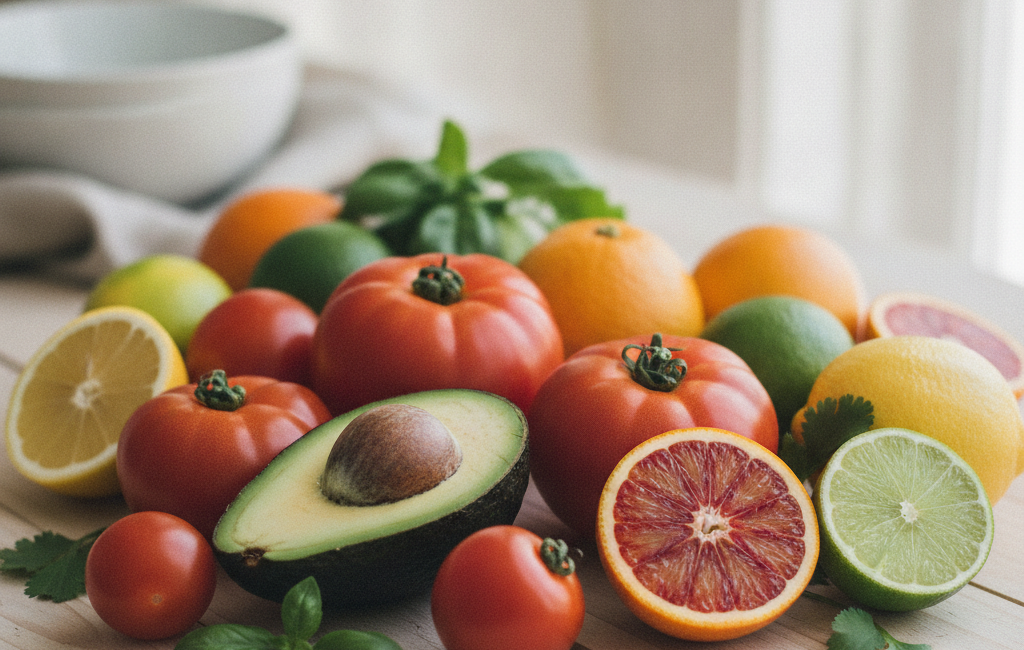
Good sources go well beyond oranges: bell peppers, amla (Indian gooseberry, one of the richest natural sources available), guava, kiwi, strawberries, and broccoli all deliver more vitamin C per serving than a typical orange.
Tomatoes (Lycopene)
A randomized controlled trial published in the British Journal of Dermatology had 20 women consume 55g of tomato paste (about 16mg of lycopene) in olive oil daily for 12 weeks. After UV exposure, the tomato-paste group showed less breakdown of collagen-related proteins and higher levels of procollagen-1 (a precursor your body converts into mature collagen) compared to the control group. (Read the study)
Cooking tomatoes in a small amount of oil actually increases lycopene bioavailability, so a simple tomato-and-olive-oil sauce is doing double duty here, not just a raw salad.
Avocados
A pilot study in the Journal of Cosmetic Dermatology had women eat one avocado daily for 8 weeks and measured facial skin with a cutometer before and after. The avocado group showed a statistically significant increase in forehead skin firmness compared to the control group, though hydration and pigmentation didn’t change. (Read the study)
The likely mechanism is avocado’s combination of monounsaturated fats and carotenoid antioxidants, both of which support the skin’s structural lipid barrier — though the study was small (39 participants) and industry-adjacent (funded by an avocado growers’ association), so treat this as promising rather than conclusive.
Berries and Other Anthocyanin-Rich Foods
Blueberries, blackberries, and pomegranate get cited constantly in “anti-aging food” lists, and there’s a real mechanism behind it: the polyphenols and anthocyanins in these foods act as antioxidants that help neutralize the free radicals generated by UV exposure — one of the main drivers of collagen breakdown (via activation of enzymes called matrix metalloproteinases, or MMPs, that literally degrade collagen fibers). The evidence here is stronger for general antioxidant/anti-inflammatory effects than for a direct, measured collagen-boosting effect the way the tomato and avocado studies show — worth eating regularly, but don’t expect a single before/after study to point to.
Bone Broth and Collagen Peptides
This is the closest thing to “eating collagen directly,” and it does have real backing — just not from bone broth itself. A double-blind, placebo-controlled study in Skin Pharmacology and Physiology gave women aged 35–55 either 2.5g or 5g of hydrolyzed collagen peptides daily for 8 weeks and found significantly higher skin elasticity in the treatment groups by week 4. (Read the study)
The catch: this study used purified, hydrolyzed collagen peptides at a measured dose — not homemade bone broth, which has wildly inconsistent collagen content depending on how it’s made. Bone broth isn’t harmful and can be a reasonable protein source, but “bone broth improves skin” is a bigger leap from the evidence than “collagen peptide supplements improve skin,” even though they get conflated constantly online.
Zinc and Copper (the Overlooked Minerals)
Vitamin C gets all the attention, but collagen synthesis also depends on trace minerals that rarely make it into “anti-aging food” lists. Copper is a cofactor for lysyl oxidase, the enzyme that cross-links collagen fibers into strong, stable structures rather than weak, loosely bound ones — cashews, sesame seeds, and dark chocolate are practical sources. Zinc supports the same synthesis pathway and is also involved in wound healing; pumpkin seeds, chickpeas, and lentils are reasonable dietary sources for people who don’t eat much red meat, which is otherwise the richest source.
Neither mineral needs supplementing for most people eating a varied diet — this is more a case for not over-restricting food groups than for adding a new pill.
What Actively Damages Collagen (and Matters as Much as What You Add)
- Excess sugar and refined carbs. High blood sugar drives a process called glycation, where sugar molecules attach to collagen fibers and make them stiff and brittle — this is one of the more well-established mechanisms of diet-related skin aging.
- Unprotected UV exposure. UV radiation activates MMPs, the enzymes that break down collagen. No food fully offsets daily unprotected sun exposure — sunscreen still does more for collagen preservation than any single food choice.
- Smoking. Reduces blood flow to skin and directly damages existing collagen and elastin; well documented as one of the fastest ways to visibly age skin.
A Realistic Way to Apply This
None of this requires an overhaul. A practical version looks like: get a vitamin-C source at most meals (it’s water-soluble and doesn’t store well, so little-and-often beats one big dose), work tomatoes cooked in olive oil and a daily handful of berries into your normal rotation, and treat avocado as a regular healthy-fat choice rather than an occasional treat. If you want to try a collagen peptide supplement, the Proksch study’s 2.5–5g daily dose is the one with actual clinical backing — look for products that specify hydrolyzed collagen peptides and a gram amount, not vague “collagen blend” labeling.
And keep expectations calibrated: food and supplements are working alongside — not instead of — sun protection, not smoking, and managing blood sugar. Skip any of those and no amount of tomato paste will fully compensate.
Related reading: Top 15 Anti-Inflammatory Foods That Slow Aging Naturally, 7 Foods that Promote Anti-ageing and Protect Sickness, Anti-Aging Skincare Routine: What Actually Works, According to the Evidence.