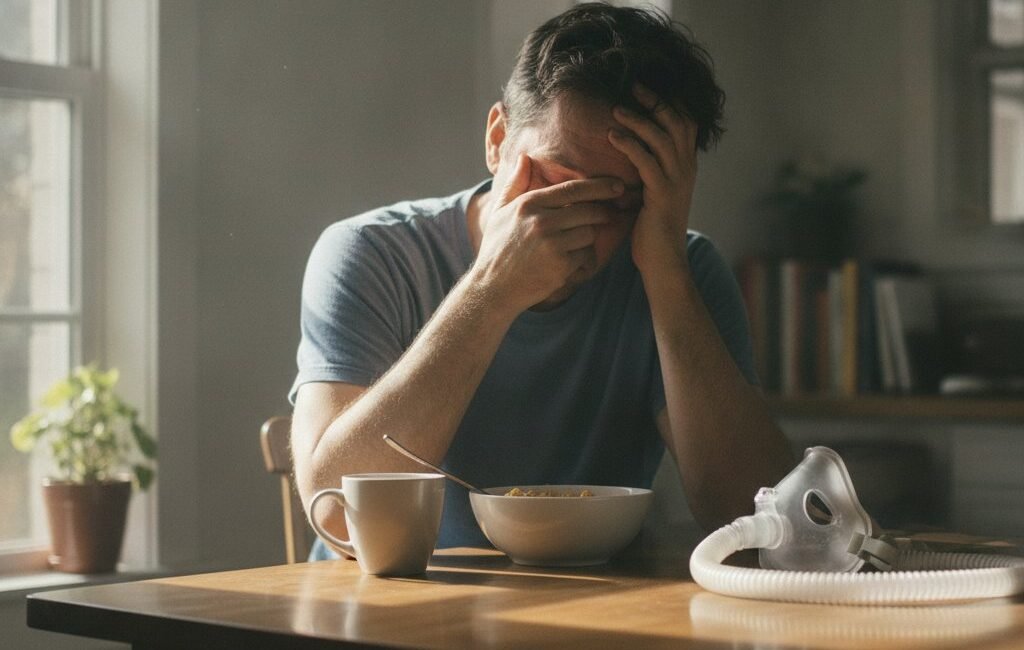
You go to bed at a sensible time, sleep through to the alarm, and still wake up feeling like you barely slept. You need coffee to get going, you fight to stay awake in afternoon meetings, and you could nod off on the sofa by 8pm. If that sounds familiar, the problem may not be how long you sleep. It may be what happens to your breathing while you’re asleep.
Obstructive sleep apnea (spelled “apnoea” in the UK) is one of the most common and most under-diagnosed reasons for feeling tired despite a full night in bed. The airway repeatedly narrows or closes during sleep, breathing stops or becomes shallow, and the brain briefly wakes you to restart it, often hundreds of times a night, usually without you remembering any of it.
This article is part of our complete guide on how to increase your energy levels naturally. It covers the signs to look for, simple screening questionnaires, how testing works, and what treatment can do for daytime energy. It is general information, not medical advice. If you recognise yourself here, please speak to a doctor.
What Happens During Sleep Apnea
When you fall asleep, the muscles that hold your throat open relax. In most people the airway stays open enough to breathe normally. In obstructive sleep apnea, it collapses partly (a hypopnea) or fully (an apnea) for ten seconds or more at a time. Oxygen levels fall, and the brain triggers a brief arousal, often with a snort or gasp, to tighten the throat muscles and restart breathing. Then you drift off again and the cycle repeats.
Doctors measure severity with the apnea-hypopnea index (AHI), the average number of these events per hour of sleep. Five to 14 per hour is usually classed as mild, 15 to 29 as moderate, and 30 or more as severe. Someone with severe sleep apnea can have their sleep broken more than 240 times over an eight-hour night.
That’s why you can “sleep” for eight hours and still feel exhausted. The time in bed is there, but the deep, continuous sleep your brain and body need to recover never gets a chance to build. We’ve written about other reasons this happens in why you can feel tired all the time even after sleeping 8 hours. Sleep apnea is one of the main medical causes on that list.
How Common It Is (And How Often It’s Missed)
Sleep apnea is not rare. A 2019 analysis in The Lancet Respiratory Medicine (Benjafield et al.) estimated that about 936 million adults aged 30 to 69 worldwide have mild to severe obstructive sleep apnea, and about 425 million have moderate to severe disease.
Most of them don’t know it. In a well-known study of nearly 5,000 employed adults in Wisconsin (Young et al., 1997, Sleep), researchers estimated that 93% of women and 82% of men with moderate to severe sleep apnea had never been clinically diagnosed. That study is old, but sleep apnea is still widely considered under-diagnosed, partly because its main symptom, tiredness, is so easy to blame on a busy life.
Signs You’re Sleeping but Not Resting
The difficulty with sleep apnea is that the most telling signs happen while you’re unconscious. The NHS lists the main symptoms as:
- Breathing that stops and starts during sleep
- Gasping, snorting or choking noises at night
- Feeling very tired during the day most days
- Loud snoring
- Waking up a lot during the night
Other common signs include:
- Headaches when you wake up
- Trouble concentrating, poor memory, or feeling foggy
- Irritability or low mood
- A dry mouth or sore throat in the morning
- Needing to get up to urinate several times a night
- Falling asleep easily when sitting still, for example reading, watching TV, or as a passenger in a car
Because you won’t notice most of the night-time signs yourself, the person you share a bed or a house with is often the first to spot the problem. The NHS suggests asking someone to watch you sleep if you’re unsure, and bringing them to your GP appointment if they’ve seen symptoms.
Snoring isn’t the whole story
Not everyone who snores has sleep apnea, and not everyone with sleep apnea snores loudly. Some people, women in particular, mainly notice tiredness, poor sleep, headaches or low mood rather than the classic loud snoring and gasping, which may help explain why the diagnosis is missed so often in women. If you’re persistently exhausted with no obvious explanation, sleep apnea is worth considering even if nobody has complained about your snoring.
Who Is Most at Risk
Anyone can develop sleep apnea, including people who are slim and young, but risk rises with:
- Excess weight, especially around the neck
- Age, particularly over 50
- Being male, although risk in women rises after menopause
- High blood pressure
- Drinking alcohol or taking sedatives, which relax the throat muscles further
- Smoking
- A naturally narrow airway, large tonsils, or a small or set-back lower jaw
Weight change matters more than many people realise. In a four-year study of 690 adults (Peppard et al., 2000, JAMA), a 10% weight gain predicted about a 32% increase in AHI, while a 10% weight loss predicted about a 26% decrease.
Two Quick Screening Questionnaires
Neither of these can diagnose sleep apnea, but both are widely used by doctors and can help you decide whether to ask for a referral.
STOP-Bang
The STOP-Bang questionnaire asks eight yes-or-no questions. Score one point for each “yes”:
- Snoring: Do you snore loudly?
- Tired: Do you often feel tired, fatigued or sleepy during the day?
- Observed: Has anyone seen you stop breathing, choke or gasp during sleep?
- Pressure: Do you have, or are you being treated for, high blood pressure?
- BMI: Is your body mass index over 35?
- Age: Are you over 50?
- Neck: Is your neck circumference over 40 cm (about 16 inches)?
- Gender: Are you male?
A score of 3 or more puts you at higher risk. The questionnaire is designed to catch as many cases as possible rather than to be precise. A 2022 meta-analysis in surgical patients (Hwang et al., BMC Anesthesiology) found that a score of 3 or more picked up about 88% of moderate to severe cases and 90% of severe cases, but many people who scored highly turned out not to have sleep apnea. In practice: a low score is fairly reassuring, while a high score means “get tested”, not “you have it”.
The Epworth Sleepiness Scale
The Epworth Sleepiness Scale (Johns, 1991, Sleep) measures how sleepy you are during the day, not sleep apnea specifically. You rate how likely you are to doze off in eight everyday situations, such as sitting and reading, watching TV, or sitting in a car stopped in traffic, from 0 (never) to 3 (high chance). Totals range from 0 to 24. A score of more than 10 is generally taken to mean excessive daytime sleepiness that’s worth discussing with a doctor.
How Sleep Apnea Is Diagnosed
Diagnosis needs a sleep study. There are two main types:
- Home sleep apnea test: you sleep in your own bed wearing a small device that records your breathing, airflow, oxygen levels and heart rate.
- In-lab polysomnography: an overnight stay in a sleep clinic, which also records brain waves, eye movements and leg movements.
The American Academy of Sleep Medicine’s 2017 clinical practice guideline (Kapur et al., Journal of Clinical Sleep Medicine) supports home testing for otherwise uncomplicated adults with signs of moderate to severe sleep apnea: excessive daytime sleepiness plus at least two of habitual loud snoring, witnessed breathing pauses or gasping, or diagnosed high blood pressure. It recommends an in-lab study instead for people with significant heart or lung disease, neuromuscular weakness, a history of stroke, long-term opioid use or severe insomnia. If a home test is negative but your symptoms strongly suggest sleep apnea, the guideline recommends following up with a full lab study, because home tests can miss milder cases.
Why It’s Worth Taking Seriously
Untreated sleep apnea isn’t just about feeling tired. The NHS notes that it is linked to high blood pressure and a higher risk of stroke, among other problems, and repeated drops in oxygen put strain on the heart. (Our evidence-based guide to heart health covers the wider picture.)
Sleepiness also has immediate safety consequences, particularly for driving. In the UK, the NHS states that people diagnosed with sleep apnea that causes excessive sleepiness must not drive until their symptoms are under control. Rules differ between countries, so check the requirements where you live.
What Treatment Can Do for Your Energy
The standard treatment for moderate to severe sleep apnea is CPAP (continuous positive airway pressure). A small machine blows air gently through a mask while you sleep, keeping the airway open. A meta-analysis of 12 randomised trials (Patel et al., 2003, Archives of Internal Medicine, summarised in American Family Physician) found that CPAP reduced daytime sleepiness on both questionnaires and objective tests, with the biggest benefit in people with severe sleep apnea.
The benefit is smaller in milder cases. A later meta-analysis focusing on mild to moderate sleep apnea (Marshall et al., 2006, Thorax) found CPAP lowered Epworth scores by only about 1.2 points on average. So the people who are sleepiest and most severely affected tend to notice the biggest change.
Other options, depending on severity and what’s causing it, include:
- Weight loss, which can meaningfully reduce severity, as the Peppard study above suggests
- Cutting back on alcohol, especially in the evening
- Stopping smoking
- Sleeping on your side if your apnea is worse on your back
- Mouthguard-style devices (mandibular advancement devices) that hold the lower jaw forward, often used for mild cases or people who can’t tolerate CPAP
- Surgery in selected cases, such as removing large tonsils
Lifestyle changes help, but they’re not a substitute for a diagnosis. If you have moderate or severe sleep apnea, it’s important to get proper treatment rather than just hoping a few changes will fix it.
The Bottom Line
If you regularly wake up unrefreshed after what should have been enough sleep, struggle to stay awake during the day, or have been told you snore, gasp or stop breathing at night, sleep apnea is worth ruling out. It is very common, usually undiagnosed, and treatable. No amount of extra coffee or early nights will fix fatigue that comes from broken breathing.
Try the STOP-Bang questions above, and if you score 3 or more, or your daytime sleepiness is affecting your life, ask your doctor about a sleep study. For the other everyday levers that affect your energy, from caffeine timing to exercise and hydration, see our full guide on how to increase your energy levels naturally. You may also find why we sleep and how poor sleep makes you feel older and our look at sleep duration and longevity useful.
Frequently Asked Questions
Can you have sleep apnea without snoring?
Yes. Loud snoring is common in sleep apnea but not universal. Some people, particularly women, mainly notice daytime tiredness, poor sleep, morning headaches or low mood. If you’re persistently exhausted without an obvious cause, it’s worth mentioning sleep apnea to your doctor even if you don’t snore.
Why do I feel tired even after 8 hours of sleep?
There are several possible reasons, including poor sleep quality, low iron, thyroid problems, depression and some medications. Sleep apnea is one of the most common medical causes because it repeatedly interrupts sleep without fully waking you, so you don’t remember it but still don’t get restorative sleep.
What score on STOP-Bang means I should get tested?
A score of 3 or more out of 8 indicates a higher risk of obstructive sleep apnea. The questionnaire is designed to catch most cases, so a high score means you should talk to a doctor about testing, not that you definitely have the condition.
Can I test for sleep apnea at home?
Often, yes, but it should be arranged through a doctor or sleep service. Home sleep apnea tests are recommended for otherwise healthy adults with signs of moderate to severe sleep apnea. People with significant heart or lung disease, neuromuscular conditions, a history of stroke, long-term opioid use or severe insomnia usually need an in-lab study instead.
Will treating sleep apnea give me more energy?
For many people, yes, especially those with moderate to severe sleep apnea and marked daytime sleepiness. Trials show CPAP reduces daytime sleepiness, with the largest improvement in severe cases. The effect is smaller in mild sleep apnea.