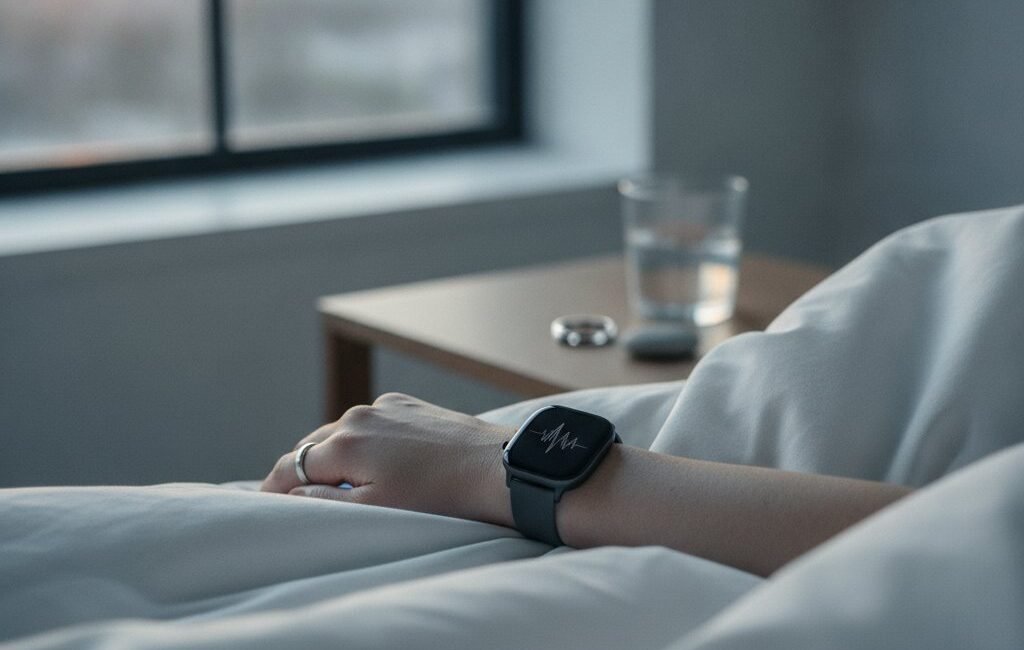
You wake up feeling fine, then check your watch: sleep score 61, only 42 minutes of deep sleep, “restless night”. Suddenly you feel tired. It’s a common experience, and it raises two fair questions. How accurate is that sleep data in the first place? And is checking it every morning actually helping you sleep better? This article covers what validation studies have found when consumer sleep trackers are tested against a sleep lab, which numbers you can trust, and when it’s better to stop looking.
This article is part of our complete guide to fitness trackers and health gadgets. For accuracy across every tracker metric, including steps, heart rate and calories, see are fitness trackers accurate? This is general information from published research, not medical advice.
In this article:
- The Short Answer
- How Sleep Trackers Are Tested
- What the Validation Studies Found
- Why Trackers Overestimate Sleep, Especially in Insomnia
- Sleep Stages and Sleep Scores: Treat Them Lightly
- When Tracking Makes Sleep Worse: Orthosomnia
- Can a Tracker Detect Sleep Apnoea?
- How to Use a Sleep Tracker Without Letting It Run Your Nights
- Frequently Asked Questions
- Key Takeaways
The Short Answer
- Asleep or awake, and for how long: fairly good in healthy adults. Modern watches and rings agree with a sleep lab on whether you’re asleep for most of the night.
- Time spent awake in the night: weaker. Trackers are good at spotting sleep but poor at spotting quiet wakefulness, so they tend to overestimate how much you slept.
- Light, deep and REM stages: rough estimates. In head-to-head tests, stage agreement is far lower than for sleep versus wake.
- Sleep scores: each brand’s own formula, with no clinical standard behind them.
- Sleep disorders: a general tracker can’t diagnose insomnia or sleep apnoea, though a few watches now have FDA-authorised sleep apnoea notification features (more on that below).
How Sleep Trackers Are Tested
The reference standard is polysomnography (PSG), an overnight sleep-lab recording. It measures brain waves (EEG), eye movements, muscle tone, breathing and heart rhythm. Sleep stages are defined by brain activity, so PSG is the only way to score them properly.
A wrist or finger device can’t record brain waves. Instead, it infers sleep from movement (an accelerometer) and from heart rate and heart rate variability (an optical sensor), sometimes adding skin temperature and breathing rate. Researchers usually compare the two in 30-second chunks called epochs, and report two numbers:
- Sensitivity: of the epochs PSG scored as sleep, how many the tracker also called sleep.
- Specificity: of the epochs PSG scored as wake, how many the tracker also called wake.
That second number is where trackers struggle, for a simple reason. Lying still and awake looks a lot like light sleep to an accelerometer.
What the Validation Studies Found
Seven devices in a sleep lab (Chinoy, 2021)
A study published in Sleep in 2021 by Chinoy and colleagues tested seven consumer sleep trackers against PSG in 34 healthy young adults (average age about 28) over three nights in a lab. Four were wearables (Fitbit Alta HR, Garmin Fenix 5S, Garmin Vivosmart 3 and Fatigue Science Readiband) and three were bedside devices. A research-grade actigraph was included for comparison.
Sensitivity for sleep was high across the board, at 0.93 or above: the devices almost never missed sleep. Specificity was low to moderate, ranging from 0.18 to 0.54, so the devices missed a large share of the time people were actually awake. Stage results were mixed. Devices tended to overestimate light sleep, and several also overestimated deep sleep. Most devices performed as well as or better than the research actigraph for sleep versus wake, though the two Garmin models did worse. The authors called the newer devices promising, but stressed they need testing in other groups, not just healthy young adults.
Six newer wearables, including Oura and Apple Watch (Miller, 2022)
A 2022 study in Sensors by Miller and colleagues put six wearables on 53 healthy adults (average age about 25) for one night in a sleep lab: Apple Watch Series 6, Garmin Forerunner 245, Polar Vantage V, Oura Ring Gen 2, WHOOP 3.0 and Somfit. For the simple sleep-or-wake question, agreement with PSG ranged from 86% to 89% across devices. When the devices had to sort sleep into stages, agreement fell to roughly 50–65%.
The authors concluded that all six were valid for tracking the timing and duration of sleep in the field, but that all of them needed improvement for specific sleep stages. Polar, Oura, WHOOP and Somfit did better than Apple Watch and Garmin at detecting wake. That gap matters more for people who spend long stretches awake in the night.
Eleven trackers in a sleep clinic (Lee, 2023)
A larger 2023 study in JMIR mHealth and uHealth by Lee and colleagues compared 11 consumer sleep trackers with PSG in 75 participants at a hospital and a sleep clinic in Korea. It included wearables (Google Pixel Watch, Galaxy Watch 5, Fitbit Sense 2, Apple Watch 8 and Oura Ring 3), bedside “nearables” such as a mattress pad, and phone apps that listen to breathing sounds.
Performance varied a lot from device to device and from stage to stage. No single tracker was best at everything. Some wearables were relatively good at detecting deep sleep, while a phone app did best on wake and REM. Accuracy also shifted with participants’ BMI, sleep efficiency and how severe their sleep apnoea was. In other words, how well a device works may depend on who is wearing it.
Pooling the studies (2025 meta-analysis)
A 2025 meta-analysis in the Journal of Clinical Sleep Medicine pooled studies of wrist-worn consumer trackers against PSG. It concluded that they are not as reliable as PSG for total sleep time, sleep efficiency and time taken to fall asleep, and that users and doctors should interpret their results carefully, while they can still be useful for tracking general sleep patterns.
Why Trackers Overestimate Sleep, Especially in Insomnia
Low specificity has a predictable result: the tracker counts some of your quiet, awake time as sleep. In good sleepers who spend little time awake, that error is small. In people with insomnia, who often lie still in bed for long periods trying to sleep, it grows.
A 2017 study in the Journal of Psychosomatic Research by Kang and colleagues showed this directly. It compared a Fitbit Flex with PSG in adults with insomnia disorder and in good sleepers. The Fitbit overestimated total sleep time by about 6.5 minutes in good sleepers, but by about 33 minutes in the insomnia group. Acceptable agreement with PSG was reached in 82% of good sleepers but only 39% of people with insomnia.
So a tracker is least accurate for the people who are most likely to be anxiously checking it.
Sleep Stages and Sleep Scores: Treat Them Lightly
The stage breakdown is the most eye-catching part of most sleep apps, and the least reliable. Across the studies above, stage agreement with PSG is consistently much lower than sleep-versus-wake agreement. A night showing “only 40 minutes of deep sleep” may simply be the algorithm’s guess on a night when your heart rate pattern was a bit different.
Sleep scores combine duration, stages, restlessness and often heart rate data into one number. Each company uses its own formula. There’s no clinical scale they map onto, so a score of 75 on one device doesn’t mean the same as 75 on another. They’re most useful compared with your own past scores on the same device, over weeks, not night to night.
When Tracking Makes Sleep Worse: Orthosomnia
In 2017, sleep researcher Kelly Baron and colleagues published a short case series in the Journal of Clinical Sleep Medicine describing three patients who had become so focused on perfecting their sleep tracker data that it was undermining their sleep. They called it orthosomnia, from “ortho” (correct) and “somnia” (sleep). The patients spent extra time in bed to push their tracked sleep up, which is the opposite of what effective insomnia treatment advises. Orthosomnia isn’t a formal diagnosis. It’s a clinical observation, but one many sleep clinicians recognise.
There’s also experimental evidence that sleep feedback can shape how you feel, whatever your actual sleep was. In a 2018 study in the Journal of Sleep Research, Gavriloff and colleagues gave 63 people with insomnia fake next-morning feedback from a watch-style device, telling them at random that their sleep had been good or poor. Those told they had slept poorly reported lower alertness and more sleepiness and fatigue later that day than those told they had slept well. Objective attention tests didn’t differ between the groups. The authors pointed out that this matters for wearables, which present their numbers as objective even when they may be wrong.
Put together, a poor score can make you feel worse even after a decent night, and chasing a better score can lead to habits that make sleep worse.
Can a Tracker Detect Sleep Apnoea?
Mostly, no. In its 2018 position statement on consumer sleep technology, the American Academy of Sleep Medicine said these devices can’t be used to diagnose or treat sleep disorders, because they lack validation against PSG and FDA clearance. It added that tracker data can still be a useful starting point for a conversation with a clinician.
There’s one recent exception, and it’s narrower than it sounds. In February 2024 the FDA authorised a sleep apnoea feature for Samsung Galaxy watches, and in September 2024 it cleared Apple’s sleep apnoea notification feature. Both look for signs consistent with moderate to severe obstructive sleep apnoea over several nights, and both are designed to prompt you to see a doctor, not to diagnose the condition. No alert doesn’t mean you don’t have sleep apnoea. If you snore loudly, wake up gasping, or feel exhausted despite enough time in bed, read our post on sleep apnoea signs and ask a doctor about a proper sleep study, whatever your watch says.
How to Use a Sleep Tracker Without Letting It Run Your Nights
- Focus on duration and timing. These are the most accurate numbers, and the ones with the strongest link to long-term health. See our post on how much sleep predicts a longer life.
- Look at weekly averages, not single nights. One bad score is mostly noise.
- Don’t stay in bed longer to raise your score. Extra time awake in bed tends to make insomnia worse, not better.
- Check in with how you feel first. If you feel rested, a low score on its own isn’t a problem.
- Take a break if it worries you. Turn off morning notifications or stop wearing it at night for a couple of weeks. How alert you are during the day is a better guide than any score.
- Pick a comfortable device if you do track. Smart rings are easier to sleep in than a watch, but use the same kinds of sensors and have the same basic limits.
- See a doctor for persistent problems. Ongoing insomnia, loud snoring or daytime sleepiness need a proper assessment. Cognitive behavioural therapy for insomnia (CBT-I) is the recommended first treatment for chronic insomnia, and a tracker can’t replace it.
Frequently Asked Questions
Are sleep trackers accurate?
For whether you’re asleep and roughly how long you slept, modern trackers agree with a sleep lab most of the time in healthy adults, about 86–89% in one six-device study. They’re much less accurate for sleep stages and for time spent awake in the night, and they tend to overestimate sleep in people with insomnia.
Is the deep sleep number on my watch or ring accurate?
Treat it as a rough estimate. Sleep stages are defined by brain waves, which wrist and finger devices can’t measure, and stage agreement with lab tests is far lower than for sleep versus wake. Some devices in studies have overestimated deep sleep.
Which sleep tracker is most accurate?
No single device wins on everything. Studies find that results vary by device, by sleep stage and by the person wearing it. Algorithms are also updated often, so a study of last year’s model isn’t a perfect guide. Any recent watch or ring from a major brand is reasonable for tracking sleep duration.
Can a sleep tracker make my sleep worse?
For some people, yes. Researchers coined the term “orthosomnia” for people whose focus on perfect tracker data worsened their sleep, and an experiment found that being told you slept badly can make you feel more tired, regardless of how you actually slept. If your scores make you anxious, take a break from checking them.
Can my smartwatch tell if I have sleep apnoea?
Some Samsung and Apple watches now have FDA-authorised features that can flag signs of possible moderate to severe sleep apnoea, but they don’t diagnose it, and no alert doesn’t rule it out. Loud snoring, gasping at night or heavy daytime sleepiness are reasons to see a doctor about a sleep study.
Key Takeaways
- Trackers are fairly good at sleep versus wake and total sleep time, especially averaged over weeks.
- They miss much of the time you lie awake, so they overestimate sleep, more so in insomnia.
- Sleep stages and sleep scores are rough estimates. Don’t judge a night by them.
- Bad-sleep feedback can make you feel worse, and chasing scores can backfire.
- Trackers don’t diagnose sleep disorders. Persistent problems need a doctor.
A sleep tracker is most useful as a nudge toward consistent, long-enough sleep, not as a nightly report card. For how sleep trackers fit alongside smartwatches, heart alerts, step counters and other health gadgets, see our full guide to fitness trackers and health gadgets.