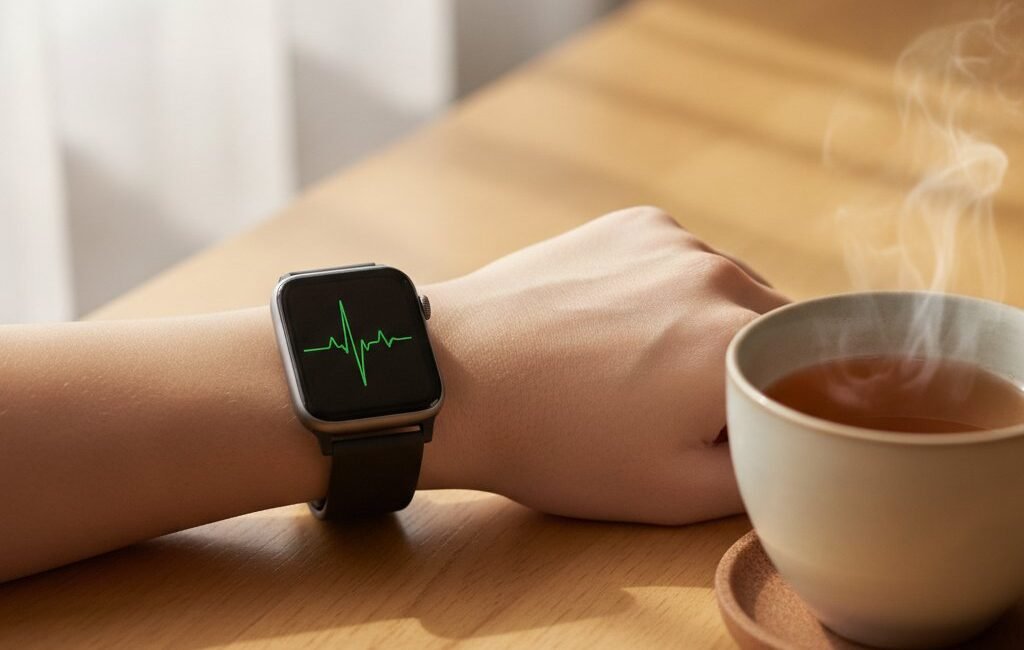
You glance at your wrist and there it is: a notification saying your watch has detected signs of an irregular heart rhythm, possibly atrial fibrillation (AFib). It’s an unsettling message to get from a gadget you bought to count steps. So how much should you trust it? The large studies behind these features give a fairly clear answer. Smartwatch AFib alerts are rare, they’re usually right when they do go off, and they’re a good reason to see a doctor. But they can’t diagnose anything, and a quiet watch doesn’t mean your heart rhythm is fine.
This article is part of our complete guide to fitness trackers and health gadgets, which covers what the research says each type of device is good for. It’s general information from published studies, not medical advice. If you have chest pain, fainting, severe breathlessness or signs of a stroke, call emergency services rather than checking your watch.
The Short Answer
- Smartwatches can flag a possible irregular rhythm, and in the two biggest studies (Apple and Fitbit, about 875,000 people combined) only a small fraction of wearers ever got an alert.
- When the watch alerts while you’re also wearing a medical ECG patch, it’s almost always right: 84% of the time in the Apple study and 98% in the Fitbit study.
- But only about a third of people who got an alert were later found to have AFib on a week-long ECG patch, partly because AFib comes and goes.
- An alert is a reason to book a doctor’s appointment, not a diagnosis. No alert doesn’t rule AFib out: the watches check only some of the time, and they aren’t designed to catch every episode.
- The watch ECG feature is less reliable in people who already have other heart rhythm problems, and it often gives an “inconclusive” result.
What AFib Is and Why It Matters
In atrial fibrillation, the upper chambers of the heart (the atria) quiver chaotically instead of contracting in a steady rhythm. The pulse becomes irregular, and often fast. Some people feel palpitations, breathlessness or tiredness. Many feel nothing at all, which is exactly why a device that checks your pulse in the background is appealing.
The main danger is stroke. When the atria don’t contract properly, blood can pool and form clots that travel to the brain. The Framingham Study, which followed 5,070 people for 34 years, found a near fivefold higher stroke risk in people with AFib (Wolf and colleagues, Stroke 1991), and the extra risk attributable to AFib rose steeply with age. Treatment, often blood thinners for people at higher risk, can cut that risk a lot. That’s the whole case for finding AFib earlier. For the wider picture of keeping your heart healthy, see our heart health guide.
How Your Watch Checks Your Rhythm
Most smartwatches and fitness bands use two different tools, and it helps to know which one is talking to you.
1. Background irregular rhythm notifications (optical sensor)
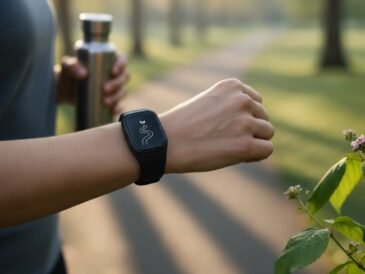
The green flashing light on the back of your watch measures blood flow under the skin (a method called photoplethysmography, or PPG). From time to time, usually while you’re sitting still, the watch looks at the gaps between beats. If they’re irregular over several checks in a row, it sends a notification. You don’t have to do anything. Our article on how accurate fitness trackers are explains why this sensor works best at rest and struggles during movement.
2. The on-demand ECG app (electrical sensor)
Some watches also let you take a 30-second electrocardiogram by touching the crown or a sensor with a finger on your other hand. This records the heart’s electrical signal, similar to one lead of a hospital ECG. The app then classifies the recording as normal rhythm, AFib, or inconclusive. You have to start it yourself, so it’s most useful when you feel symptoms or after you get a notification.
Apple’s ECG app and irregular rhythm notification were cleared by the US Food and Drug Administration (FDA) in September 2018 through its De Novo route for new types of low-to-moderate-risk devices. That’s a clearance, not a full “approval”, and the clearance has limits: the ECG app isn’t meant for people under 22, and the notification feature isn’t meant for people who’ve already been diagnosed with AFib. The FDA also noted that the notification isn’t designed to flag every episode. Fitbit’s background algorithm was cleared by the FDA in 2022 after its own large study.
What the Two Big Studies Found
The Apple Heart Study (Perez 2019)
Published in the New England Journal of Medicine in 2019, this study enrolled 419,297 Apple Watch users with no known AFib. Over a median of about four months:
- Only about 0.5% got an irregular pulse notification. Age made a huge difference: 3.2% of people over 65 got one, compared with 0.16% of people under 40.
- People who got a notification were sent an ECG patch to wear for about a week. AFib showed up on 34% of those patches.
- When the watch sent a notification while the patch was being worn, the patch confirmed AFib 84% of the time.
The Fitbit Heart Study (Lubitz 2022)
Published in Circulation in 2022, this study enrolled 455,699 people using Fitbit devices. They were younger (median age 47) and mostly women. Fitbit’s algorithm waits for at least 30 minutes of irregular rhythm before notifying, which is a deliberately cautious setting.
- Of 1,057 people who got a notification and then wore a one-week ECG patch, 32% had AFib on the patch.
- When the watch detected an irregular rhythm again while the patch was on, the patch showed AFib at the same time in 221 of 225 cases (98%). In people 65 and over, the figure was 97%.
Why “a third” and “almost always right” are both true
These numbers look contradictory, but they answer different questions. The 84–98% figures show that when the watch flags an irregular rhythm, it’s rarely a false alarm. The ~33% figures show that a week of patch monitoring after an alert found AFib in only a third of people. That’s largely because AFib is often paroxysmal: it comes and goes, sometimes weeks apart. A clean week on a patch doesn’t prove the watch was wrong. It does mean many people who get an alert will go through tests without a clear answer straight away.
How Reliable Is the Watch ECG?
Apple’s own instructions report that, for recordings the app could classify, it identified AFib with 98.3% sensitivity and normal rhythm with 99.6% specificity. The important part is “recordings it could classify”. Real-world tests are less tidy.
A 2022 study in the Canadian Journal of Cardiology (Racine, Strik and colleagues) gave 734 consecutive hospital patients a standard 12-lead ECG, immediately followed by a 30-second Apple Watch recording:
- In about one in five patients, the watch gave no automatic diagnosis at all.
- The app correctly identified 78% of patients who were in AFib and 81% of those who weren’t. Heart rhythm specialists reading the same watch tracings did better: 97% and 89%.
- People with extra or “skipped” beats (premature contractions) were about three times more likely to get a false AFib result, and the watch was poor at picking up atrial flutter, a related rhythm problem.
Those were hospital patients, many with other heart conditions, so the results don’t transfer exactly to healthy wearers. But they make a useful point: if you already have other rhythm problems, a watch result is weaker evidence either way. It also explains why a doctor will want to look at the actual tracing rather than just the app’s label. If you get “inconclusive”, sit still, rest your arm on a table and try again. Apple notes that a heart rate between 100 and 120 beats per minute, poor contact, or another type of arrhythmia can all cause it.
Should Everyone Wear One to Screen for AFib?
Not necessarily. The US Preventive Services Task Force reviewed the research in 2022 and concluded there wasn’t enough evidence to say whether screening adults 50 and over who have no symptoms does more good than harm (an “I” statement, published in JAMA). The open questions are whether AFib found by screening, particularly brief episodes, carries the same stroke risk as AFib found the usual way, and whether treating it improves outcomes enough to outweigh the downsides: anxiety, extra tests, and the bleeding risk of blood thinners.
That’s not a reason to switch the feature off. It’s a reason to treat it as one input among many, not a screening programme. The alert is most meaningful for people at higher baseline risk: those over 65, or with high blood pressure, diabetes, heart failure, sleep apnoea or a previous stroke. If high blood pressure is on your list, our guide to blood pressure numbers and home monitoring covers how to check it properly, which matters more for stroke prevention than any watch.
If Your Watch Says You Might Have AFib
- Don’t panic. An alert isn’t an emergency in itself. Most people who get one feel completely normal.
- If you have symptoms such as chest pain, fainting, severe breathlessness, or face drooping, arm weakness or slurred speech, call emergency services. Don’t wait for the watch.
- If your watch has an ECG app, take a recording while seated and still, and save or export it.
- Book an appointment with your doctor and bring the alerts and recordings. They’ll usually do a 12-lead ECG and may give you a monitor to wear for several days or longer.
- Don’t start or stop any medicine on the strength of a watch reading.
Already diagnosed with AFib? The background alert isn’t designed for you, but some watches have features for people with a diagnosis. Apple’s AFib History, introduced in 2022, estimates how much of the time you spend in AFib each week. In 2024 the FDA qualified it as a tool that device makers can use to measure AFib burden in clinical trials of ablation procedures. That’s an endorsement of its use in research, not a replacement for your cardiologist’s monitoring, so discuss any readings with your care team.
If Your Watch Has Never Alerted You
That’s reassuring, but only partly. The watch checks your rhythm intermittently, mostly at rest, and the FDA clearance itself says it won’t catch every episode. If you have palpitations, a racing or fluttering heart, unexplained breathlessness or tiredness, see a doctor regardless of what your watch says. The same goes for heart attack symptoms, which can be subtle, especially in women and older adults; our article on heart attack warning signs covers them. Smartwatches don’t detect heart attacks.
Frequently Asked Questions
Can a smartwatch detect AFib?
It can flag a possible irregular rhythm suggestive of AFib. In the Apple and Fitbit studies, when the watch alerted while users also wore a medical ECG patch, the patch confirmed AFib 84% and 98% of the time. But only a doctor can diagnose AFib, and no alert doesn’t rule it out.
How accurate is the Apple Watch ECG for AFib?
For recordings it can classify, Apple reports about 98% sensitivity and over 99% specificity. In a 2022 study of 734 hospital patients, about one in five recordings gave no automatic diagnosis, and accuracy was lower in people with other rhythm problems such as extra beats.
What should I do if my smartwatch says I have an irregular heart rhythm?
Stay calm, take an ECG recording if your watch has the feature, and book an appointment with your doctor. Call emergency services straight away if you have chest pain, fainting, severe breathlessness or stroke symptoms.
Can a smartwatch give a false AFib alert?
Yes, though it’s uncommon. Extra heartbeats (premature contractions) are the most common cause of false AFib readings on watch ECGs. Movement and poor sensor contact can also interfere, which is why the background checks mostly run while you’re still.
Does a smartwatch detect heart attacks?
No. A single-lead watch ECG is designed to check rhythm, not to detect a heart attack. If you have chest pain or other heart attack symptoms, call emergency services, whatever your watch shows.
Related reading: Fitness trackers and health gadgets: what’s worth it · Are fitness trackers accurate? · Heart health guide