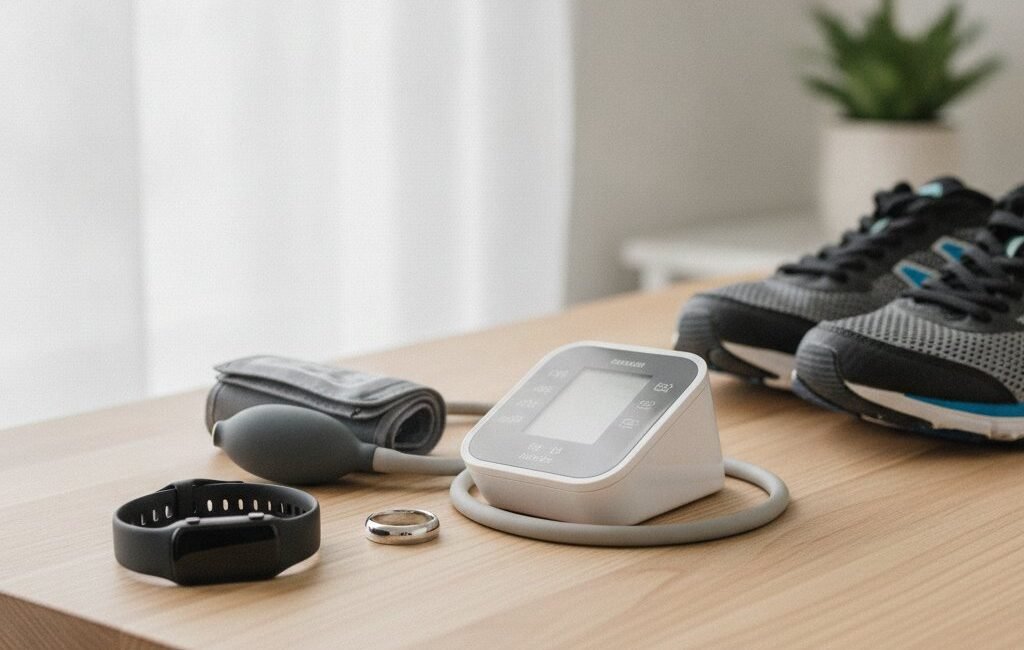
Fitness trackers, smartwatches, smart rings, walking pads, home blood pressure cuffs and even over-the-counter glucose sensors all promise to make you healthier. Some of them do help. Others measure things less accurately than their apps suggest, and a few can make things worse for some people. This guide goes through what the research says about each kind of gadget: what it measures well, what it gets wrong, and who is most likely to get something useful from it. It also connects this site’s posts on smart rings, walking pads and health-tracking apps in one place.
This is general information drawn from published research. It is not medical advice, and no consumer gadget replaces a diagnosis. If a device flags an irregular heartbeat, a high blood pressure reading or an unusual glucose pattern, take that to your doctor rather than acting on the number by itself.
Do Fitness Trackers Actually Make You More Active?
On average, yes, though the effect is modest. A 2022 umbrella review in The Lancet Digital Health by Ferguson and colleagues pooled 39 systematic reviews and meta-analyses covering about 164,000 participants. Activity trackers were linked to roughly 1,800 extra steps a day, about 40 more minutes of walking a day, and about 1 kg of weight loss. The authors found the benefit across age groups and in both healthy people and people with long-term conditions, and concluded that there is enough evidence to recommend trackers for increasing physical activity.
That’s the case for trackers. The catch is that most of the trials ran for weeks or months. Many people stop wearing a tracker once the novelty wears off, and a tracker in a drawer doesn’t do anything. The best predictor of benefit is whether you’ll still be looking at it six months from now.
The Weight-Loss Surprise
Trackers are often sold as weight-loss tools, but the best-known long-term trial found the opposite of what you’d expect. In the IDEA trial (Jakicic and colleagues, JAMA 2016), 470 adults with overweight or obesity followed a behavioural weight-loss programme. Half were given a wearable activity monitor from month six onward. After two years, the wearable group had lost less weight: about 3.5 kg on average, against 5.9 kg in the standard group.
Nobody knows exactly why. One possibility is that seeing “calories burned” on a screen encourages people to eat that number back. That ties in with the biggest accuracy problem trackers have, covered next. The practical lesson is that a tracker can help you move more, but it isn’t a substitute for the eating and behaviour changes that drive weight loss. For the exercise side of that, see this site’s guide to low-intensity exercise.
What Trackers Measure Well, and What They Don’t
A 2017 Stanford study in the Journal of Personalized Medicine (Shcherbina and colleagues) tested seven wrist-worn devices, including the Apple Watch and a Fitbit, on 60 volunteers while they sat, walked, ran and cycled. The researchers compared the devices against medical-grade heart monitoring and a lab measurement of energy use.
- Heart rate: mostly good. Six of the seven devices had a median heart-rate error under 5% in at least one setting, and the best had about 2% error overall.
- Calories burned: poor. No device had an energy-expenditure error below 20%. Median errors ranged from about 27% for the best device to about 93% for the worst.
Errors were larger during walking, and in people with higher body weight or darker skin. Devices and algorithms have changed since 2017, but independent testing still tends to find the same pattern: heart rate and step counts are reasonably reliable, while calorie estimates are rough guesses. Treat “calories burned” as a vague indicator, never as a number to eat back. For a closer look at each measurement, including newer reviews covering more than 150 studies, see how accurate fitness trackers really are.
Steps: You Probably Don’t Need 10,000
The 10,000-step target began as a marketing slogan, not a research finding. The research now points lower:
- A 2022 meta-analysis of 15 international cohorts in The Lancet Public Health (Paluch and colleagues) found that the drop in death risk from more steps levelled off at about 6,000–8,000 steps a day for adults aged 60 and over, and about 8,000–10,000 for adults under 60. People in the highest step group had about half the death risk of those in the lowest.
- A 2025 dose-response meta-analysis in the same journal (Ding and colleagues) found that, compared with 2,000 steps a day, 7,000 steps was linked to a 47% lower risk of death from any cause and a 38% lower risk of dementia. Going from 7,000 to 10,000 added only modest extra benefit.
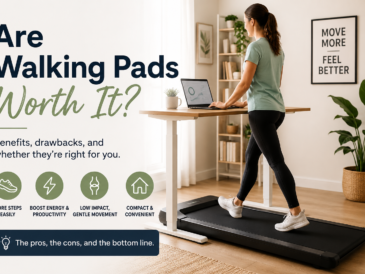
Both are observational studies, so they show association rather than proof that steps alone cause the benefit. Still, the message for tracker owners is reassuring: if you’re well below 7,000 steps, every extra thousand counts, and you don’t have to hit five figures for your walking to be worthwhile. For more on why walking matters, see this site’s post on the health benefits of walking. A walking pad under a standing desk is one practical way to add steps without finding extra time.
Smartwatch Heart Alerts: Useful, but Not a Diagnosis
Many smartwatches can now flag a possible irregular heart rhythm, most often atrial fibrillation (AF), which raises stroke risk. The largest test of this was the Apple Heart Study (Perez and colleagues, New England Journal of Medicine 2019), which enrolled 419,297 people.
- Only about 0.5% of participants got an irregular-pulse notification over a median of about four months. The rate was far higher in people over 65 (3.2%) than in people under 40 (0.16%).
- Of the notified people who later wore an ECG patch, AF showed up on the patch in 34%. AF comes and goes, so a clear patch doesn’t prove the alert was wrong.
- When the watch notified someone while they were wearing the patch at the same time, the patch confirmed AF in 84% of cases.
So an alert is worth taking seriously, especially if you’re older, but it’s a reason to see a doctor, not a diagnosis. The opposite is also true: a watch that never alerts you hasn’t ruled anything out. For what else affects heart risk, see this site’s heart health guide.
Sleep Trackers and “Orthosomnia”
Wearables are fairly good at telling whether you were asleep or awake, and they give a reasonable sense of how long you sleep across weeks. They are much weaker at splitting sleep into light, deep and REM stages, which is the part apps tend to highlight most.
Sleep researchers have also described a side effect. In a 2017 paper in the Journal of Clinical Sleep Medicine, Baron and colleagues coined the term “orthosomnia” for patients so focused on perfecting their tracker data that their sleep got worse. Some spent extra time in bed trying to raise their scores, which is the opposite of what sleep therapy recommends. The authors also stressed that consumer trackers can’t diagnose sleep apnoea.
If your sleep score makes you anxious, stop checking it for a while. How you feel during the day is a better guide. If you’re tired despite enough hours in bed, read this site’s post on sleep apnoea signs and talk to a doctor rather than trusting a sleep score. For how much sleep matters long-term, see sleep duration and longevity.
Smart Rings and Heart Rate Variability
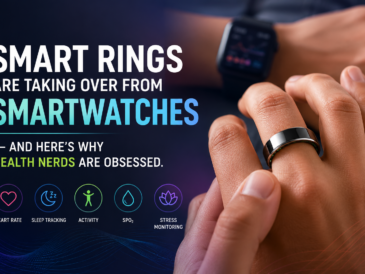
Smart rings such as the Oura Ring and Samsung Galaxy Ring track much the same things as a watch: heart rate, sleep, skin temperature and activity. Their main draw is comfort for wearing overnight, plus the “readiness” scores built largely on heart rate variability (HRV), the beat-to-beat variation in your heart rhythm. Lower-than-usual HRV often follows poor sleep, illness, alcohol or hard training.
HRV varies a lot from person to person, so comparing your number with someone else’s means little. What’s useful is your own trend over weeks. A single morning’s score is a nudge, not an instruction. Our smart rings post covers why people are switching from watches.
Home Blood Pressure Monitors: The Most Useful Gadget for Many People
For many adults, especially over 40, a home blood pressure monitor gives more health value per pound than any fitness tracker. High blood pressure usually causes no symptoms, and home readings catch what a single clinic visit can miss.
The important detail is accuracy. In the US, FDA clearance of a home blood pressure monitor doesn’t require proof of clinical accuracy. The American Medical Association runs a free list of devices that have been checked against accuracy standards at validatebp.org. Choose an upper-arm cuff from a validated list, and get the cuff size right. For how to take a reading and what the numbers mean, see this site’s blood pressure numbers guide.
Glucose Monitors Without Diabetes
Continuous glucose monitors (CGMs) used to need a prescription. In March 2024 the US FDA cleared the first over-the-counter CGM, Dexcom’s Stelo, for adults who don’t use insulin. That includes people without diabetes who want to see how food and exercise affect their blood sugar. The FDA was explicit that it is not designed for people with problematic low blood sugar, because it doesn’t alert to dangerous lows.
For people with diabetes, CGMs are a proven tool. For healthy people, the evidence that wearing one improves long-term health is much thinner. Normal glucose rises after meals, and seeing every spike can push people toward unnecessarily restrictive eating. If you try one, treat it as a short experiment to learn which meals affect you most, not as something to wear for life.
Health Apps
Your phone already counts steps, and free apps can log activity, food, weight and blood pressure readings. Apps don’t measure anything themselves. They’re only as good as the sensor or the data you type in. Their main value is the same as a tracker’s: they make habits visible. Our older roundup of Android health apps covers some options.
Who Should Be Careful With Tracking
- People with a history of eating disorders: calorie and weight numbers can feed unhealthy patterns, and calorie estimates are inaccurate anyway.
- People with health anxiety or insomnia: constant heart, sleep or glucose data can increase worry, as orthosomnia shows.
- Anyone tempted to self-diagnose: a watch, ring or app can prompt a conversation with a doctor, but it can’t rule a condition in or out.
Frequently Asked Questions
Are fitness trackers accurate?
For heart rate and step counts, mostly yes. A 2017 Stanford study found most wrist devices had under 5% heart-rate error in at least one setting. Calorie estimates are much less reliable: no device tested had an error below 20%, and some were off by about 90%.
Do fitness trackers help you lose weight?
Not by themselves. A 2022 umbrella review linked trackers to about 1 kg of weight loss on average, but the two-year IDEA trial found people given a wearable lost less weight (3.5 kg) than those on the same programme without one (5.9 kg).
How many steps a day do I really need?
Large meta-analyses suggest most of the benefit comes at around 7,000 steps a day. The benefit levelled off at about 6,000–8,000 steps for adults over 60 and 8,000–10,000 for younger adults. The 10,000-step target began as marketing.
Can a smartwatch detect atrial fibrillation?
It can flag a possible irregular rhythm. In the Apple Heart Study, an ECG patch confirmed AF in 84% of cases where the watch alerted while the patch was being worn. An alert is a reason to see a doctor, not a diagnosis, and no alert doesn’t rule AF out.
Are sleep trackers worth it?
They give a rough picture of how long you sleep over weeks but are weak at measuring sleep stages, and they can’t diagnose sleep apnoea. Some people become anxious about their scores (“orthosomnia”), so stop checking if it worries you.
The Bottom Line
- Trackers modestly increase activity, by about 1,800 steps a day on average, if you keep using them.
- Heart rate and steps are reasonably accurate. Calories burned are not, so don’t eat them back.
- About 7,000 steps a day captures most of the benefit seen in studies, and 10,000 isn’t a magic number.
- Smartwatch AF alerts are worth acting on, but only a doctor can confirm a diagnosis.
- Sleep scores are rough. If they cause anxiety, stop checking.
- A validated home blood pressure cuff is one of the most useful health gadgets for adults over 40.
Tracking is most useful as a tool for building habits that matter on their own: walking more, sleeping enough and keeping an eye on blood pressure. For the habits themselves, see this site’s guides to increasing your energy naturally and staying young.