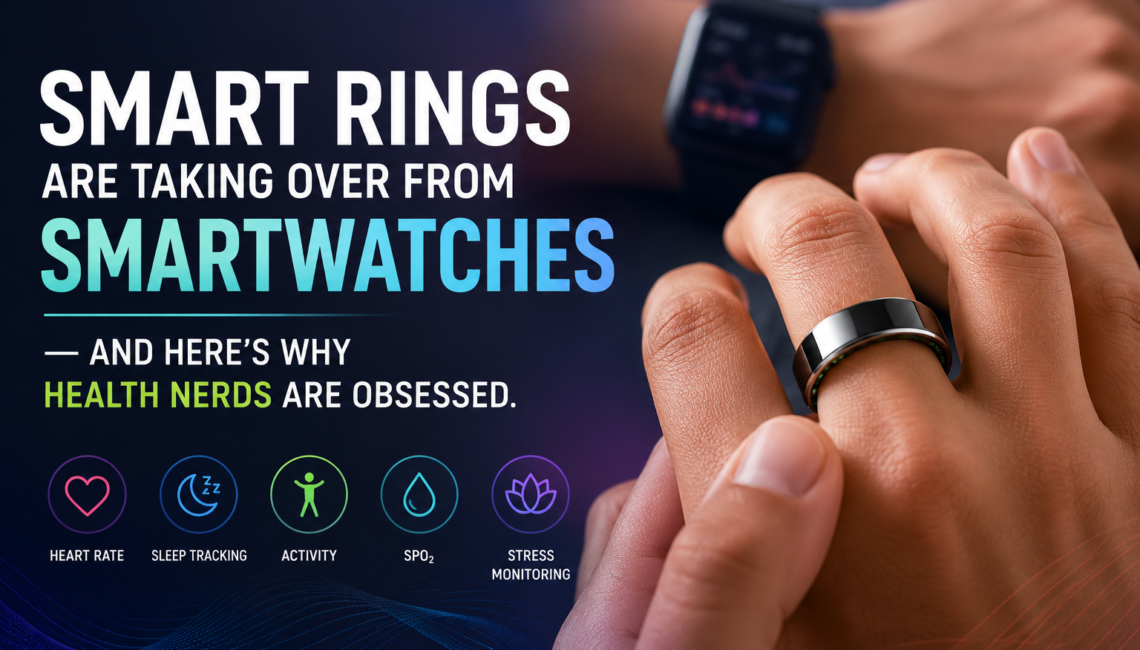
A couple of months ago, a friend showed me her finger. Not a ring in the traditional sense — it was slim, smooth, almost invisible. “That’s my health tracker,” she said. I’d been wearing a bulky smartwatch for three years and suddenly felt a little old-fashioned.
Smart rings have quietly become one of the most talked-about fitness gadgets of 2025. The Oura Ring 4, Samsung Galaxy Ring, and a handful of competitors are pulling people away from wrist-based trackers. And the more you look at what they actually measure, the more you understand why.
What a Smart Ring Tracks — And Why One Metric Matters More Than the Rest
The basics: continuous heart rate, blood oxygen, skin temperature, sleep stages, step count. Most serious fitness trackers cover those. But the reason people obsess over smart rings is HRV — heart rate variability.
HRV measures the tiny variation in time between each heartbeat. When those gaps vary a lot, your nervous system is relaxed and your body has recovered well. When they’re rigid and uniform, something is draining you — last night’s bad sleep, a workout you haven’t bounced back from, or accumulated stress. It sounds subtle, but once you start tracking it, you’ll be surprised how closely it matches how you actually feel.
The Oura Ring 4 built its whole product around turning HRV and other signals into a single “readiness score.” One number, every morning. Wake up, check it, decide whether to train hard or take it easy. Some people say it’s changed how they approach their entire week.
So here’s something worth sitting with: how often do you push through a workout your body clearly wasn’t ready for? That daily readiness score makes the guesswork disappear.
The Finger Knows What Your Wrist Doesn’t
Optical sensors have a placement problem. On your wrist, there’s bone, tendons, inconsistent skin contact — especially when you move. The finger, by contrast, is packed with capillaries and sits right against steady arterial blood flow. The signal is cleaner. Full stop.
This matters most during sleep. When you’re lying still, a smartwatch can slip, tilt, or lose contact with your skin. A ring stays snug. And since sleep quality is arguably the biggest recovery lever you have, getting accurate data there is worth paying for. Studies comparing smart ring sleep staging against clinical polysomnography — the lab gold standard — have found rings performing competitively, often better than wrist trackers. If you’ve ever had your Apple Watch declare it a “great sleep night” when you woke up feeling wrecked, you know exactly what I mean.
Nobody Talks About the Attention Thing
Smartwatches are notification machines. Even if you mute most alerts, the glance reflex is hard to kill. You look down. You check. Your attention fragments a little. Multiply that by 40 times a day. A ring has no screen. It doesn’t buzz. It just sits there, quietly collecting data, without asking anything from you.
People who make the switch often describe a shift in how they relate to health tracking. Instead of checking stats throughout the day, they look at the app once in the morning, absorb what it says, and get on with their lives. That’s a saner relationship with biometrics — use it as a signal, not a scoreboard.
There’s also the social dimension. A smart ring looks exactly like a regular ring. You can wear it to a formal dinner, a job interview, a wedding. A chunky fitness tracker on your wrist always looks slightly out of place in those settings.
Oura or Samsung — Which One Should You Actually Buy?
Here’s my honest take: if budget isn’t a hard constraint, start with the Oura Ring 4. It’s been refined over three hardware generations, the sleep algorithms are the best in class, and the app genuinely teaches you things about your body over time. It costs around $350 plus a $5.99/month subscription. Battery lasts 7–8 days. Yes, the ongoing subscription is annoying — but the depth of data analysis justifies it for most people who take recovery seriously.
The Samsung Galaxy Ring is worth considering if you’re deep in the Android ecosystem or the subscription model is a dealbreaker. No monthly fee, 6–7 day battery, solid Samsung Health integration. The catch is that the algorithms are newer and less proven than Oura’s, and it runs noticeably thicker on smaller finger sizes. It’s a good product — just not quite at the same level of analytical depth yet.
One practical tip before ordering either: use the free sizing kit. Both brands offer them. Getting the wrong ring size is the most common first-time mistake, and a loose fit ruins the sensor accuracy entirely.
One Honest Caveat Before You Spend the Money
Smart rings aren’t magic, and the data is worthless if you don’t act on it. If your readiness score is in the red and you train hard anyway because you “feel okay,” you’re paying $350 to ignore yourself. The real value builds slowly — sleeping earlier when recovery consistently dips, backing off intensity after a brutal week, noticing that your HRV tanks every time you have a drink on a weeknight.
Give it two weeks of actually listening to what the data says. See if it changes any decisions. That’s the real test — not the spec sheet, not the comparison chart.