A friend of mine, a senior product manager at a Bengaluru tech company, described her relationship with her phone like this: “It’s like having a boss who lives in my bedroom.” Her phone was on her nightstand. Slack notifications came through after midnight. She checked it before she was fully awake. She checked it during her child’s school concert. She checked it, sometimes, mid-conversation with her husband — then felt the immediate guilt of what that communicated to him.
She wasn’t unusual. She was representative of a generation of professionals for whom work has followed them home so thoroughly that home barely exists as a separate category anymore.
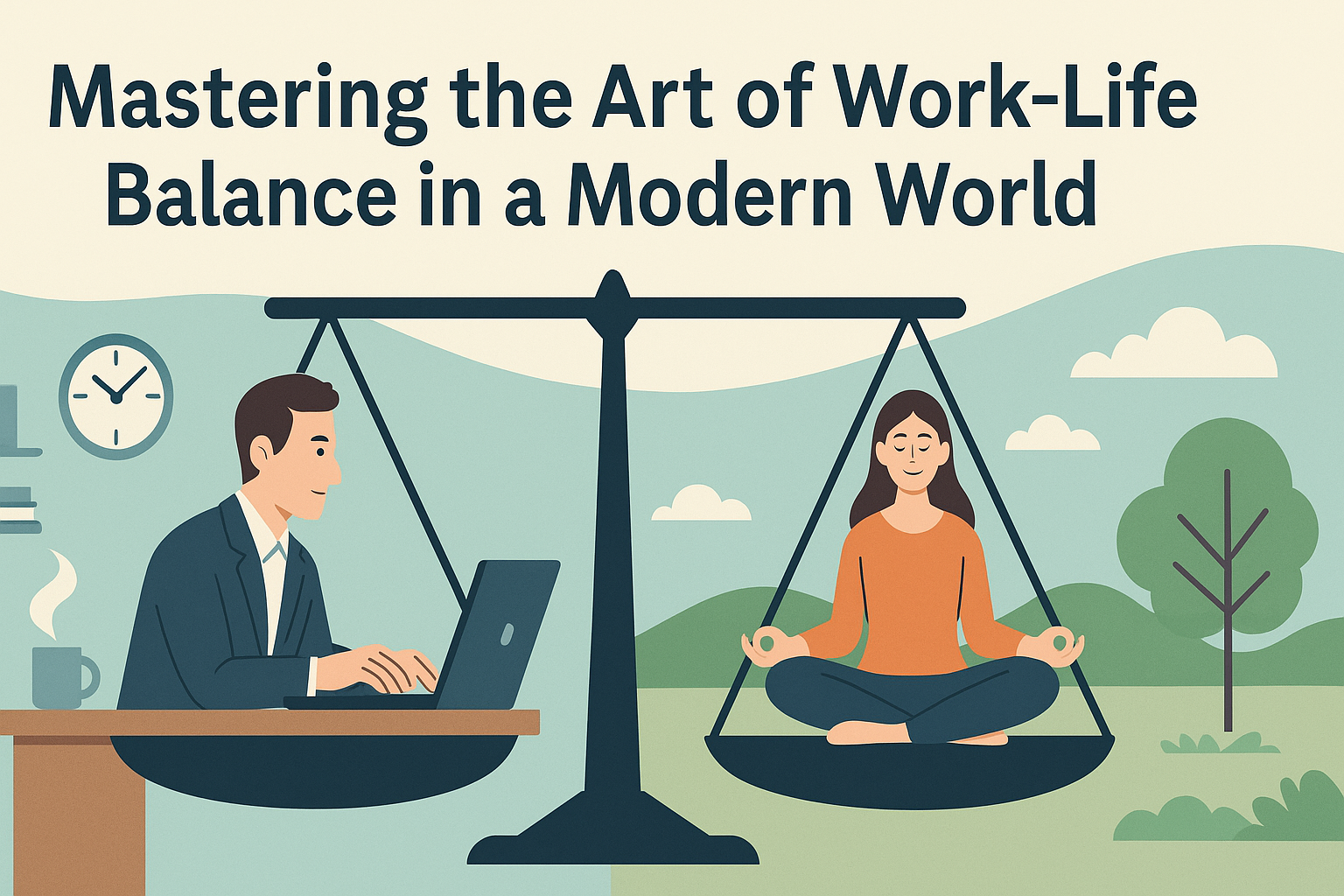
The modern work-life balance problem is genuinely different from what previous generations faced. It’s not just about hours — it’s about the collapse of psychological separation between work and personal life that smartphones and always-on digital communication have produced. Solving it requires strategies that match this specific problem.
What Changed (And When)
The smartphone arrived in mainstream consciousness around 2007-2010. By 2015, smartphone penetration among professionals was essentially complete. The same decade saw the rise of corporate messaging platforms (Slack, Teams, WhatsApp for business) that created an expectation of response availability that email had not previously produced. Email allowed asynchronous communication with an implicit norm of hours-long response windows. Messaging platforms collapsed that window to minutes — or less.
Simultaneously, open-plan offices and hot-desking replaced private offices and fixed desks, reducing physical boundaries at work. Remote work — accelerated explosively by COVID — eliminated the physical separation between work location and home location entirely for hundreds of millions of people.
The result: no physical separation, no temporal separation, no expectation of separation. Work is everywhere, always available, and the professional who is not available risks being seen as less committed than colleagues who are.
The Neuroscience of Why This Matters
The problem isn’t just philosophical or social. It’s physiological. Your nervous system requires genuine periods of deactivation — of not being on alert for professional demands — in order to recover its capacity for focused work, emotional regulation, and creative thinking.
The autonomic nervous system has two modes: sympathetic (alert, responsive, engaged — your “work state”) and parasympathetic (rest, repair, recovery — your “off state”). Good health and sustained performance require both, alternating regularly. Chronic sympathetic activation without adequate parasympathetic recovery produces burnout — which is not a moral failure or a sign of weakness, but a physiological depletion state with measurable biological markers.
A landmark 2006 study by Sonnentag and Bayer found that psychological detachment from work during off-hours — the ability to mentally disengage, not just physically leave — was the strongest predictor of next-day energy and engagement. Workers who couldn’t mentally detach during evenings came to work the next day more depleted than those who rested fully, regardless of how many hours they had slept.
Physical absence from the office is necessary but not sufficient for recovery. The phone in the bedroom is preventing the psychological detachment that physical rest requires to actually work.
The Myth of Always-On Performance
The implicit belief driving overwork culture is that more hours equal more output, and constant availability signals commitment. Both are demonstrably false at the level where sustained performance actually operates.
Anders Ericsson’s research on expert performance — which gave rise to the “10,000 hours” framework — found that elite performers across fields (musicians, athletes, chess players, surgeons) practiced intensely for 4-5 hours per day and then rested completely. They did not work more hours than near-elite performers; they worked more intensely during working periods and rested more completely during rest periods. The quality of focus, not the quantity of hours, determined performance.
Research on surgeon error rates, air traffic controller performance, and legal judgment quality all show that cognitive performance degrades significantly after 8-10 hours of sustained engagement, and that no amount of “pushing through” reverses this degradation — only rest does. The doctor making medical decisions at hour 14 of a shift is not equally capable to the doctor at hour 4, regardless of how motivated or experienced they are.
Reconstructing Separation in a Connected World
Boundaries in a smartphone world have to be actively constructed; they don’t arise naturally. Here’s what research and practical experience suggest actually works:
Technological Separation
The single most effective intervention my friend made was removing Slack from her personal phone and using it only on her laptop. Work could not follow her into her bedroom because the device that delivered it didn’t go there. She kept a separate on-call protocol for genuine emergencies — a specific phone number that colleagues could use for truly urgent situations — but eliminated the ambient availability that a work app on a personal device creates.
This physical-device separation — work apps on the work device, personal life on a personal device — recreates something like the old physical boundary between office and home. It’s not perfect, but it’s dramatically more effective than relying on willpower to not check messages that are already installed and buzzing on your phone.
Time Boundaries With Explicit Team Agreements
Individual boundary-setting in a work culture that doesn’t support it is exhausting and ultimately unsustainable. The most durable version is a team-level agreement: specific hours when messages are expected to be responded to, specific channels for urgent vs. non-urgent communication, and an explicit norm that off-hours messages don’t require off-hours responses.
If you’re in a position to influence these norms — whether as a manager or as someone who can model the behaviour you want to see — start there. Send messages during work hours. When you think of something at 11 PM, draft it but schedule the send for 9 AM. Signal clearly that you do not expect or appreciate off-hours responses to non-urgent matters.
Transition Rituals
For remote workers, the absence of a commute removes the natural transition time between work and personal life. Creating an artificial equivalent matters: a 20-minute walk at the end of the work day, a shower and change of clothes, a specific meal or drink that marks the end of work. The brain uses environmental and ritual cues to shift modes; without cues, it stays in work mode by default.
Protecting “Sacred” Personal Time
Identify one or two regular activities that are completely non-negotiable — a weekly dinner with your family, a Friday evening with friends, a Sunday morning yoga practice. Protect these with the same firmness as your most important work commitments. The practice of having inviolable personal commitments trains both your own psychology and your colleagues’ expectations about your availability.
The Indian Work Culture Specific Context
In India’s professional culture, particularly in large metros, the norms around after-hours availability vary enormously by industry, company, and individual manager. Some organisations — particularly multinationals with explicit wellness policies — have made genuine progress. Others remain cultures where the appearance of constant availability is equated with seriousness.
The additional layer in India: family obligations rarely stop at the door either. WhatsApp family groups, parental expectations, extended family dynamics — personal time in Indian urban life is often also highly managed rather than genuinely free. The “recovery time” that European work-life balance discussions assume exists in the personal sphere often doesn’t exist there either.
This means the stakes of protecting genuine downtime are actually higher for many Indian professionals — it requires navigating two sets of demands (work and family) rather than one. And it makes the deliberate construction of truly personal time — that daily practice that belongs only to you — not just a nice idea but a survival requirement.
Frequently Asked Questions
My company culture genuinely rewards constant availability. How do I navigate this without damaging my career?
This is real and not dismissible. In some cultures, setting work boundaries does carry career risk. The calculus has to include: what is the long-term cost to your performance and health of not setting boundaries? The research suggests that chronically overworked professionals decline in effectiveness over 2-5 years — which eventually shows up in their careers regardless of their availability. The strategic question is whether to accept short-term optics risk for long-term performance sustainability, or accept short-term performance boost for long-term burnout. Most people who’ve experienced burnout retrospectively wish they’d set earlier limits.
I’m a startup founder. Does work-life balance even apply?
Yes, though the constraints are different. Early-stage founding genuinely requires intense, sometimes unsustainable effort for defined periods. The key word is “defined.” Sprints with clear endpoints — launch, fundraising round, crisis — are manageable. Permanent sprint mode is not a mode; it’s a trajectory toward collapse. Even in intensive startup contexts, protecting sleep (absolute minimum), one genuine relationship, and some form of physical activity preserves the cognitive capacity that the work itself demands.
I’ve tried setting limits before and I always creep back. What actually makes it stick?
Willpower-based boundaries don’t stick because they require constant expenditure of a depleted resource. System-based boundaries stick because they don’t require willpower at the moment of decision. Remove the app. Set the autoresponder. Tell your team explicitly and in writing what your availability hours are. Make the boundary structural rather than psychological. The decision is made once; the structure maintains it without requiring you to re-decide every evening.
Recovery Is Strategy
My friend who described her phone as a boss in her bedroom made one structural change — the removal of Slack from her personal device — and within three weeks described a fundamental shift in how she felt at work and at home. She was the same person, doing the same job, with the same demands. The single change that restored a boundary did more than any stress management technique she’d tried.
Work-life balance in the modern world isn’t about finding some perfect equilibrium between professional and personal life. It’s about deliberately reconstructing the separations that technology has eroded — creating the conditions in which your brain and body can actually recover, so that the work you do during work time is done by a person who is genuinely capable of doing it well.
Rest is not the opposite of performance. It is the precondition for it.