Search this site for heart health and you’ll find eight separate posts written over nine years: exercises for a healthy heart, foods for your heart, seven steps, winter heart tips, a rainbow-diet piece, and more. Most are short and none link to each other. This guide pulls it together around one question: what does the evidence say actually protects your heart, and how do you tell whether you’re on track?
This is general information about cardiovascular risk factors from published research and major heart-health guidelines. It is not medical advice. If you have symptoms, a diagnosed heart condition, or take heart medication, talk to your doctor before changing your routine.
Why Heart Health Is Worth Getting Right
According to the World Health Organization, cardiovascular diseases are the leading cause of death worldwide. An estimated 17.9 million people died from them in 2019, about 32% of all deaths. More than four in five of those deaths were from heart attacks and strokes, and roughly a third happened before age 70.
The encouraging part comes from INTERHEART, a large case-control study published in The Lancet in 2004 that covered 52 countries. It found that nine potentially modifiable risk factors accounted for more than 90% of the risk of a first heart attack: abnormal blood lipids, smoking, high blood pressure, diabetes, abdominal obesity, psychosocial stress, low fruit and vegetable intake, alcohol intake, and lack of regular physical activity. The same factors applied in every region, ethnic group, and in both men and women. Genes and age still matter, but most heart attack risk comes from things you can measure and change.
The Framework: The American Heart Association’s “Life’s Essential 8”
In 2022 the American Heart Association (AHA) updated its definition of cardiovascular health in a presidential advisory published in Circulation. The framework, called Life’s Essential 8, scores cardiovascular health from 0 to 100 across eight measures:
- Four behaviours: diet, physical activity, nicotine exposure, and sleep
- Four health factors: body mass index, blood lipids (cholesterol), blood glucose, and blood pressure
Scores of 80 or above count as high cardiovascular health, 50–79 as moderate, and below 50 as low. The 2022 update added sleep, which the older “Life’s Simple 7” left out. The rest of this guide follows this structure, because it’s more useful than a list of “tips”: it tells you what to measure, not only what to do.
Movement: How Much Exercise Your Heart Actually Needs
The AHA recommends that adults get at least 150 minutes a week of moderate-intensity aerobic activity, or 75 minutes of vigorous activity (or a mix of the two), spread across the week. It also recommends muscle-strengthening work on at least two days a week. Going up to 300 minutes a week adds further benefit. The guidance also asks you to sit less, because even light activity offsets some of the harm of long sedentary stretches.
Moderate means you can talk but not sing, such as brisk walking or easy cycling. Vigorous means you can only say a few words before you need a breath. Both count. The research on cardiorespiratory fitness suggests that harder effort moves the needle further, which our VO2 max and exercise intensity guide covers in detail. If you’re starting from a low base, our zone 2 cardio explainer is a gentler place to begin. Our guide to the best exercise for heart health breaks down how much, what type, and what the trials show.
Diet: The Strongest Trial Evidence Points to a Mediterranean Pattern
Much heart-healthy eating advice is built on observational studies. One of the few large randomised trials is PREDIMED, which assigned 7,447 Spanish adults at high cardiovascular risk (aged 55–80) to a Mediterranean diet with extra-virgin olive oil, a Mediterranean diet with nuts, or a control diet that advised cutting fat.
PREDIMED also shows why honest reporting matters. The original 2013 paper in the New England Journal of Medicine was retracted in 2018 after irregularities were found in how some participants were randomised. It was then republished with corrected analyses. The results barely changed. Compared with the control group, major cardiovascular events (heart attack, stroke, or cardiovascular death) were about 31% lower in the olive-oil group (hazard ratio 0.69) and about 28% lower in the nuts group (hazard ratio 0.72).
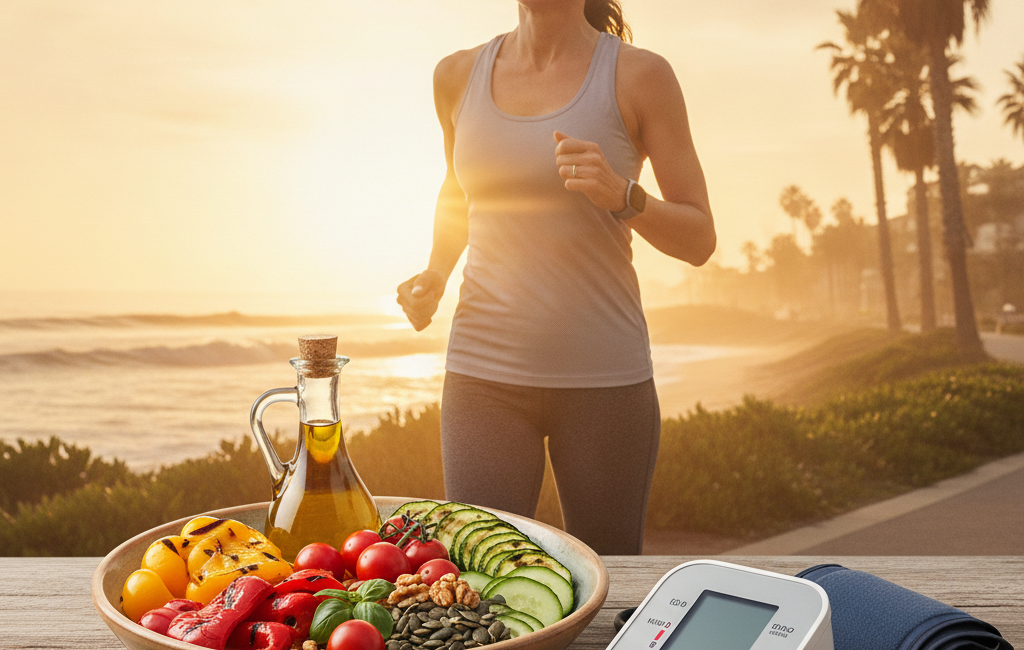
In practice, that means building meals around vegetables, fruit, legumes, whole grains, nuts, and olive oil. It also fits INTERHEART’s finding that low fruit and vegetable intake is one of the nine key risk factors. A spoke on which “heart-healthy foods” have real evidence behind them, and which don’t, is planned for this series.
Blood Pressure: The Silent Number to Know
High blood pressure usually causes no symptoms, which is why so many people don’t know they have it. In 2017, the American College of Cardiology and the AHA lowered the threshold for diagnosis. A reading of 130–139 systolic or 80–89 diastolic is now stage 1 hypertension, down from the older 140/90 cut-off. The guideline estimated that the change raised the share of US adults classed as hypertensive from about 32% to about 46%. The rise was sharpest in adults under 45.
The practical step is simple: get your blood pressure checked, and if it’s borderline, consider a validated home monitor so you see more than one clinic reading. A deeper guide to blood pressure, including how to measure it properly at home, is planned for this cluster.
Cholesterol and Blood Sugar: The Other Two Numbers
Abnormal blood lipids came out as one of the strongest risk factors in INTERHEART, and diabetes was on the same list. Both are in Life’s Essential 8 as “health factors” for a reason: you can’t feel them, and you only find out from a blood test. If you haven’t had a lipid panel and a fasting glucose or HbA1c test recently, ask your doctor what’s appropriate for your age and family history.
Sleep, Nicotine, and Stress
Sleep: Life’s Essential 8 gives full marks for 7–9 hours a night in adults. Points drop off in both directions, down to zero for under 4 hours. That fits the U-shaped relationship between sleep and mortality covered in our longevity habits guide, and in more depth in our sleep and longevity deep dive.
Nicotine: smoking was one of the two strongest risk factors in INTERHEART. The AHA framework scores “nicotine exposure” rather than only cigarettes, so vaping and second-hand smoke count too.
Stress: INTERHEART counted psychosocial stress among the nine key risk factors, which is easy to overlook next to diet and exercise. Social connection belongs here as well. Our guide to loneliness and longevity covers the research linking isolation to cardiovascular risk.
Know the Warning Signs
Prevention reduces risk but doesn’t remove it. Knowing the signs of a heart attack matters as much as any habit. Chest pain or pressure is the classic symptom. The American Heart Association notes that women are somewhat more likely than men to also have shortness of breath, nausea or vomiting, and back or jaw pain, symptoms that are easy to dismiss as flu, stress, or indigestion. If you suspect a heart attack, call emergency services immediately. Don’t wait to see if it passes.
Blockages can build silently for years before a first event. Our first-person story, what a father’s heart emergency taught us about silent heart blockage, covers how that can play out in real life. If you already have a heart condition, our guide to making a weak heart stronger covers lifestyle steps to discuss with your cardiologist.
A Simple Heart-Health Checklist
- Know your blood pressure, cholesterol, and blood glucose numbers, and re-check them as your doctor advises.
- Build up to at least 150 minutes of moderate (or 75 of vigorous) activity a week, plus strength work twice a week.
- Eat mostly vegetables, fruit, legumes, whole grains, nuts, and olive oil.
- Don’t smoke or vape, and avoid second-hand smoke.
- Aim for 7–9 hours of sleep.
- Take stress and social isolation seriously as risk factors.
- Learn the heart attack warning signs, including the less typical ones.
Frequently Asked Questions
What is the single best thing I can do for my heart?
There isn’t one. INTERHEART found that nine factors together explained over 90% of first heart attack risk, and smoking and abnormal blood lipids were among the strongest. If you smoke, stopping is the biggest single change. Otherwise, knowing your blood pressure and cholesterol numbers is the best starting point, because you can’t feel either.
How much exercise is enough for heart health?
The American Heart Association recommends at least 150 minutes of moderate-intensity or 75 minutes of vigorous aerobic activity a week, plus muscle strengthening on two or more days. More, up to 300 minutes, gives additional benefit, and any movement is better than none.
What blood pressure counts as high?
Under the 2017 ACC/AHA guideline, 130/80 mmHg or above counts as hypertension (stage 1 is 130–139 systolic or 80–89 diastolic). Some other countries’ guidelines still use 140/90, so ask your doctor which target applies to you.
Is the Mediterranean diet really proven for heart health?
It has stronger evidence than most diets. The PREDIMED trial was retracted and republished in 2018 after randomisation problems were found, and the corrected results still showed about 28–31% fewer major cardiovascular events with a Mediterranean diet plus olive oil or nuts, compared with a low-fat control diet. It was run in older Spanish adults at high cardiovascular risk, so the results may not carry over exactly to everyone.
Are heart attack symptoms different in women?
Chest pain or pressure is common in both sexes, but women are somewhat more likely to also have shortness of breath, nausea or vomiting, and back or jaw pain. Treat any of these as a possible emergency.