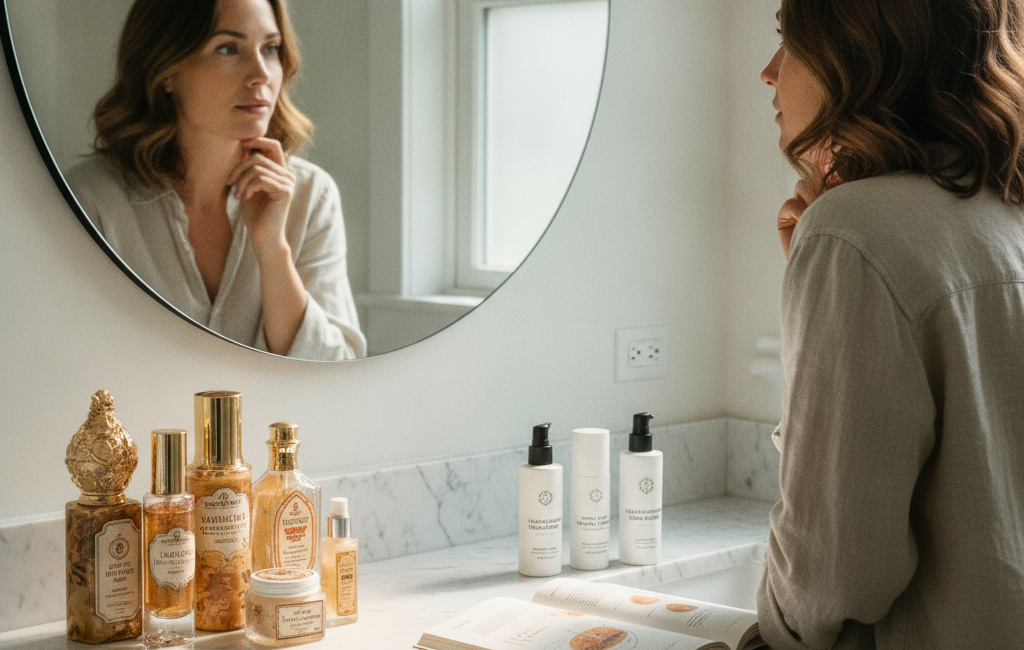
Search “anti-aging” and you’ll find a marketplace of miracle claims: creams that promise to erase decades, supplements that claim overnight results, and rituals passed around as fact simply because they sound plausible. Some of it is harmless. Some of it wastes money. And some of it — like skipping sunscreen on cloudy days — actively works against you.
This article is part of our complete guide to anti-aging. Below, we go through the most persistent anti-aging myths and check each one against what the evidence actually says.
Not medical advice — for concerns about your skin or a diagnosed condition, talk to a dermatologist.
Myth 1: Expensive products work better than affordable ones
Price is a marketing lever, not a formulation guarantee. What actually determines whether a product does anything is its active ingredients and their concentration — a $12 moisturizer with a well-formulated retinoid or a stable vitamin C derivative can outperform a $150 jar with the same active at a token concentration, or none at all. Packaging, brand story, and celebrity endorsement add cost without adding efficacy. Before buying based on price, check the ingredient list for actives with actual evidence behind them (retinoids, vitamin C, niacinamide, sunscreen filters) — see our anti-aging skincare routine guide for what those look like in practice.
Myth 2: You can reverse wrinkles that have already formed
This is the claim behind most “turn back time” marketing, and it overstates what topical products can do. Fine lines caused by dehydration or loss of surface elasticity can visibly soften with consistent use of the right actives. But deep, static wrinkles — creases that are visible even when your face is relaxed — form from structural changes in the dermis (collagen and elastin breakdown) that a cream applied to the surface cannot rebuild on its own. Ingredients like retinoids can stimulate new collagen production over months of consistent use, which is genuinely useful for prevention and gradual improvement, but that’s a different claim than “reversal,” and it doesn’t undo deep, established wrinkles the way a procedure like fillers or lasers can.
Myth 3: Anti-aging skincare should start in your 40s
By the time visible signs of aging show up, the underlying damage — much of it from cumulative sun exposure — has usually been building for decades. Dermatologists generally recommend starting sun protection and a basic preventive routine in your 20s, not because you’ll look old at 25 without it, but because prevention is dramatically more effective than correction. Waiting until wrinkles are visible means you’re managing damage that’s already been done rather than avoiding it in the first place.
Myth 4: “Natural” or “organic” ingredients are automatically safer or more effective
Natural and synthetic are not proxies for safe and effective. Plenty of natural plant extracts are potent irritants or allergens (certain essential oils, for instance), while some of the most well-studied and effective anti-aging ingredients — retinoids, synthesized vitamin C derivatives, peptides — are lab-made precisely because that makes them more stable and better-absorbed than their natural counterparts. The relevant question for any ingredient is “what evidence exists for this, at what concentration, in what formulation” — not whether it originated in a plant or a lab.
Myth 5: Sun protection only matters on sunny days at the beach
This is one of the most consequential myths because it undoes prevention efforts elsewhere. UV-A rays, the wavelength primarily responsible for photoaging (as opposed to sunburn), penetrate clouds and window glass, and are present year-round, not just in summer. A landmark study of nearly 300 women found that cumulative sun exposure — not chronological age alone — was strongly linked to visible signs of aging like wrinkles, texture changes, and pigmentation (Flament et al., 2013, Clinical, Cosmetic and Investigational Dermatology). We cover the mechanics of this in detail, including a randomized controlled trial showing measurably less photoaging in people who used sunscreen daily, in our sun protection and photoaging guide. The short version: daily sunscreen, indoors and out, cloudy or not, is the single highest-leverage anti-aging habit that exists.
Myth 6: Drinking more water will plump out your wrinkles
Hydration matters for overall skin health, and chronic dehydration can make skin look duller and fine lines more pronounced. But drinking extra water beyond what your body needs doesn’t get routed specifically to your skin, and it won’t smooth out wrinkles that are caused by structural collagen loss rather than surface dehydration. If your skin looks dehydrated, a topical humectant (like a hyaluronic acid serum) that holds water in the skin barrier will do more than an extra liter of water a day.
Myth 7: Retinoids thin and damage your skin over time
This myth usually comes from real but temporary experience: retinoids can cause peeling, redness, and sensitivity during the first few weeks of use, which looks and feels like “thinning” or irritation. But the actual, well-documented long-term effect is the opposite — retinoids increase collagen production and epidermal turnover, which thickens the functional layers of skin over sustained use rather than thinning them. The initial irritation is a real reason to start slow (a few nights a week, buffered with moisturizer) — not a reason to avoid retinoids altogether.
Myth 8: Collagen supplements will fix your skin fast
Collagen supplement marketing often implies near-immediate visible results. The actual evidence is more measured: some studies show modest improvements in skin elasticity and hydration after consistent use over 8-12 weeks, but the effect size is nowhere near what topical retinoids or sunscreen deliver, and a meaningful share of the supporting research has been industry-funded, which is worth factoring into how much weight you give it. Diet-based collagen support (vitamin C, protein, and specific food sources) and supplement evidence are covered in more depth in our anti-aging supplements guide and foods that boost collagen guide.
Myth 9: Genetics determine everything, so lifestyle doesn’t matter
Genetics do set a baseline, but the research consistently shows environmental and lifestyle factors — sun exposure chief among them — explain a large share of visible aging, not chronological age or genetics alone. That same Flament et al. (2013) study found that pigmentation issues in particular tracked much more closely with cumulative UV exposure than with age. Sleep quality plays a measurable role too — we go into the mechanism in our sleep and skin aging guide. The practical takeaway: you don’t control your genes, but you control a surprisingly large share of the inputs that determine how those genes get expressed on your skin.
FAQ
What’s the one anti-aging myth worth caring about most?
Skipping daily sunscreen because it’s cloudy or you’re indoors. Of all the myths here, this is the one with the largest measurable cost, because UV exposure is the single biggest driver of preventable visible skin aging.
Are expensive anti-aging products ever worth it?
Sometimes — but the price itself isn’t the signal. Check for the same evidence-backed actives (retinoids, vitamin C, sunscreen filters, niacinamide) at a meaningful concentration, whether the product is $15 or $150.
Is it too late to start an anti-aging routine in your 50s or 60s?
No. Prevention is most effective when started early, but sun protection and evidence-backed actives like retinoids continue to provide benefit at any age — they slow further damage and can still improve texture and tone, even if they can’t undo decades of prior sun exposure.
Every myth on this list traces back to the same principle: the products and habits that actually move the needle are the boring, well-evidenced ones — daily sunscreen, a consistent routine with proven actives, decent sleep — not the ones with the most dramatic marketing claims.