Vitamin D and iron get most of the attention when hair loss and nutrition come up, and for good reason — they’re the two most common deficiencies behind diffuse thinning. But they’re not the only ones. Protein and zinc both play a direct, well-documented role in hair growth, and deficiencies in either can trigger the same kind of diffuse shedding as low iron or low vitamin D. This is part of our complete guide to hair growth and hair loss.
Protein: the raw material hair is built from
Hair shaft is almost entirely keratin, a protein — so when the body doesn’t get enough protein or amino acids, hair growth is one of the first non-essential processes it deprioritizes. This isn’t a fringe idea: acute telogen effluvium (a sudden, diffuse shedding phase) is a well-recognized consequence of crash dieting, severe calorie restriction, or bariatric surgery, all of which sharply cut protein intake at the same time.
A widely cited 2017 review in Dermatology Practical & Concept by Guo and Katta on diet and hair loss lays out the mechanism: when dietary protein is inadequate, the body shifts amino acids away from hair follicles (a genuinely non-essential tissue, biologically speaking) toward organs it needs to keep running. The result, typically appearing 2-4 months after the dietary restriction started, is the same kind of diffuse telogen shedding covered in our postpartum and stress-related hair loss article — a large fraction of hairs shifting into the shedding phase at once.
The practical implication isn’t “eat more protein than you need” — there’s no good evidence that excess protein beyond what the body uses helps hair grow faster. It’s specifically about avoiding a deficit: very low-protein diets, extreme calorie restriction, or heavily restrictive vegan/vegetarian diets that don’t plan for adequate protein and the amino acids that come with it are the actual risk factor.
Zinc: less common than iron deficiency, but backed by real trial data
Zinc deficiency’s link to hair loss has more direct clinical evidence behind it than most nutrient-hair claims. Zinc is required for hair follicle protein synthesis and helps hair follicles cycle properly between growth and rest phases — when levels drop, follicles cycle out of the growth phase early.
Multiple studies have found significantly lower serum zinc levels in people with hair loss compared to controls, with the pattern strongest in telogen effluvium specifically. One case-control study found severe zinc deficiency in close to 10% of people with hair loss versus none of the controls, with mild-to-moderate deficiency far more common in the hair loss group as well.
The stronger evidence, though, is a small but real intervention study: Karashima and colleagues, published in Dermatologic Therapy in 2012, gave oral zinc (as polaprezinc) to five patients with confirmed zinc deficiency and telogen effluvium. All five improved. It’s a small trial — five patients — but it’s a rare case of an actual before/after intervention result for a hair-loss nutrient claim, rather than just an association between low levels and shedding.
The zinc caveat: more is not better, and excess has a real downside
Unlike vitamin D, zinc has a narrow safety margin, and this is the part supplement marketing tends to skip. The tolerable upper intake level for adults is 40 mg/day (FDA) to 25 mg/day (the more conservative European Food Safety Authority figure) — and sustained intake above that range is a documented cause of copper deficiency, because excess zinc competes with copper for absorption in the gut. Zinc-induced copper deficiency can itself cause anemia and, in more severe or prolonged cases, neurological problems — a reminder that with hair-loss supplements generally, a nutrient that helps at a deficiency-correcting dose can cause a different problem entirely at a much higher one.
The sensible approach mirrors what we recommend for iron and vitamin D: get zinc levels tested before supplementing at anything beyond a standard multivitamin dose, rather than assuming more is better.
Other deficiencies worth knowing about
- Essential fatty acids (omega-3 and omega-6) — some evidence links very low intake to hair thinning and a dull, brittle hair shaft, though the trial evidence is weaker than for zinc or iron.
- Selenium — both deficiency and excess have been associated with hair loss; this is a case where a doctor-ordered test matters more than guessing, since supplementing blind carries real risk in either direction.
- L-lysine, an essential amino acid — a 2002 study by Rushton and colleagues found that in women with zinc-deficient, iron-deficient hair loss, adding L-lysine (1-1.5g daily) alongside iron supplementation improved outcomes more than iron alone; in one cohort of 22 women given iron plus L-lysine, the proportion of hairs in the shedding (telogen) phase dropped from 19.5% to 11.3% over six months. The proposed mechanism is that lysine improves the body’s uptake of iron and zinc rather than acting independently.
Getting enough without guessing
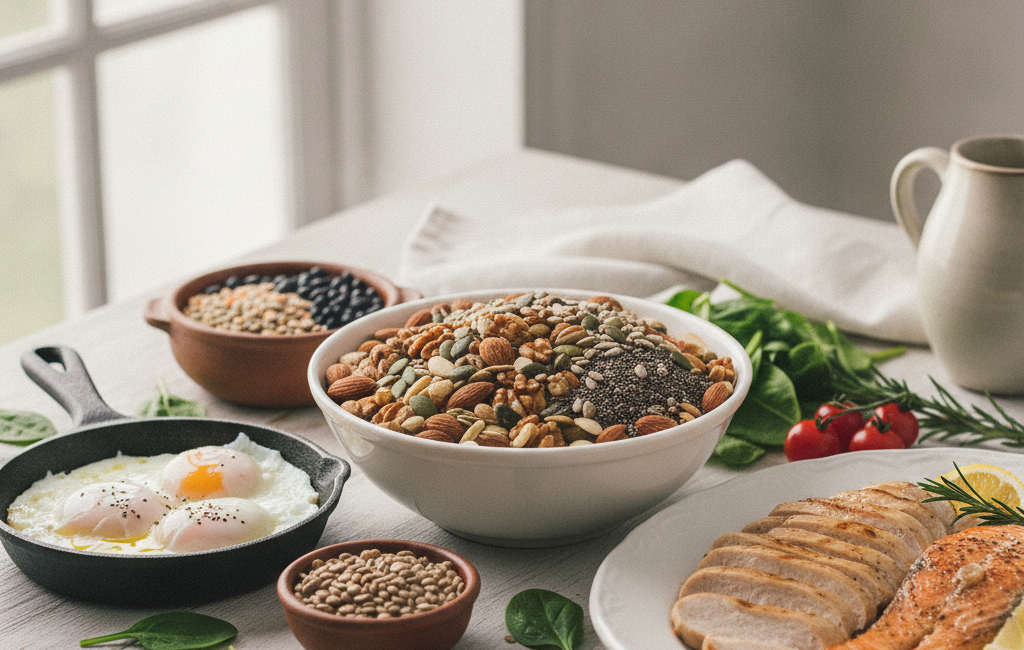
For most people who eat a varied, non-restrictive diet, neither protein nor zinc deficiency is likely — these are more relevant if you’re on a heavily restricted diet, recovering from illness or surgery, or have a condition (like inflammatory bowel disease) that affects absorption. Good dietary sources of both overlap heavily: meat, poultry, fish, eggs, and dairy provide both complete protein and well-absorbed zinc, while legumes, nuts, seeds, and whole grains provide meaningful amounts of each, though the zinc in plant sources is less bioavailable because of phytates that bind it. This is one reason vegetarians and vegans are sometimes advised to aim somewhat higher than the standard recommended intake for zinc specifically.
A rough general benchmark cited in nutrition literature is 0.8g of protein per kilogram of body weight per day for a sedentary adult, with higher needs during recovery from illness, pregnancy, or significant physical activity — though this is a general nutrition guideline, not a hair-specific one, and isn’t a substitute for individualized medical advice.
What this means in practice
None of this is a case for supplementing broadly “just in case.” The evidence for protein, zinc, and these secondary nutrients supports the same pattern we’ve seen throughout this cluster: correcting an actual, confirmed deficiency helps; supplementing without one usually doesn’t, and for zinc specifically, high-dose self-supplementation carries a real downside. If you’re dealing with diffuse shedding, the reasonable first steps are the ones covered across this guide — confirm ferritin, vitamin D, and thyroid function (see our vitamin D and iron deficiency articles), and ask a doctor whether zinc and a broader nutritional review make sense given your specific diet and symptoms.
Frequently Asked Questions
Can eating more protein regrow hair if I’m not actually deficient?
No — the evidence supports correcting an actual protein deficit, not exceeding normal protein needs. If your diet already has adequate protein, adding more has no established benefit for hair growth.
How much zinc is safe to take for hair loss?
Stay within standard multivitamin-level doses unless a doctor has confirmed a deficiency and is guiding a higher, time-limited dose. Sustained intake above 25-40 mg/day (adult upper limit) risks copper deficiency, which can cause its own problems including anemia.
How would I know if I’m protein or zinc deficient rather than iron or vitamin D deficient?
Diffuse shedding can look identical regardless of the underlying nutrient, which is exactly why guessing and self-supplementing isn’t a reliable approach. A doctor can order zinc levels alongside the ferritin, vitamin D, and thyroid panel typically used to investigate hair loss.
Is a vegetarian or vegan diet a risk factor here?
It can be, mainly if protein and zinc intake aren’t specifically planned for — plant sources of both exist (legumes, tofu, nuts, seeds, whole grains) but are generally less bioavailable than animal sources, so people on restrictive diets are somewhat more likely to run low without deliberate attention to intake.
This article is for general information and isn’t medical advice. Talk to a doctor before starting or stopping any supplement, and especially before taking zinc above standard multivitamin doses.