Your watch says you walked 9,412 steps, burned 2,640 calories, slept 7 hours 12 minutes with 1 hour 38 minutes of deep sleep, and had a resting heart rate of 61. Those numbers look precise, but they aren’t all equally trustworthy. Some are close to what a lab would measure. Others can be off by a third or more. This article goes through what validation studies have found for each number a fitness tracker gives you, why some are much worse than others, and how to use the data without being misled by it.
This article is part of our complete guide to fitness trackers and health gadgets, which covers what the evidence says each type of device is good for. It’s general information from published research, not medical advice.
The Short Answer
Ranked roughly from most to least reliable, based on the studies below:
- Steps: usually close during normal walking, less so at slow speeds or when your arms aren’t swinging.
- Heart rate: good at rest, a bit worse during exercise, and worst during activities with lots of wrist movement.
- Total sleep time: a reasonable estimate over weeks, but weak at telling quiet wakefulness from sleep.
- Calories burned: the least reliable number on the screen. Errors of 20% or more are normal.
Researchers keep finding the same pattern across brands and years, even as the hardware improves.
How Researchers Test a Tracker
To check a tracker, researchers compare it with a “criterion” measure, the best available reference. For heart rate that’s an electrocardiogram (ECG) or a chest strap. For steps it’s a person counting steps directly, often from video. For calories it’s indirect calorimetry, which measures oxygen used and carbon dioxide breathed out through a mask, or a technique called doubly labelled water over longer periods. For sleep it’s polysomnography in a sleep lab.
Two things are worth knowing before you read any accuracy claim. First, most tests happen in a lab, on a treadmill or exercise bike, which is easier for a device than real life. Second, manufacturers update their algorithms often, so a study of last year’s model isn’t a perfect guide to this year’s. What tends to stay the same is which measurements are hard.
Steps: Mostly Good, With Known Weak Spots
Step counting is the oldest and best-tested tracker feature. A 2020 systematic review in JMIR mHealth and uHealth by Fuller and colleagues looked at 158 publications covering nine brands. It concluded that commercial wearables measure steps and heart rate accurately in laboratory settings, though accuracy varies by manufacturer and device type. Fitbit, Apple Watch and Samsung did well for steps in the lab.
An earlier review that looked only at Fitbit devices (Feehan and colleagues, JMIR mHealth and uHealth 2018, 67 studies) gives a more detailed picture. Step counts were accurate in roughly half of the tests. In controlled tests, the devices tended to undercount steps. In everyday life, they tended to overcount them, probably because some arm movements that aren’t steps get counted. Accuracy also depended on where the device was worn and how fast people walked.
Slow walking is the best-documented weak spot. Studies in older adults have repeatedly found that wrist and waist trackers miss more steps at slow walking speeds. The device relies on movement of a certain size and rhythm, and short, slow steps can fall below that threshold. This matters if you use a walking aid, push a pram or shopping trolley, or hold a treadmill handrail, all of which reduce arm swing at the wrist.
In practice, steps are good enough for what most people use them for: seeing whether today was more or less active than usual. A few hundred steps either way doesn’t change anything. For how many steps the research suggests you actually need, see the steps section of our tracker guide. If you’re trying to add steps without finding extra time, a walking pad is one option. Walking at a steady pace without holding the rails also gives a wrist tracker its best chance of counting accurately.
Heart Rate: Good at Rest, Weaker When You Move
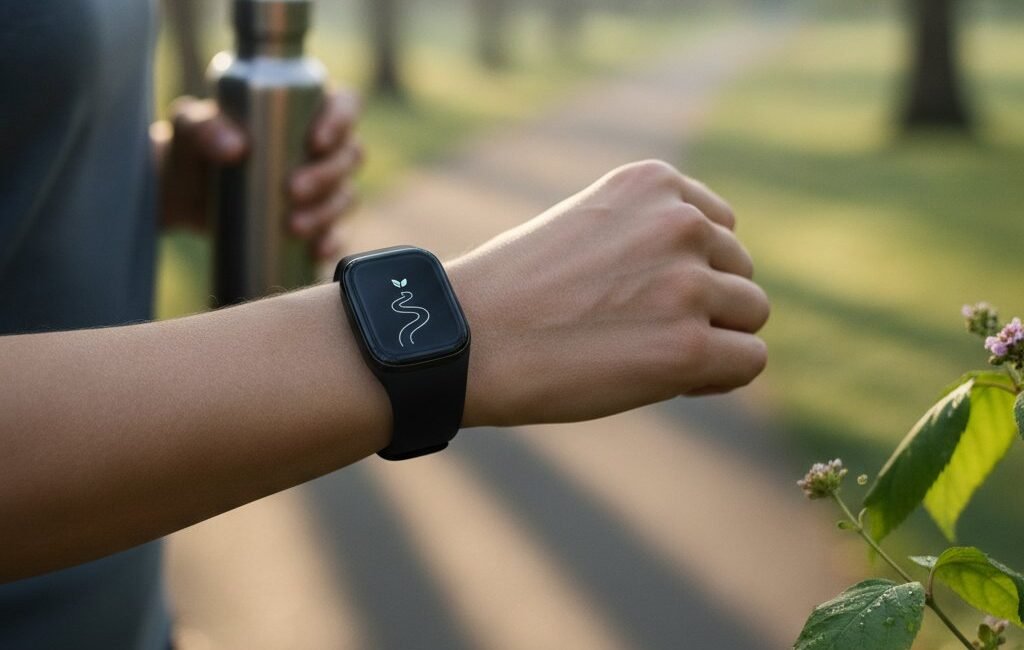
Wrist trackers measure heart rate with photoplethysmography (PPG): small green lights shine into your skin, and a sensor picks up tiny changes in how much light is absorbed as blood pulses through. It’s clever, but it’s sensitive to movement, because a sliding watch changes the light path too.
A 2017 Stanford study in the Journal of Personalized Medicine (Shcherbina and colleagues) tested seven wrist devices on 60 volunteers against ECG. Six of the seven had a median heart-rate error under 5% in at least one setting, and the best, the Apple Watch, had about 2% error.
A 2020 Duke University study in npj Digital Medicine (Bent and colleagues) tested six consumer and research wearables, including Apple Watch, Fitbit, Garmin and Xiaomi devices, against ECG while people sat, breathed deeply, walked and typed. Readings were more accurate at rest than during activity. Walking tended to push readings above the true heart rate, and typing tended to push them below it. Typing is a good example of why: it moves the wrist a lot while the heart barely changes.
In practice:
- Resting heart rate and overnight trends are the most reliable heart data a tracker gives you. A resting rate that’s clearly higher than your usual for several days is worth noticing.
- Heart rate during steady cardio such as running or cycling is usually close enough for training zones.
- Heart rate during weights, boxing, rowing or anything with gripping and wrist flexing is less reliable. A chest strap is more accurate if those numbers matter to you.
- Wearing the device snugly, a finger’s width above the wrist bone, reduces movement errors.
Does skin tone affect accuracy?
The evidence is mixed. In the Stanford study, error was higher in people with darker skin. The Duke study, which was designed to test this question, found no significant difference in accuracy across skin tones. Other researchers criticised the Duke study because only a small number of participants had the darkest skin tones, and because the scale used to classify skin tone is subjective. The authors defended their design. The honest summary is that this hasn’t been settled. Movement during exercise is a better-established source of error than skin tone. Light passes through darker skin differently, so the question is a reasonable one to keep studying.
Calories Burned: The Number to Trust Least
Calorie estimates are where trackers struggle most, and the studies agree on this.
- In the Stanford study, no device had an energy-expenditure error below 20%. Median errors ranged from about 27% for the best device to about 93% for the worst.
- The Fitbit review (Feehan 2018) found energy expenditure was inaccurate across all conditions tested.
- A 2020 meta-analysis in the British Journal of Sports Medicine (O’Driscoll and colleagues) pooled 60 studies of 41 wrist- and arm-worn devices. On average, the devices underestimated energy expenditure, accuracy varied with the type of activity, and adding physiological sensors such as heart rate improved the estimates.
The reason is simple: a tracker doesn’t measure calories at all. It estimates them from your movement, heart rate, and the age, sex, height and weight you entered, using a formula built on averages. Two people with the same heart rate and steps can burn quite different amounts of energy, depending on fitness, body composition and how efficiently they move. The device has no way to know which one you are. Errors in either direction are common, and the same device can overestimate one activity and underestimate another.
The practical risk is “eating back” exercise calories. If your watch says you burned 600 calories on a run and the true figure was 400, eating the difference can erase the calorie deficit you were aiming for. This is one possible explanation for the IDEA trial, discussed in our tracker guide, in which people given a wearable lost less weight over two years than people who weren’t. Use the calorie number, if at all, to compare one day with another on the same device, never as a figure to add to your food budget. For the exercise side of energy, see our guide to low-intensity exercise, which doesn’t depend on burning a particular number.
Sleep: Duration Is Fair, Stages Are Rough
Trackers estimate sleep from movement and heart rate. The Fitbit review found sleep measures were comparable to research-grade accelerometers, which is reasonable for total time asleep. The common error is counting time lying still awake as sleep, so people with insomnia may see more sleep than they actually got.
Splitting sleep into light, deep and REM stages properly requires brain-wave recordings (EEG), which a wrist or finger device can’t do. The stage breakdown is an estimate from indirect signals. Look at your average total sleep across a week rather than any single night’s deep-sleep figure. A tracker also can’t diagnose sleep apnoea. If you’re tired despite enough time in bed, read our post on sleep apnoea signs and talk to a doctor. Smart rings are comfortable to wear at night, but they rely on the same kinds of sensors and have the same basic limits.
How to Get the Most Accurate Data From Your Tracker
- Enter your details correctly, especially weight, and update them when they change. Calorie and some fitness estimates depend on them.
- Wear it snugly, slightly above the wrist bone, and tighten it a notch for workouts.
- Use a chest strap for heart rate if you train with intervals, weights or rowing and care about the numbers.
- Stick with one device. Different brands use different algorithms, so switching devices can create jumps in your data that didn’t happen in your body.
- Watch trends, not single readings. A week’s average is far more reliable than one day.
- Don’t use it for medical decisions. Unusual heart, sleep or blood pressure readings are a reason to talk to a doctor, who can measure them properly.
Frequently Asked Questions
Are fitness trackers accurate for steps?
Mostly, during normal walking. Systematic reviews find good step accuracy in lab tests, though trackers tend to undercount at slow walking speeds and can overcount arm movements in daily life. They’re accurate enough to compare one day’s activity with another.
How accurate is fitness tracker heart rate?
Good at rest and during steady cardio. In a 2017 Stanford study, six of seven wrist devices had under 5% median error in at least one setting. Accuracy drops during activities with lots of wrist movement, where a chest strap is more reliable.
Are calories burned on a fitness tracker accurate?
No. This is the least reliable tracker measurement. In the Stanford study, no device had an energy-expenditure error below 20%, and a 2020 meta-analysis of 41 devices found they underestimated on average, with accuracy varying by activity. Don’t eat back the calories your tracker reports.
Does skin tone affect fitness tracker accuracy?
The evidence is mixed. One 2017 study found higher heart-rate error in people with darker skin, while a 2020 study designed to test this found no significant difference. That study was criticised for having few participants with the darkest skin tones, so the question isn’t settled.
Which fitness tracker is most accurate?
In the 2017 Stanford study, the Apple Watch had the lowest heart-rate error, and a 2020 review found Fitbit, Apple Watch and Samsung counted steps accurately in the lab. But rankings change as models and software are updated. For most people, wearing any reputable device consistently and watching trends matters more than the brand.
The Bottom Line
- Steps and resting heart rate are the most trustworthy numbers a tracker gives you.
- Heart rate gets less reliable as wrist movement increases. Use a chest strap if exercise heart rate matters to you.
- Total sleep time is a fair weekly estimate. Sleep stages are rough.
- Calories burned are estimates with errors of 20% or more, so never eat them back.
- Trends over weeks on the same device are more meaningful than any single reading.
A tracker is most useful as a mirror for your habits rather than a precision instrument. For what each kind of health gadget is actually worth, from smartwatches to blood pressure cuffs, see our full guide to fitness trackers and health gadgets.