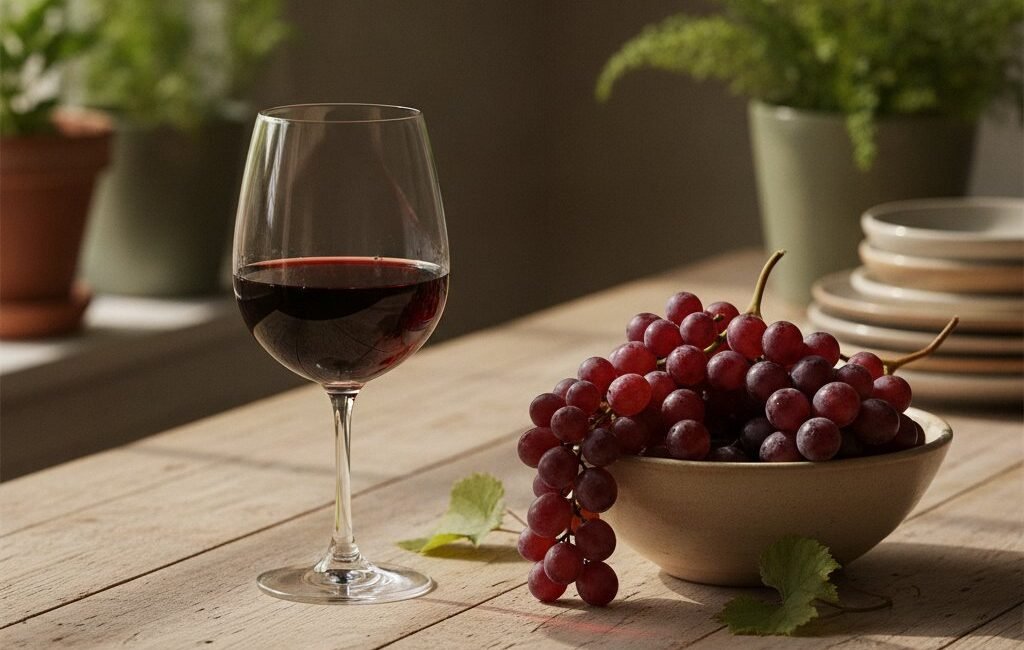
For more than 30 years, a glass of red wine with dinner has been sold as a heart-healthy habit. It’s an appealing idea, and it came from real research. But over the last decade, better-designed studies have chipped away at it. So is red wine good for your heart, or did the original research get it wrong?
This article is part of our evidence-based guide to healthy drinks. Below we look at where the red wine idea came from, the problems researchers later found with it, what newer genetic and trial evidence shows, and what that means if you drink. It is general information, not medical advice.
Where the “Red Wine Is Good for Your Heart” Idea Came From
In 1992, French researchers Serge Renaud and Michel de Lorgeril published a paper in The Lancet on what became known as the French paradox. People in France ate a diet high in saturated fat, yet died of coronary heart disease at relatively low rates. Renaud and de Lorgeril suggested wine was part of the explanation. They estimated that drinking at French levels, about 20 to 30 g of alcohol a day, could cut coronary heart disease risk by at least 40%, possibly by making blood platelets less sticky.
The idea reached a mass audience the year before, when the US TV programme 60 Minutes ran a segment crediting red wine for the paradox. That broadcast is widely credited with boosting US red wine sales.
Over the following years, many observational studies seemed to back it up. When researchers plotted alcohol intake against heart disease or death rates, they often found a “J-shaped curve”: light drinkers did better than non-drinkers, and heavy drinkers did worse than both. A glass a day looked like the sweet spot.
The Problem: Who Were the Non-Drinkers?
The J-shaped curve depends entirely on who is in the “non-drinker” comparison group. In many older studies, that group included former drinkers: people who had stopped because of illness, medication, or past alcohol problems. Comparing light drinkers with a group that includes sick people who quit makes light drinking look protective, even if it isn’t. Researchers call this the “sick quitter” or abstainer bias.
In 2016, Tim Stockwell and colleagues tested how much this mattered. Their meta-analysis in the Journal of Studies on Alcohol and Drugs pooled 87 studies on alcohol and death from any cause. Taken at face value, the data reproduced the familiar curve: low-volume drinkers had about a 14% lower risk of death. But only 13 of the 87 studies avoided mixing former drinkers or occasional drinkers into the non-drinker group, and those studies showed no health benefit from low-volume drinking. After adjusting for study design, the benefit disappeared.
A larger 2023 update by Jinhui Zhao and colleagues in JAMA Network Open covered 107 cohort studies with about 4.8 million participants and 425,564 deaths. The authors noted that 86 of the 107 studies misclassified some former or occasional drinkers as lifelong abstainers. After correcting for this and for study quality, people drinking under about 25 g of alcohol a day had no lower risk of death than lifelong non-drinkers. Risk rose at higher intakes, and the rise started at lower amounts for women than for men.
For reference, the US National Institute on Alcohol Abuse and Alcoholism (NIAAA) defines a standard drink as 14 g of alcohol, roughly a 150 ml (5 oz) glass of 12% wine. Many restaurant pours are larger.
What Genetic Studies Show
Observational studies can never fully separate the effect of alcohol from everything else about the people who drink moderately: they tend to be wealthier, more active and healthier to begin with. Mendelian randomisation studies get around this by using genes that affect how much people drink. Because these genes are assigned at conception, they aren’t tied to income, diet or illness.
The ADH1B study (2014)
Michael Holmes and colleagues used a variant of the ADH1B gene, which makes alcohol less pleasant to drink. Their analysis in the BMJ pooled 56 studies with 261,991 people of European descent. Carriers of the variant drank about 17% less alcohol and were more likely to be non-drinkers. They also had about 10% lower odds of coronary heart disease, and the pattern held even among light and moderate drinkers. The authors concluded that cutting alcohol, even for light to moderate drinkers, benefits heart health.
The China Kadoorie Biobank (2019)
In 2019, Iona Millwood and colleagues published a study in The Lancet using the China Kadoorie Biobank, which recruited more than 500,000 adults. Many people in East Asia carry gene variants that make drinking very unpleasant, which gives researchers a powerful natural experiment. In men, self-reported drinking showed the usual J-shaped curve for stroke. The genetic analysis did not: stroke risk rose steadily with alcohol intake, and the authors found no substantial protective effect of moderate drinking. The results for heart attack were less clear, and few women in the study drank, so it says little about women.
UK Biobank (2022)
Kiran Biddinger and colleagues analysed UK Biobank data in JAMA Network Open in 2022. Higher genetically predicted alcohol intake was linked to higher risk of high blood pressure and coronary artery disease. Light drinking carried only a small added risk, but the risk rose steeply with heavier drinking. None of the analyses showed light drinking protecting the heart.
Mendelian randomisation has its own limits. It assumes the genes affect heart disease only through alcohol, which isn’t always certain. But the consistency across these studies is hard to ignore.
Alcohol, Blood Pressure and Heart Rhythm
Two effects of alcohol on the heart are now well established, and neither depends on the type of drink.
Blood pressure
A 2023 meta-analysis in Hypertension by Di Federico and colleagues pooled seven cohort studies with 19,548 participants. Compared with not drinking, about 12 g of alcohol a day was linked to systolic blood pressure about 1.25 mmHg higher, and 48 g a day to about 4.9 mmHg higher. The relationship was linear, with no safe threshold. A follow-up 2024 analysis by Cecchini and colleagues in the same journal found the risk of developing high blood pressure rose with intake, especially above about 12 g a day. If you’re watching your numbers, our guide to blood pressure readings explains what they mean.
Atrial fibrillation
Atrial fibrillation (AF) is an irregular heart rhythm that raises stroke risk. In a 2021 European Heart Journal study, Dora Csengeri and colleagues followed about 100,000 people in Europe for a median of nearly 14 years. Just one drink (12 g of alcohol) a day was linked to a 16% higher risk of AF, regardless of the type of drink.
This is one of the few areas with a randomised trial. In 2020, Aleksandr Voskoboinik and colleagues published a trial in the New England Journal of Medicine in 140 regular drinkers with AF. Over six months, AF came back in 53% of those asked to stop drinking, compared with 73% of those who kept drinking as usual. People who stopped also spent less time in AF.
What About Resveratrol?
Red wine’s special status rests largely on resveratrol, a compound from grape skins that looked promising in lab and animal studies. Two problems undermine it.
First, the dose. A 2007 review by Ulrik Stervbo and colleagues pooled published analyses of red wine and found an average of about 1.9 mg of trans-resveratrol per litre, ranging from undetectable to 14.3 mg/L. That’s around 0.3 mg in an average glass. Resveratrol supplements are sold in doses of tens or hundreds of milligrams, so a glass of wine provides a tiny fraction of that.
Second, the human data. A 2014 study by Richard Semba and colleagues in JAMA Internal Medicine measured resveratrol breakdown products in the urine of older adults in Italy’s Chianti region, where wine is part of everyday life. People with the highest levels lived no longer and were no less likely to develop heart disease than those with the lowest. We cover this in more detail in our article on myths about staying young.
If you want the plant compounds found in red grapes, whole grapes and berries provide them without the alcohol.
What Health Bodies Say Now
- World Health Organization: In a January 2023 statement in The Lancet Public Health, WHO Europe said no safe level of alcohol consumption has been identified. Alcohol is a Group 1 carcinogen that causes at least seven types of cancer, including bowel cancer and female breast cancer.
- American Heart Association: A 2025 AHA scientific statement in Circulation, led by Mariann Piano, said clinicians should not recommend alcohol to improve heart health. It found heavy drinking (generally more than two drinks a day) and binge drinking consistently linked to worse heart outcomes, and noted that many studies reporting benefits from moderate drinking suffer from bias and confounding.
- Canada: Canada’s 2023 Guidance on Alcohol and Health classes two standard drinks a week or fewer as low risk, three to six as moderate risk, and seven or more as increasingly high risk, including for heart disease and stroke.
- United States: The 2025–2030 Dietary Guidelines for Americans, released in January 2026, advise people to “consume less alcohol for better overall health”. They dropped the earlier numerical limits of one drink a day for women and two for men.
So, Should You Drink Red Wine for Your Heart?
The evidence points one way: if you don’t drink, there’s no heart-health reason to start. If you do drink, less is better for your blood pressure, heart rhythm and cancer risk, and red wine isn’t meaningfully different from other alcoholic drinks.
That doesn’t mean a glass of wine with dinner is dangerous for most healthy adults. Light drinking carries small risks. But it isn’t a health habit, and it shouldn’t be treated as one.
The things that do protect your heart are less glamorous: not smoking, staying active, managing blood pressure and cholesterol, and eating plenty of vegetables, fruit, whole grains and legumes. Our guide to heart health covers these in detail, and our article on heart-healthy foods looks at the diet side. If you’re looking for a drink that has better evidence behind it, see our look at whether green tea is good for you.
Frequently Asked Questions
Is one glass of red wine a day good for your heart?
Newer evidence says no. Once studies stopped counting former drinkers as non-drinkers, the apparent benefit of light drinking disappeared. Genetic studies also found no protective effect. Even one drink a day is linked to higher blood pressure and a higher risk of atrial fibrillation.
Is red wine healthier than beer or spirits?
Not in any meaningful way for the heart. The risks come mainly from the alcohol itself. The resveratrol in red wine is present in tiny amounts, around 0.3 mg in an average glass, and studies haven’t found it improves health or lifespan in people.
What about the French paradox?
The French paradox came from comparing countries and populations, which can’t separate the effect of wine from other differences in diet, lifestyle and how heart deaths were recorded. Better-designed studies since then haven’t supported the idea that wine explains it.
Should I stop drinking if I have heart disease or atrial fibrillation?
Talk to your doctor. For people with atrial fibrillation who drink regularly, a randomised trial found that stopping reduced how often AF came back. Alcohol can also interact with heart medications, including blood thinners.
This article is for general information and is not medical advice. If you have heart disease, high blood pressure, atrial fibrillation, are pregnant, take regular medication, or are worried about how much you drink, speak to a doctor.
Sources
- Renaud S, de Lorgeril M. Wine, alcohol, platelets, and the French paradox for coronary heart disease. The Lancet, 1992;339(8808):1523–1526.
- Stockwell T, et al. Do “moderate” drinkers have reduced mortality risk? A systematic review and meta-analysis of alcohol consumption and all-cause mortality. Journal of Studies on Alcohol and Drugs, 2016;77(2):185–198.
- Zhao J, et al. Association between daily alcohol intake and risk of all-cause mortality: a systematic review and meta-analyses. JAMA Network Open, 2023;6(3):e236185.
- Holmes MV, et al. Association between alcohol and cardiovascular disease: Mendelian randomisation analysis based on individual participant data. BMJ, 2014;349:g4164.
- Millwood IY, et al. Conventional and genetic evidence on alcohol and vascular disease aetiology: a prospective study of 500 000 men and women in China. The Lancet, 2019;393(10183):1831–1842.
- Biddinger KJ, et al. Association of habitual alcohol intake with risk of cardiovascular disease. JAMA Network Open, 2022;5(3):e223849.
- Di Federico S, et al. Alcohol intake and blood pressure levels: a dose-response meta-analysis of nonexperimental cohort studies. Hypertension, 2023;80(10):1961–1969.
- Cecchini M, et al. Alcohol intake and risk of hypertension: a systematic review and dose-response meta-analysis of nonexperimental cohort studies. Hypertension, 2024;81(8):1701–1715.
- Csengeri D, et al. Alcohol consumption, cardiac biomarkers, and risk of atrial fibrillation and adverse outcomes. European Heart Journal, 2021;42(12):1170–1177.
- Voskoboinik A, et al. Alcohol abstinence in drinkers with atrial fibrillation. New England Journal of Medicine, 2020;382(1):20–28.
- Stervbo U, Vang O, Bonnesen C. A review of the content of the putative chemopreventive phytoalexin resveratrol in red wine. 2007.
- Semba RD, et al. Resveratrol levels and all-cause mortality in older community-dwelling adults. JAMA Internal Medicine, 2014;174(7):1077–1084.
- World Health Organization Regional Office for Europe. No level of alcohol consumption is safe for our health. Statement in The Lancet Public Health, January 2023.
- Piano MR, et al. Alcohol use and cardiovascular disease: a scientific statement from the American Heart Association. Circulation, 2025.
- Canadian Centre on Substance Use and Addiction. Canada’s Guidance on Alcohol and Health: Final Report, 2023.
- US Department of Health and Human Services and US Department of Agriculture. Dietary Guidelines for Americans, 2025–2030.