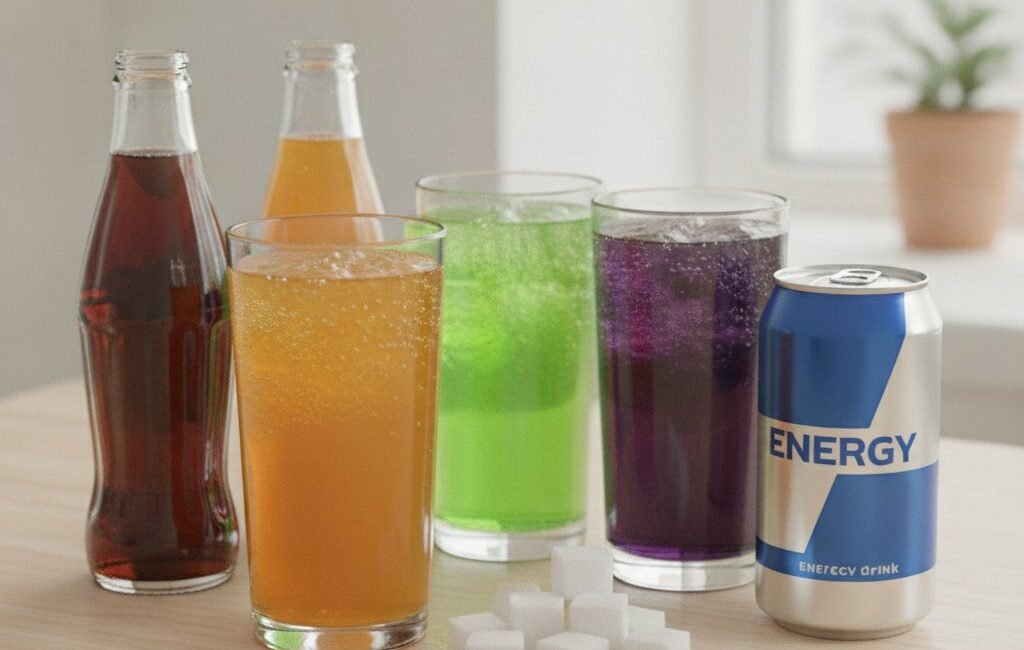
Soft drinks, sweetened iced teas, energy drinks and packaged “fruit drinks” are some of the easiest ways to take in sugar without noticing. A single can of cola can contain more sugar than the World Health Organization suggests most adults aim for in a whole day. So how much do sugary drinks actually matter for your health, and especially for type 2 diabetes? Quite a lot, according to large studies that followed hundreds of thousands of people for years.
This article is part of our evidence-based guide to healthy drinks. Here we look at what sugary drinks do in your body, what the research links them to, where energy drinks fit in, and what to drink instead. It is general information, not medical advice.
How Much Sugar Is in a Sugary Drink?
According to Coca-Cola’s own UK nutrition information, a standard 330 ml can of Coca-Cola Original contains 35 grams of sugar and about 139 calories. That’s roughly nine teaspoons.
Compare that with WHO’s 2015 sugars guideline. It strongly recommends keeping free sugars (sugar added to food and drink, plus the sugar in honey, syrups and fruit juice) below 10% of daily energy. It also conditionally suggests going below 5%, which works out to about 25 grams (around six teaspoons) a day for an adult. One can of cola is already well over that lower target before you’ve eaten anything sweet.
Other sugary drinks are in the same range: regular soft drinks, sweetened iced tea, flavoured milk drinks, many “juice drinks” and regular energy drinks. Labels vary, so check the “of which sugars” or “total sugars” line on the pack.
Why Sugar in Drinks Is Different From Sugar in Food
You don’t eat less to make up for it
The best-known experiment on this was published in the International Journal of Obesity in 2000 by Diane DiMeglio and Richard Mattes at Purdue University. For four weeks, 15 adults added about 450 extra calories a day as soda. For another four weeks, they added the same calories as jelly beans.
When people ate the jelly beans, they automatically ate less of their other food, and their total calorie intake stayed roughly the same. When they drank the soda, they didn’t compensate at all: their daily intake went up by the full amount of the drink. It was a small study, and scientists still debate exactly why liquids behave like this. But the pattern fits a wider finding that calories you drink don’t fill you up the way calories you chew do. We see the same thing with fruit juice compared with whole fruit.
Extra sugar means extra weight
A 2013 BMJ meta-analysis by Lisa Te Morenga, Simonette Mallard and Jim Mann pooled randomised trials on sugar and body weight. In adults eating freely, cutting sugar was linked to about 0.8 kg of weight loss, and adding sugar to about 0.75 kg of weight gain. When sugar was swapped for the same number of calories from other carbohydrates, weight didn’t change. The authors concluded that sugar affects weight mainly by adding calories. Drinks are one of the easiest ways to add those calories without noticing.
Sugary Drinks and Type 2 Diabetes: What the Studies Show
The 2010 meta-analysis
In 2010, Vasanti Malik, Frank Hu and colleagues at Harvard pooled prospective studies of sugar-sweetened beverages in the journal Diabetes Care. Their analysis of type 2 diabetes covered more than 310,000 people and about 15,000 cases. People in the highest intake group (most often one to two sugary drinks a day) had a 26% higher risk of type 2 diabetes than people in the lowest intake group. They also had about a 20% higher risk of metabolic syndrome, the cluster of high blood pressure, high blood sugar, excess belly fat and abnormal cholesterol that often comes before diabetes and heart disease.
The link isn’t only about weight
An obvious question is whether sugary drinks raise diabetes risk simply because they make people gain weight. A 2015 BMJ meta-analysis by Fumiaki Imamura and colleagues at Cambridge looked at this directly, pooling 17 cohort studies. Each extra daily serving of a sugary drink was linked to an 18% higher incidence of type 2 diabetes. After adjusting for body weight and body fat, the link was smaller but still there: 13% per daily serving.
The researchers also estimated how many diabetes cases might be attributable to sugary drinks. Over ten years, they put the figure at about 1.8 million cases in the US (8.7% of new cases) and about 79,000 in the UK (3.6%).
These are observational studies, so they show a strong, consistent association rather than proof that sugary drinks alone cause diabetes. People who drink a lot of soda may differ in other ways too, and the researchers adjusted for as many of those factors as they could. But the findings point the same way as the trials on sugar and weight, and they’re why health bodies treat sugary drinks as one of the clearest dietary targets. If you already have diabetes or prediabetes, see our guide on controlling diabetes naturally.
Beyond Diabetes: Heart Health and Lifespan
In 2019, Malik and colleagues published a study in Circulation that drew on two long-running Harvard cohorts, the Nurses’ Health Study and the Health Professionals Follow-Up Study, which followed US adults for decades. Compared with people who rarely had sugary drinks (less than once a month), those who had two or more a day had about a 21% higher risk of dying early from any cause and a 31% higher risk of dying from cardiovascular disease. Each extra daily serving was linked to roughly a 10% higher risk of cardiovascular death, and the links were stronger in women than in men.
Keep these numbers in perspective. A 21% higher relative risk sounds dramatic, but the change in any one person’s yearly risk of death is small. The point is that a daily habit carried on for decades adds up across a population. The same study found that replacing one sugary drink a day with an artificially sweetened drink was linked to a lower risk of death. Whether diet drinks are a good long-term substitute is a separate question. For the bigger picture on protecting your heart, see our evidence-based heart health guide.
What About Energy Drinks?
Energy drinks combine two things: sugar (in the regular versions) and caffeine.
- Caffeine content varies widely. Red Bull says its 250 ml (8.4 fl oz) can contains 80 mg of caffeine, about the same as a cup of coffee. Larger cans and other brands can contain much more, so check the label.
- The general caffeine limit. The US Food and Drug Administration says that for most healthy adults, up to 400 mg of caffeine a day from all sources isn’t generally linked to harmful effects. Pregnant women are usually advised to stay much lower, around 200 mg a day.
- Effects on the heart. In a 2019 randomised trial in the Journal of the American Heart Association, Sachin Shah and colleagues gave 34 healthy young adults about 950 ml (32 fl oz) of one of two energy drinks, or a placebo drink, on separate days. Both energy drinks raised blood pressure more than the placebo and lengthened the QT interval, a measure of the heart’s electrical activity, more than the placebo did. The changes were modest in these healthy volunteers, but the authors flagged them as a concern for people with heart rhythm problems or high blood pressure. (Shah has worked as an expert witness in legal cases about energy drinks.)
If you rely on energy drinks to get through the day, the caffeine timing matters as much as the amount. Our article on caffeine timing, tolerance and sleep explains why an afternoon can can leave you more tired the next day.
Do Sugar Taxes Work?
Many countries now tax sugary drinks. The UK’s Soft Drinks Industry Levy, introduced in 2018, charges manufacturers more for drinks with more sugar, which pushed many companies to reformulate. A 2023 study led by Nina Rogers at the University of Cambridge found that the levy was associated with an 8% relative drop in obesity among girls in their final year of primary school (about 5,000 fewer cases a year), with the largest drop in more deprived areas. It found no clear effect in boys or younger children. It shows an association rather than proof, but it suggests cutting sugar from drinks can make a measurable difference across a population.
How to Cut Back on Sugary Drinks
- Make water the default. Plain or sparkling water, with a slice of lemon, cucumber or a few mint leaves for flavour. If you’re not sure how much you need, see our guide to dehydration and how much water to drink.
- Cut down gradually. If you drink two cans a day, go down to one, then to a few a week. Your taste for very sweet drinks tends to fade over time.
- Switch to unsweetened tea or coffee, or reduce the sugar you add a little at a time.
- Read labels on “healthy-looking” drinks. Flavoured waters, iced teas, sports drinks, packaged lassi and fruit drinks can contain as much sugar as soda.
- Don’t swap soda for juice. Under WHO’s definition, the sugar in fruit juice is still free sugar.
- Keep sugary drinks out of the house and have them as an occasional choice when you’re out, not a daily habit.
Frequently Asked Questions
Are sugary drinks really linked to type 2 diabetes?
Yes. A 2015 BMJ meta-analysis of 17 cohort studies found that each extra daily serving of a sugary drink was linked to an 18% higher incidence of type 2 diabetes, and still 13% higher after accounting for body weight. These are observational studies, but the link has been found again and again across large populations.
How much sugar is in a can of soda?
A 330 ml can of Coca-Cola Original contains 35 grams of sugar, roughly nine teaspoons. That’s more than the WHO’s suggested target of under about 25 grams of free sugars a day for an adult.
Are energy drinks bad for your heart?
In a 2019 randomised trial, drinking about 950 ml of energy drink raised blood pressure and altered the heart’s electrical activity (QT interval) more than a placebo drink in healthy young adults. The effects were modest, but people with heart conditions, high blood pressure, or who are pregnant should be especially cautious with energy drinks.
What should I drink instead of soda?
Water, sparkling water, and unsweetened tea or coffee are the best everyday replacements. Fruit juice isn’t a good swap because its sugars count as free sugars too. Cutting down gradually tends to work better than quitting all at once.
This article is for general information and is not medical advice. If you have diabetes, prediabetes, a heart condition or high blood pressure, speak to a doctor or registered dietitian about what’s right for you.
Sources
- World Health Organization. Guideline: Sugars intake for adults and children. Geneva: WHO, 2015.
- Coca-Cola Original Taste 330 ml, UK product nutrition information (35 g sugars, 139 kcal per can).
- DiMeglio DP, Mattes RD. Liquid versus solid carbohydrate: effects on food intake and body weight. International Journal of Obesity, 2000;24:794–800.
- Te Morenga L, Mallard S, Mann J. Dietary sugars and body weight: systematic review and meta-analyses of randomised controlled trials and cohort studies. BMJ, 2013;346:e7492.
- Malik VS, et al. Sugar-sweetened beverages and risk of metabolic syndrome and type 2 diabetes: a meta-analysis. Diabetes Care, 2010;33(11). doi:10.2337/dc10-1079.
- Imamura F, et al. Consumption of sugar sweetened beverages, artificially sweetened beverages, and fruit juice and incidence of type 2 diabetes: systematic review, meta-analysis, and estimation of population attributable fraction. BMJ, 2015;351:h3576.
- Malik VS, et al. Long-term consumption of sugar-sweetened and artificially sweetened beverages and risk of mortality in US adults. Circulation, 2019;139(18):2113–2125.
- Shah SA, et al. Impact of high volume energy drink consumption on electrocardiographic and blood pressure parameters: a randomized trial. Journal of the American Heart Association, 2019. doi:10.1161/JAHA.118.011318.
- US Food and Drug Administration. Spilling the beans: how much caffeine is too much? (fda.gov).
- Red Bull. Caffeine content of Red Bull Energy Drink, 250 ml can (redbull.com).
- Rogers NT, et al. UK soft drinks industry levy and obesity prevalence in English primary school children. PLOS Medicine, 2023.