This article is part of our complete guide to hair growth and hair loss. Not medical advice — talk to a dermatologist about a diagnosis and treatment plan for hair loss.
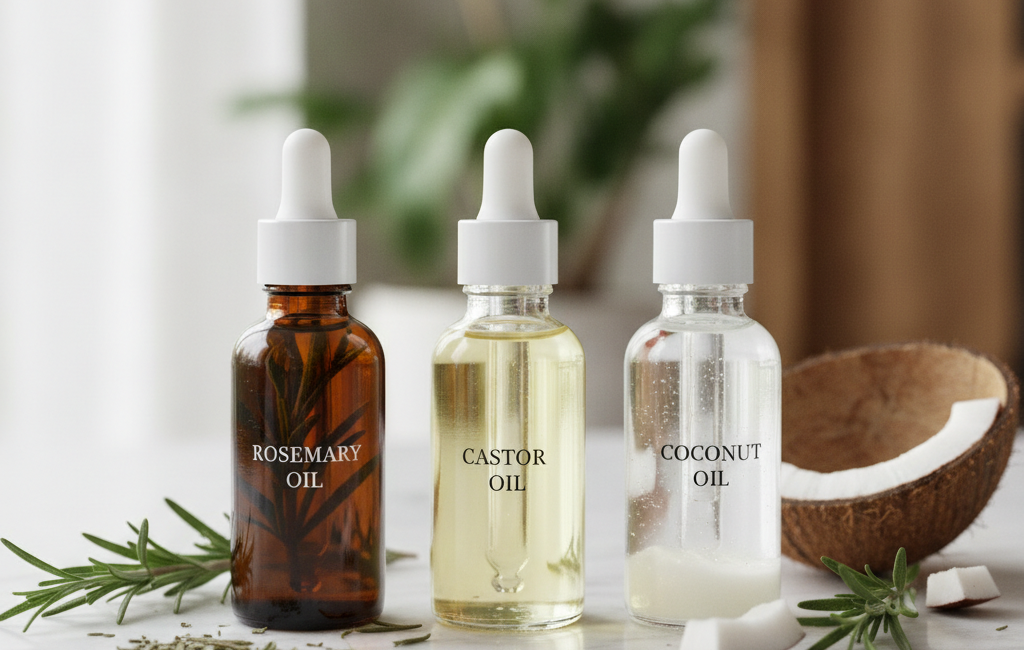
Walk into any pharmacy or scroll any hair-care corner of the internet and you’ll find rosemary oil, castor oil, and coconut oil marketed as natural alternatives to minoxidil — sometimes as “even better” than it. The three oils get lumped together as if they have equally strong backing. They don’t. One has a real head-to-head clinical trial behind it. One has essentially none for hair growth specifically. And one has good evidence for a benefit that isn’t actually hair growth. Here’s what each oil’s evidence actually shows.
Rosemary oil: one real trial, and it’s a good one
Rosemary oil is the only one of the three with a published randomized controlled trial testing it against an approved hair-loss treatment. Panahi and colleagues (2015, Skinmed) randomized 100 people with androgenetic alopecia into two groups: one applied rosemary oil twice daily, the other applied 2% minoxidil twice daily, for six months. Both groups showed a significant increase in hair count by the end of the trial, with no statistically significant difference between them — and the rosemary group reported less scalp itching than the minoxidil group.
That’s a genuinely useful result, but it’s worth being precise about what it does and doesn’t show:
- There was no placebo arm, so the trial can’t rule out that both groups improved for reasons other than the treatment itself (regression to the mean, seasonal shedding variation, or a strong expectation effect from twice-daily scalp care).
- It’s a single trial with 100 participants. That’s a meaningful sample for a dermatology trial, but it hasn’t been independently replicated at the same scale.
- 2% minoxidil is the lower of the two common over-the-counter strengths (2% and 5%); the trial didn’t test rosemary against 5% minoxidil, which is what most men actually use today.
The proposed mechanism is that rosemary oil’s active compounds (carnosic acid and others) improve microcirculation to hair follicles in a way that overlaps with how minoxidil works, plus some anti-inflammatory and antioxidant activity at the follicle. That’s a plausible, mechanistically grounded explanation — but plausibility isn’t proof, and one unreplicated trial is a reasonable, not a slam-dunk, case. If you already know you tolerate minoxidil well, there’s no strong reason from this evidence to switch. If minoxidil’s itching or irritation is what’s stopping you from using it consistently, rosemary oil is one of the few “natural” alternatives with an actual RCT behind it rather than just tradition and marketing.
Castor oil: the evidence gap is real
Castor oil is the most aggressively marketed of the three for hair growth specifically, and it’s also the one with the least to back it up. A 2022 systematic review in the Journal of Drugs in Dermatology (Phong, Lee, Yale, Sung, and Mesinkovska) pooled 22 studies on coconut, castor, and argan oil for hair, spanning 1964 to 2020. Its finding on castor oil was blunt: there was only weak evidence that it improves hair quality (shine and luster), and no strong evidence supporting its use for actual hair growth.
There is no published randomized controlled trial testing castor oil against a placebo or an approved treatment for androgenetic alopecia or telogen effluvium. The popular claim that castor oil dramatically speeds up growth rate has no clinical trial behind it at all — it traces back to anecdote and viral social media routines, not research.
What castor oil likely does do: its main fatty acid, ricinoleic acid, has some anti-inflammatory and moisturizing properties, and a very thick, occlusive oil like castor oil can reduce breakage of existing hair simply by coating the shaft and reducing friction. That’s a real, if modest, cosmetic benefit — it’s just not the same thing as growing new hair faster, which is what most castor oil marketing implies.
Coconut oil: strong evidence, for the wrong claim
Coconut oil is the oil with the best-designed lab research behind it — but the research supports a different claim than “grows hair,” and marketing tends to blur the two. Rele and Mohile (2003, Journal of Cosmetic Science) compared coconut oil, mineral oil, and sunflower oil applied to hair samples, both before and after washing, and measured protein loss from the hair shaft. Coconut oil reduced protein loss significantly more than the other two oils, in both damaged and undamaged hair — likely because its lauric acid content lets it penetrate the hair shaft rather than just coating the surface the way mineral oil does.
That’s a real, well-supported finding about hair strength and damage prevention, not hair growth. Reducing protein loss and breakage means the hair you already have looks and feels healthier and is less likely to snap off — which can create the visual impression of “more hair” or faster growth, especially if you were previously losing length to breakage. But it does not mean coconut oil stimulates new follicle activity or increases growth rate. No high-quality trial has shown that coconut oil outperforms placebo for actual hair regrowth in androgenetic alopecia or any other cause of hair thinning, and the JDD systematic review above reached the same weak-evidence conclusion for coconut oil’s growth claims that it did for castor oil.
What this means if you’re deciding what to actually use
Putting the three side by side:
- Rosemary oil — the only one with a real comparative RCT for growth; reasonable option if you want a plant-based alternative to minoxidil, with the caveat that it’s one unreplicated trial without a placebo arm.
- Castor oil — essentially no growth evidence; may help hair look glossier and feel less brittle, but treat “grows hair faster” claims as marketing, not science.
- Coconut oil — solid evidence for reducing protein loss and breakage of existing hair; not evidence for growing new hair.
None of these oils address an underlying medical cause of hair loss. If your shedding is tied to a nutrient deficiency, oils applied to the scalp won’t fix it — see our spokes on iron deficiency and hair fall and vitamin D and hair fall for how to check whether that’s driving yours. And if minoxidil is already working for you, there isn’t good evidence that any of these three oils outperforms it — rosemary oil’s trial only showed it matched a lower-strength dose, not beat it.
Frequently Asked Questions
Is rosemary oil as effective as minoxidil for hair growth?
One 2015 randomized trial found rosemary oil produced a similar increase in hair count as 2% minoxidil over six months, with less scalp itching. It hasn’t been tested against the more commonly used 5% minoxidil, and the trial had no placebo group, so treat this as promising rather than conclusive.
Does castor oil really make hair grow faster?
No published clinical trial supports that claim. A 2022 systematic review found only weak evidence that castor oil improves hair shine and quality, and no strong evidence it grows hair faster than normal.
Why do people think coconut oil grows hair if the evidence is about protein loss?
Because reducing breakage and protein loss makes existing hair look fuller and healthier, which can be mistaken for faster growth. The underlying research (Rele & Mohile, 2003) measured damage prevention, not new follicle growth.
Can I combine rosemary, castor, and coconut oil?
There’s no clinical trial testing the three combined, so any specific claims about a combination are marketing, not evidence. Using coconut oil as a carrier for rosemary oil is common in practice and not known to cause harm, but don’t expect an additive growth effect beyond what rosemary oil alone showed.
Are hair oils safe to use alongside minoxidil or finasteride?
There’s no evidence of a dangerous interaction, since these oils work topically and superficially rather than through the hormonal pathway that finasteride targets or the vasodilation pathway minoxidil targets. If you’re combining treatments, it’s still worth mentioning to a dermatologist, especially if you notice new irritation.