Search “hair fall solution” and you’ll get flooded with onion juice recipes, yoga poses, and biotin gummies — most of it repeated from site to site with no real evidence behind it. Meanwhile the two causes that actually explain most hair loss (a nutrient deficiency or a hormonal/pattern process) rarely get mentioned. Figuring out which kind of hair loss you have changes everything about what’s worth trying.
This guide pulls together what the evidence actually supports — not folk wisdom, not marketing claims — across the real causes of hair loss, what’s proven to help, and where the popular home remedies genuinely fit (and don’t). Each section links to a deeper, dedicated article if you want the full detail.
Shedding vs. Thinning: Two Different Problems
Dermatologists broadly split non-scarring hair loss into two categories, and mixing them up is the most common reason people try the wrong fix:
- Telogen effluvium (shedding) — a temporary, diffuse increase in hair fall triggered by a physical or hormonal stressor (illness, crash dieting, childbirth, major stress). Roughly 70% of hairs in the growth phase can be pushed prematurely into the resting/shedding phase. It’s reactive and usually self-limited once the trigger resolves.
- Androgenetic (pattern) hair loss (thinning) — a gradual, progressive miniaturization of hair follicles driven by dihydrotestosterone (DHT), a hormone derived from testosterone. Unlike shedding, this doesn’t reverse on its own without treatment.
If your hair loss came on suddenly a few months after a stressful event, illness, or giving birth, it’s very likely telogen effluvium. If it’s been a slow, gradual thinning at the crown or part line over months to years, pattern hair loss is more likely. For a case that doesn’t fit either pattern clearly, see our deeper look at sudden hair fall.
Nutritional Deficiencies: The Fixable Cause
Before anything else, deficiencies are worth ruling out because they’re the most fixable cause of diffuse hair thinning.
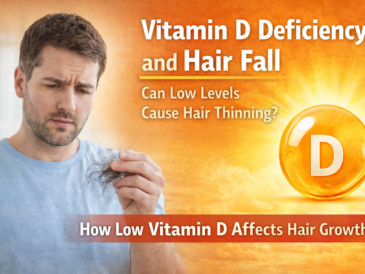
Vitamin D deficiency is strongly associated with hair loss — a meta-analysis pooling multiple studies found women with female pattern hair loss were over 5 times more likely to have low vitamin D than controls, with an average difference of about 15.67 ng/mL lower serum vitamin D in affected women. The association is also seen in alopecia areata and telogen effluvium, though researchers are still working out how much is causal versus correlated. For the full picture and what levels to target, see our dedicated guide to vitamin D and hair fall.
Iron deficiency, including “non-anemic” iron deficiency (low ferritin without full-blown anemia), has been studied as a contributor to diffuse hair loss in women since the 1960s, though a widely-cited 2006 review in the Journal of the American Academy of Dermatology concluded the evidence for recommending iron supplementation specifically for hair loss (absent anemia) was still insufficient to make it a blanket recommendation — worth knowing before assuming a ferritin test alone explains everything. Still, checking ferritin is a reasonable, low-cost step. See our full breakdown of iron deficiency and hair fall.
Protein and zinc deficiencies can trigger the same kind of diffuse shedding as low vitamin D or iron — hair is almost entirely built from keratin, a protein, and zinc plays a direct role in the hair growth cycle. These are less commonly tested for than vitamin D or ferritin but worth knowing about, especially after a restrictive diet. See our full guide to protein, zinc, and other nutrient deficiencies linked to hair loss.
Stress and Postpartum Hair Loss
Telogen effluvium after childbirth is extremely common and follows a predictable pattern: pregnancy’s high-estrogen environment keeps an unusually large share of hair follicles in the growth phase, and when estrogen drops after delivery, those follicles shift into the resting phase together — showing up as a wave of shedding around 3-4 months postpartum. The same mechanism explains stress- and illness-triggered shedding more generally. It typically resolves within 6-12 months without treatment once the underlying trigger passes, though it can feel alarming while it’s happening. For the full breakdown of timing, what to expect, and when to worry, see our deep dive on postpartum and stress-related hair loss.
Pattern Hair Loss and What Actually Treats It
For androgenetic (pattern) hair loss, the strongest evidence-based treatment remains topical minoxidil — the only FDA-approved option for both men and women, and the one most randomized controlled trials have been built around. Trials comparing concentrations found the 5% formulation producing meaningfully more regrowth than 2% at 48 weeks. Results take time (typically 3-6 months of consistent use before visible change) and are only maintained with continued use — stopping reverses the gains. Oral and sublingual low-dose minoxidil have also emerged as options for people who don’t tolerate the topical version well, with early evidence suggesting comparable effectiveness, though this route should go through a doctor rather than self-prescribing. For the full randomized-trial data behind minoxidil and finasteride, see our deep dive on DHT, pattern hair loss, and what the minoxidil evidence actually shows.
Does Biotin Actually Help?
Biotin supplements are heavily marketed for hair growth, but the evidence is thinner than the marketing suggests. A 2017 systematic review found only 18 documented cases in the literature where biotin supplementation clearly improved hair or nail growth — and in every one of those cases, the person had an underlying biotin deficiency or a related condition (like brittle nail syndrome), not simply “thin hair.” True biotin deficiency is uncommon in people eating a normal diet. If you’re not deficient, there’s little evidence extra biotin will do anything for hair that’s thinning for other reasons — a blood test for deficiency is a more useful first step than a bottle of gummies. See our full breakdown of the biotin research, including a real FDA safety caveat about biotin interfering with certain blood tests.
Home Remedies: What Onion Juice and Balayam Yoga Evidence Actually Shows
Two of the most popular home remedies for hair deserve an honest look, because the real evidence is narrower than the internet folklore around them suggests.
Onion juice does have a real clinical study behind it — but not for the condition most articles imply. A 2002 trial in The Journal of Dermatology tested topical onion juice specifically on alopecia areata (patchy, autoimmune-driven hair loss), not general thinning or pattern hair loss. In that trial, 86.9% of the onion juice group showed hair regrowth versus 13.3% in a tap-water control group, with regrowth becoming statistically significant by 4 weeks. That’s a genuinely striking result — but it’s specific to alopecia areata’s patchy bald spots, and hasn’t been shown to work the same way for diffuse thinning or pattern hair loss, which is how the remedy is usually marketed today. See our full onion hair mask guide for how to use it and what it can realistically be expected to do.
Balayam yoga (rubbing the fingernails together to stimulate hair growth via a claimed nerve-ending connection to the scalp) has no clinical trial evidence behind it — it’s a traditional practice, not a studied intervention. That doesn’t automatically make it useless (it’s harmless and costs nothing), but it shouldn’t be relied on as a primary strategy for real hair loss the way the nutritional and medical options above can be. More in our balayam yoga deep dive.
When to See a Doctor
Home management is reasonable for mild diffuse shedding, but see a dermatologist if: hair loss is patchy rather than diffuse (possible alopecia areata), you notice scalp scarring, redness, or scaling (could indicate a scarring alopecia that needs early treatment to prevent permanent loss), hair loss is sudden and severe, or it’s accompanied by other symptoms like fatigue, irregular periods, or weight changes (which can point to thyroid disease or PCOS as the underlying driver rather than hair being the primary problem) — see our guide to hair loss from thyroid disease, PCOS, and alopecia areata for the specific red flags and what testing looks like.
Frequently Asked Questions
How much daily hair loss is normal?
Losing 50-100 hairs a day is considered within normal range for the scalp’s natural growth cycle. What signals a real problem is a noticeable increase from your personal baseline, visible thinning, or widening of the part line — not the raw number of hairs on your pillow or in the shower drain, which is hard to count accurately anyway.
Can hair loss be reversed, or only stopped?
It depends on the cause. Telogen effluvium (stress/postpartum shedding) typically reverses on its own once the trigger passes. Nutritional-deficiency-related thinning improves once the deficiency is corrected. Androgenetic (pattern) hair loss can be slowed or partially reversed with consistent treatment (like minoxidil) but tends to resume progressing if treatment stops — it’s managed, not cured.
Do hair growth oils (coconut, castor, rosemary) work?
Evidence varies by oil and is generally weaker than for minoxidil — rosemary oil has a real randomized trial showing results comparable to 2% minoxidil, while castor and coconut oil lack strong growth evidence despite heavy marketing. See our full study-by-study breakdown of hair growth oils.
Is it worth getting a blood test before trying supplements?
Generally yes. Vitamin D and ferritin (iron) deficiency are both common, testable, and directly linked to hair loss in research — testing first avoids spending months on supplements (like biotin) that only help if you’re actually deficient in them.
Where to Start
If you’re not sure where to begin, in order of what’s most likely to actually move the needle:
- Identify whether your hair loss is diffuse shedding or localized thinning/patterned — this determines almost everything else.
- Get vitamin D and ferritin checked before buying any supplement.
- For confirmed pattern hair loss, topical minoxidil has the strongest evidence of anything sold over the counter.
- Treat home remedies like onion juice and balayam yoga as low-cost, low-risk additions — not replacements for the steps above.
- See a dermatologist if loss is patchy, sudden, or comes with scalp changes or other symptoms.