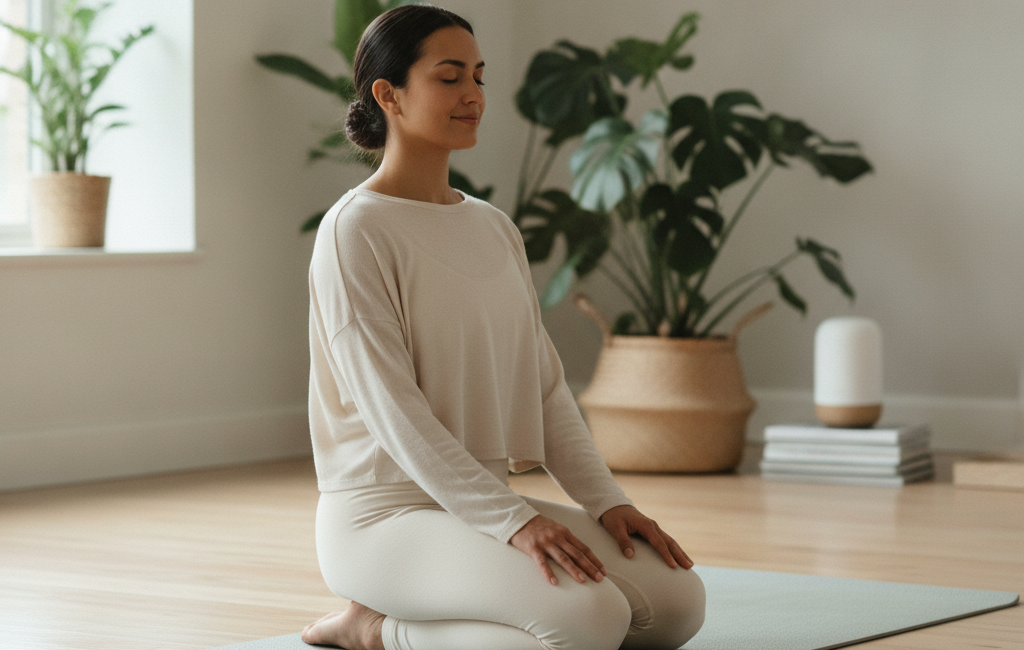
Vajrasana — the kneeling “thunderbolt” or “diamond” pose — is the only yoga pose traditionally recommended to do right after a meal, and it’s widely credited with fixing everything from bloating to constipation. Some of that reputation holds up under scrutiny; a lot of it is tradition dressed up as fact. This article separates what’s actually been studied from what’s simply repeated across yoga blogs, and is more cautious about the evidence than most of what’s written on this pose.
This is one piece of our complete evidence-based guide to flat-stomach exercise and yoga claims, which covers why spot reduction doesn’t work and which core exercises are actually backed by research. It builds on the same evidence-first approach used in our look at kapalbhati pranayama, another traditional practice with a mixed evidence picture. This article is general information, not medical advice; talk to a doctor before starting any new practice if you have an existing health condition, especially a knee, spine, or digestive condition.
What Vajrasana Actually Is
Vajrasana combines “vajra” (thunderbolt or diamond) and “asana” (seat). It’s also called Thunderbolt Pose, Diamond Pose, or Kneeling Pose. Unlike almost every other seated yoga posture, it’s specifically recommended for practice immediately after eating rather than on an empty stomach — that’s the detail that gives it its reputation as a “digestion pose” in the first place.
How to Do It
- Kneel on a soft mat, then sit back so your buttocks rest on your heels, with your big toes touching.
- Keep your spine upright and relaxed — don’t force an exaggerated straight back.
- Rest your palms on your thighs, facing down or up.
- Hold for 1-2 minutes to start, breathing normally. Some discomfort in the ankles or knees is common at first.
- Build up gradually over weeks, not days — traditional guidance suggests up to 15-30 minutes for experienced practitioners, but there’s no evidence a longer hold produces meaningfully more digestive benefit than a few minutes.
What the Evidence Actually Shows
The evidence specifically on vajrasana is thin compared to other practices in this cluster, like kapalbhati. A 2023 study published in the peer-reviewed Global Journal for Research Analysis (Naragatti) followed practitioners over six weeks, tracking blood pressure, heart rate, flexibility, and self-reported stress and mood alongside regular vajrasana practice, and reported improvements across those measures. That’s a real, published study directly on this pose — but it’s a small, mixed-methods study without the kind of randomized, controlled design that would let researchers rule out other explanations (regular practice of almost any calming seated posture, plus attention and expectation, can move self-reported stress scores). It’s evidence that something is happening, not proof of a specific digestive mechanism.
Directly relevant clinical evidence for vajrasana’s core claim — that it measurably speeds digestion or relieves bloating — doesn’t really exist yet in the form of a controlled trial isolating this pose. What does exist is broader: a 12-week randomized controlled trial published in the European Journal of Integrative Medicine in 2015 tested a full yoga module (not vajrasana specifically) against conventional treatment in people with irritable bowel syndrome, and found significant improvements in bowel symptoms, IBS severity, and anxiety in the yoga group. That’s a genuine, credible data point that structured yoga practice in general can meaningfully help digestive symptoms — but it’s evidence for yoga as a category, not for this one pose in isolation, and it isn’t safe to extrapolate it into a specific claim like “vajrasana cures constipation.”
The honest summary: there’s real evidence that yoga practice broadly can help digestive symptoms, and one small study specifically on vajrasana showing general physiological and stress benefits. There is not yet a controlled study proving vajrasana itself accelerates digestion or gastric emptying — anyone telling you it does with confidence is overstating what’s actually been measured.
The Traditional Mechanism, and Why It’s Plausible (Not Proven)
The traditional explanation is mechanical: the kneeling position redirects blood flow toward the abdominal and pelvic region, and the gentle compression of the abdomen is said to support the stomach and intestines during digestion. This is a physiologically plausible mechanism — it’s not an unreasonable idea — but “plausible mechanism” is a different category of evidence from “demonstrated effect,” and no study has directly measured whether that redirected blood flow actually changes digestion speed or symptom outcomes in a controlled way. Compare this to the pillar guide’s coverage of spot reduction, where a mechanism that sounds intuitive (working a muscle burns the fat over it) turned out not to hold up once it was actually tested. Vajrasana’s mechanism hasn’t been debunked the way spot reduction has — it simply hasn’t been rigorously tested either way.
Where vajrasana most plausibly helps, based on what has been studied, is indirect: sitting still and upright for a few minutes after a meal — instead of lying down or slumping on a couch — is a reasonable, low-risk habit on its own, and the general stress-reduction signal from the 2023 study is consistent with what’s known about how stress and the nervous system affect digestion more broadly. That’s a real, modest benefit. It’s just a different, more limited claim than “this pose fixes your digestion.”
Who Should Skip or Modify Vajrasana
The kneeling position that defines this pose is also exactly why it’s unsuitable for several groups:
- Knee or joint problems — anyone with arthritis, recent knee injury, or acute pain/stiffness in the ankles or knees should avoid or heavily modify this pose; a folded blanket or block under the knees/ankles can help with mild discomfort, but persistent pain is a signal to stop.
- Pregnancy, especially later stages — guidance is mixed for early pregnancy, but most sources recommend avoiding the pose later in pregnancy due to abdominal pressure and potential effects on blood flow; check with a doctor.
- Spinal issues — people with a slipped disc, sciatica, or coccyx pain (coccydynia) are commonly advised to avoid this position.
- Hemorrhoids — the pose can increase pressure on the rectal area and may aggravate existing hemorrhoids.
- Hernia — people with a hernia are generally advised to only attempt this pose under supervision from a qualified instructor, if at all.
Outside these groups, vajrasana is one of the lower-risk yoga poses — there’s no forceful movement or breath-holding involved, unlike kapalbhati. If you have any condition not listed here, check with a doctor before adding it to a routine.
Frequently Asked Questions
Does vajrasana actually cure constipation?
There’s no controlled study proving that. What exists is a plausible traditional mechanism (mild abdominal compression, improved posture after eating) and broader evidence that yoga practice in general can help digestive symptoms — but no trial has isolated vajrasana itself and measured its effect on constipation specifically.
Why is vajrasana the only pose recommended right after eating?
Traditionally because it’s gentle enough not to strain a full stomach, unlike more active postures, and the upright kneeling position is thought to support digestion rather than compress it the way lying down or slouching might. This is a plausible, low-risk rationale rather than a proven mechanism.
How long should I hold vajrasana after a meal?
A few minutes is a reasonable starting point, building up gradually if comfortable. There’s no evidence that longer holds (some traditional sources suggest up to 30 minutes) produce meaningfully more digestive benefit than a shorter session.
Is vajrasana safe for everyone?
No. People with knee or joint problems, spinal issues like a slipped disc or sciatica, hemorrhoids, a hernia, or who are in the later stages of pregnancy should avoid or modify it, and check with a doctor first if unsure.
Is there any real research on vajrasana specifically?
Yes, but it’s limited. A small 2023 study tracked six weeks of regular practice and found improvements in blood pressure, flexibility, and self-reported stress, but it wasn’t a randomized controlled trial, so it can’t rule out other explanations. Stronger digestion-specific evidence exists for yoga practice broadly (a 12-week RCT on IBS symptoms), not for this pose in isolation.