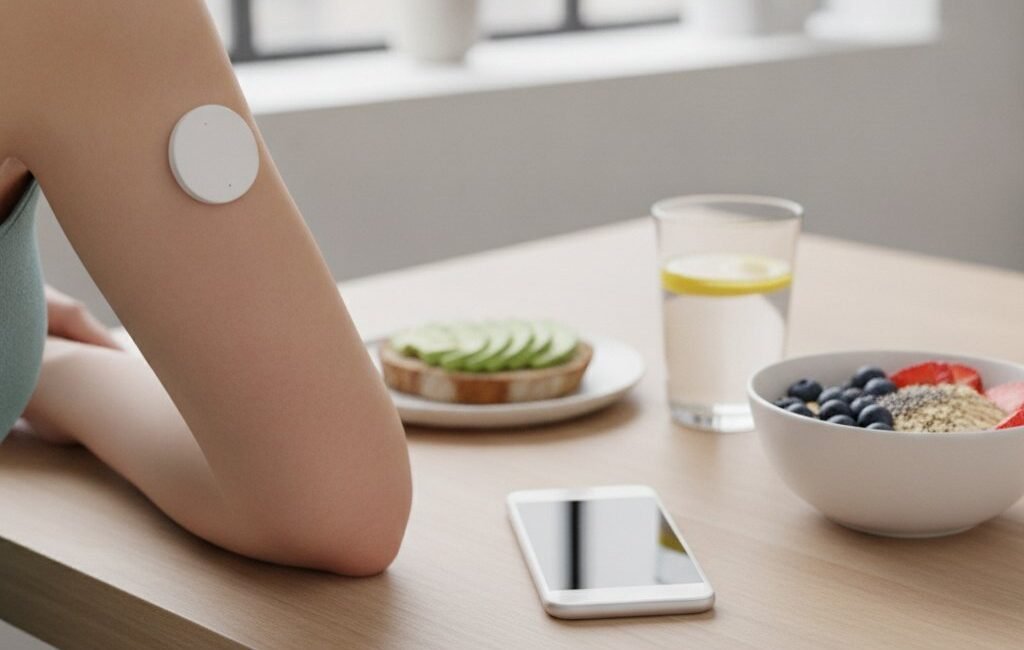
A few years ago you needed a prescription and a diabetes diagnosis to wear a continuous glucose monitor (CGM). Now you can buy one over the counter, stick it on your arm, and watch your blood sugar rise and fall after every meal on your phone. Wellness influencers post their “glucose spikes” and swap tips for flattening them. So is a CGM worth it if you don’t have diabetes? The short answer is that it can be an interesting two-week experiment. There’s no good evidence that wearing one improves long-term health in people without diabetes, though, and the numbers are easy to misread. This article covers what normal glucose actually looks like, what the research says about personal food responses, how reliable the sensors are, and who might reasonably try one.
This article is part of our complete guide to fitness trackers and health gadgets. This is general information from published research, not medical advice. If you have diabetes or prediabetes, or you take medicine that lowers blood sugar, follow your own care team’s advice on glucose monitoring rather than anything here.
In this article:
- The Short Answer
- What a CGM Is, and What You Can Buy
- What Normal Glucose Looks Like
- Are Glucose Spikes Bad for You?
- How Reliable Are the Readings?
- Does Wearing a CGM Improve Health?
- Who Might Get Something Useful From One
- How to Try a CGM Without Overreacting
- Frequently Asked Questions
- Key Takeaways
The Short Answer
- Healthy glucose is not flat: in healthy adults it rises after meals and comes back down. Rises are normal, not a sign that something is wrong.
- No proven health benefit: a 2026 review in JAMA Internal Medicine found no scientific evidence that CGMs improve health or prevent disease in people without diabetes.
- The readings are noisier than they look: two sensors worn at the same time can rank the same meals differently, and the same meal eaten a week apart can give a different curve.
- Useful as a short experiment: if you’re curious, a couple of weeks can show you broad patterns, such as how a sugary drink compares with a mixed meal. It isn’t a diagnostic test and shouldn’t become a source of food anxiety.
What a CGM Is, and What You Can Buy
A CGM is a small sensor, usually worn on the back of the upper arm, with a thin filament that sits just under the skin. It doesn’t measure blood directly. It measures glucose in the interstitial fluid around your cells every few minutes and sends the readings to a phone app. Interstitial glucose tends to lag a few minutes behind blood glucose, which matters most when levels are changing quickly, such as right after a meal or during exercise.
In March 2024 the US Food and Drug Administration cleared the first over-the-counter CGM, Dexcom’s Stelo, for adults who don’t use insulin. The FDA was explicit that it isn’t meant for people with problematic low blood sugar, because it doesn’t give alerts for dangerous lows. Abbott followed in mid-2024 with two over-the-counter systems: Libre Rio, aimed at adults with type 2 diabetes who don’t use insulin, and Lingo, a consumer wellness product for adults aged 18 and over that Abbott says is not intended to diagnose any disease, including diabetes. Availability and branding differ by country, so check what’s sold where you live.
That last point is worth holding on to. A wellness CGM is sold to show you trends, not to tell you whether you have a medical condition.
What Normal Glucose Looks Like
The most useful single study for anyone about to wear a CGM is a 2019 paper by Shah and colleagues in the Journal of Clinical Endocrinology & Metabolism. They gave blinded Dexcom G6 sensors to 153 healthy people without diabetes, aged 7 to 80, for up to 10 days, to set out what “normal” looks like on a CGM.
- The typical participant spent about 96% of the time between 70 and 140 mg/dL (roughly 3.9 to 7.8 mmol/L).
- They spent a median of about 2% of the day above 140 mg/dL, around 30 minutes, mostly after meals.
- They also spent a median of about 1% of the day below 70 mg/dL, around 15 minutes.
In other words, healthy people do go above 140 after some meals, and they briefly dip below 70 too. If your CGM shows a post-meal peak or an overnight low now and then, that alone isn’t evidence of a problem. A short dip below 70 overnight is often a sensor artefact rather than real low blood sugar (more on that below).
A 2018 Stanford study in PLOS Biology (Hall and colleagues, 57 participants) found more variation than standard tests suggest. Some people whose fasting glucose and HbA1c were normal still reached glucose levels usually associated with prediabetes about 15% of the time and the diabetic range about 2% of the time. The authors grouped people into “glucotypes” by how much their glucose varied. That’s interesting research, but it’s a small study, and it didn’t show that a “spikier” glucotype leads to worse health. It also hasn’t replaced standard diagnostic tests.
Are Glucose Spikes Bad for You?
This is where the wellness marketing gets ahead of the evidence. Large rises after meals are clearly a concern in people with diabetes. For people with normal glucose control, a rise after a bowl of rice that comes back to baseline within a couple of hours is just what a working metabolism does.
What the research does show is that people respond differently to the same food. In a 2015 study in Cell, Zeevi and colleagues monitored 800 people for a week and logged 46,898 meals. They found large differences between people in their glucose response to identical meals, and built a model that could predict individual responses better than standard carbohydrate counting. In the larger PREDICT 1 study (Berry and colleagues, Nature Medicine, 2020), about 1,000 UK adults, many of them twins, ate standardised meals. Glucose responses varied widely between people, even between identical twins, and the authors concluded that much of that variation came from modifiable factors such as meal timing, sleep and activity, not genes alone.
That’s the appealing idea behind consumer CGMs: find out which foods spike you. The weak link is the step from “this food raises my glucose more than that one” to “avoiding this food will make me healthier.” That step hasn’t been shown in people without diabetes. Some of the foods that raise glucose quickly, such as fruit, potatoes and whole grains, are part of healthy diets in long-term studies. Cutting them out to flatten a curve could leave you worse off.
The clearer signal is sugary drinks. They raise glucose fast and, unlike whole foods, have strong long-term evidence against them. See our article on sugary drinks and type 2 diabetes for what that research shows. You don’t need a sensor to act on it.
How Reliable Are the Readings?
CGMs are accurate enough to help people with diabetes manage their treatment. Using them to rank individual meals in healthy people is a harder job, because the differences between meals are small and the sensor’s error is a bigger share of the signal.
Two studies from Kevin Hall’s group at the US National Institutes of Health tested this directly:
- Two sensors, different answers: Howard and colleagues (American Journal of Clinical Nutrition, 2020) had 16 adults without diabetes wear a Dexcom and an Abbott sensor at the same time for 28 days on an inpatient ward, covering 760 meals. The two devices often ranked the same person’s meals differently, with only a moderate rank correlation (about 0.43). A meal that looked like a “spiker” on one sensor could look unremarkable on the other.
- Same meal, different curve: Hengist and colleagues (American Journal of Clinical Nutrition, 2025) looked at 30 adults without diabetes who ate duplicate meals about a week apart under controlled conditions. Individual responses to the identical meal were highly variable, about as variable as responses to different meals.
Not every study is this negative. An analysis from the PREDICT team found better agreement between two sensors of the same brand than between brands. Still, the practical lesson is that a single meal’s curve isn’t a reliable verdict on that food. Patterns repeated over several days tell you more than any one reading.
There’s also a well-known artefact called a compression low. If you sleep on the arm with the sensor, pressure reduces the fluid around it and the reading can drop sharply, then bounce back when you roll over. People without diabetes who see a scary overnight low often find this is the cause. A fingerstick meter will tell you whether a low is real. As the FDA noted for Stelo, over-the-counter devices aren’t designed to manage dangerous lows anyway.
Does Wearing a CGM Improve Health?
This is the question that matters, and so far the answer is that nobody has shown it does in people without diabetes. In 2026, JAMA Internal Medicine published a commissioned narrative review by Dower, Johansson, Camp, Montori and Lipska on CGM use in type 2 diabetes and beyond. They found no scientific evidence that CGMs improve health or prevent disease in people without diabetes. One of the authors, Minna Johansson of the University of Gothenburg, also warned that normal glucose fluctuations can be overinterpreted, leading to unnecessary dietary restriction or anxiety.
That fits a pattern seen across health gadgets. As with sleep trackers, the data can become a source of worry in its own right. And as with fitness trackers and weight loss, short-term behaviour changes don’t automatically turn into lasting health benefits. A CGM may nudge you to swap a fizzy drink for water or take a walk after dinner. Those are good habits, but you can build them without spending money on sensors every two weeks.
It’s also not a replacement for proper testing. If you’re worried about diabetes because of family history, weight, tiredness or thirst, the standard route is a fasting glucose or HbA1c blood test through your doctor. Our guide to blood tests to ask for when you’re always tired covers when those are worth requesting.
Who Might Get Something Useful From One
- Curious people who can treat it as an experiment: if you like data and won’t lose sleep over a spike, two weeks can show you how sugary drinks, large meals, late-night snacks or a walk after eating affect you.
- People with prediabetes or type 2 diabetes not on insulin: some over-the-counter devices are aimed at this group, but use one together with your doctor or diabetes team, not instead of them. Our article on managing diabetes through lifestyle covers the basics.
- People who often feel sleepy after meals: a CGM can show whether there’s a large rise around your afternoon slump, though the post-lunch dip happens for other reasons too.
Who should probably skip it:
- People with a history of eating disorders or very restrictive eating: constant food feedback can feed unhealthy patterns.
- People with health anxiety: normal ups and downs can feel like warning signs when you see them all day.
- Anyone on insulin or other medicine that can cause low blood sugar: wellness CGMs don’t have the alerts you need. Talk to your care team about a prescription device.
How to Try a CGM Without Overreacting
- Set a time limit. One or two sensors is enough to learn your broad patterns.
- Know the normal range first. In healthy adults most readings sit between 70 and 140 mg/dL, with short trips above after some meals.
- Look for repeated patterns, not single curves. Repeat a test meal on different days before deciding anything about it.
- Test changes, not just foods. Try the same meal with and without a 10-minute walk afterwards, or with protein and vegetables added, rather than banning foods.
- Check scary readings. A sudden overnight low may be a compression artefact. Use a fingerstick meter if you’re unsure, and see a doctor if you have symptoms.
- Don’t cut out healthy foods to flatten a line. Fruit, legumes and whole grains have good long-term evidence behind them, even if they cause a rise.
- Stop if it’s making you anxious. The device is meant to inform you, not to police every bite.
Frequently Asked Questions
Is a CGM worth it if you don’t have diabetes?
For most people, not as a long-term tool. A 2026 JAMA Internal Medicine review found no evidence that CGMs improve health or prevent disease in people without diabetes. A short trial can show you broad patterns if you’re curious, but it isn’t necessary for healthy eating.
What is a normal glucose level on a CGM for someone without diabetes?
In a 2019 study of 153 healthy people, the typical participant spent about 96% of the time between 70 and 140 mg/dL (3.9 to 7.8 mmol/L). They were above 140 for about 30 minutes a day and below 70 for about 15 minutes, so brief readings outside that range are normal.
Are glucose spikes after eating bad if you don’t have diabetes?
A rise after eating that returns to baseline within a few hours is normal. There’s no good evidence that flattening every post-meal rise improves long-term health in people with normal glucose control. Persistently high readings are a reason to see a doctor for proper testing.
How accurate are over-the-counter CGMs?
Accurate enough to show trends, but not precise enough to judge single meals. In one NIH study, two sensors worn at the same time often ranked the same person’s meals differently. Sleeping on the sensor can also cause false lows.
Can a CGM tell me if I have prediabetes?
No. Over-the-counter wellness CGMs aren’t intended to diagnose diabetes or prediabetes. If you’re concerned, ask your doctor for a fasting glucose or HbA1c blood test.
Key Takeaways
- Over-the-counter CGMs became available in the US in 2024, but wellness versions are sold for trends, not diagnosis.
- Healthy glucose isn’t flat. Typical healthy adults spend about 96% of the day between 70 and 140 mg/dL, with short rises after meals.
- People do respond differently to the same foods, but avoiding your personal “spikers” hasn’t been shown to improve health in people without diabetes.
- Single-meal readings are noisy: different sensors and repeat meals can give different answers.
- A 2026 review found no evidence that CGMs improve health or prevent disease in people without diabetes.
- If you try one, keep it short, look for repeated patterns, and stop if it makes you anxious about food. If you have diabetes, follow your care team.
For an overview of which health gadgets are worth it, from step counters and smartwatches to blood pressure monitors, see our full guide to fitness trackers and health gadgets.