Your ring says your HRV dropped from 48 to 31 overnight and your readiness score has turned amber. Should you skip today’s workout? Heart rate variability (HRV) is one of the most talked-about and most misunderstood numbers on modern watches and rings. This article explains what HRV actually measures, what the research says it can and can’t tell you, why your number can’t fairly be compared with anyone else’s, and how to use it without letting it run your day.
This article is part of our complete guide to fitness trackers and health gadgets. For how accurate trackers are across steps, heart rate and calories, see are fitness trackers accurate? This is general information from published research, not medical advice.
In this article:
- The Short Answer
- What Heart Rate Variability Actually Is
- RMSSD, SDNN and Why Your Apps Disagree
- How Accurate Is HRV From a Ring or Watch?
- What Low HRV Is Linked To (and What That Does Not Mean)
- What Is a “Good” HRV? Age and the Problem With Comparisons
- What Moves Your HRV From Night to Night
- Readiness Scores and HRV-Guided Training
- How to Use Your HRV Data Sensibly
- Frequently Asked Questions
- Key Takeaways
The Short Answer
- What it is: the small, normal variation in time between one heartbeat and the next. Higher HRV generally reflects a stronger “rest and recover” (parasympathetic) influence on your heart.
- Accuracy: overnight HRV from a good ring or watch can track a chest ECG closely in healthy adults. Daytime and moment-to-moment readings are much less reliable.
- Health meaning: in large studies, people with low HRV have higher rates of heart disease and death. But a single low night on your tracker is not a diagnosis of anything.
- Comparisons: HRV varies hugely between people and falls with age. Your own trend matters far more than how you compare with a friend or a chart.
- Readiness scores: each brand’s own formula. They can be a useful nudge, not an instruction.
What Heart Rate Variability Actually Is
A heart rate of 60 beats per minute doesn’t mean your heart beats exactly once every second. One gap between beats might be 0.98 seconds, the next 1.05, the next 1.01. That beat-to-beat variation is heart rate variability, usually reported in milliseconds.
The variation comes mostly from the autonomic nervous system. The vagus nerve, the main “brake” of the parasympathetic system, can speed up or slow down individual beats very quickly. You can see this in yourself: heart rate rises slightly as you breathe in and falls as you breathe out. When you’re rested and relaxed, that fine-tuning is active and HRV tends to be higher. Under stress, illness, heavy training load, poor sleep or after alcohol, the “accelerator” (sympathetic) side tends to dominate and HRV usually falls.
So a more variable heartbeat at rest is generally a good sign. (This is different from an irregular rhythm such as atrial fibrillation, which is a heart rhythm disorder, not high HRV. For that, see our article on whether a smartwatch can detect AFib.)
RMSSD, SDNN and Why Your Apps Disagree
The standard definitions come from a 1996 Task Force of the European Society of Cardiology and the North American Society of Pacing and Electrophysiology, which set out how HRV should be measured and named. Two measures matter for consumer devices:
- RMSSD (root mean square of successive differences): based on the difference between each pair of neighbouring beats. It mainly reflects fast, vagal (parasympathetic) activity and is the measure most rings and watches, including Oura, Garmin and Fitbit, report.
- SDNN (standard deviation of normal-to-normal intervals): a broader measure of overall variability. Apple Health’s HRV figure has historically been reported as SDNN.
These are different calculations, so they produce different numbers from the same heartbeats. Devices also measure at different times: some average across the whole night, some use particular sleep stages, and some take short readings during the day. That’s why an Apple Watch and an Oura Ring worn on the same night can give quite different HRV figures, and why neither is “wrong”. Pick one device and compare it only with itself.
How Accurate Is HRV From a Ring or Watch?
Medical HRV measurement uses an ECG, which times each beat electrically. Rings and most watches use optical sensors (PPG) that detect pulses of blood flow under the skin, which movement easily disrupts.
This is why most devices measure HRV while you sleep, when you’re still. A 2020 study in Physiological Measurement by Kinnunen and colleagues compared the Oura Ring with a simultaneous ECG overnight in 49 adults aged 15 to 72. For whole-night averages, agreement was very high (r² of 0.98 for HRV, with a mean difference of about 1.2 milliseconds). Agreement was lower for five-minute segments within the night (r² around 0.77). Two caveats: the participants were healthy, and the authors included people affiliated with Oura.
The practical takeaway matches what we found for sleep trackers: the overnight average from a reputable device is reasonably trustworthy as a personal trend, while one-off daytime “stress” readings taken while you’re moving or talking are much rougher.
What Low HRV Is Linked To (and What That Does Not Mean)
HRV became famous in cardiology long before it reached wrists. In 1987, Kleiger and colleagues reported in the American Journal of Cardiology that among 808 people who had survived a heart attack, those with low HRV on a 24-hour ECG (SDNN below 50 ms) had higher mortality over the following years.
The link also shows up in the general population. In the Framingham Heart Study, Tsuji and colleagues (Circulation, 1994) analysed ambulatory ECGs from 736 older adults (average age 72). Over about four years, lower HRV predicted higher all-cause mortality, even after accounting for traditional risk factors. A 2013 meta-analysis in Europace by Hillebrand and colleagues pooled eight studies of nearly 22,000 people without known heart disease and found that low HRV was associated with a 32–45% higher risk of a first cardiovascular event.
It’s important to read these findings carefully:
- They are associations. Low HRV often travels with things that independently raise risk, such as older age, inactivity, high blood pressure, diabetes and poor sleep. It isn’t proven that pushing your HRV number up, by itself, lowers your risk.
- They used medical-grade ECG recordings under standard conditions, not a smart ring’s overnight estimate.
- They compare groups of people. They don’t tell you what one person’s low reading on a Tuesday means.
So a persistently low HRV isn’t something to panic about, but it is a reasonable prompt to look at the basics that protect your heart anyway: activity, sleep, blood pressure and weight. Our heart health guide covers these in detail. If you have symptoms such as chest pain, breathlessness, palpitations or fainting, see a doctor regardless of what your tracker says.
What Is a “Good” HRV? Age and the Problem With Comparisons
There is no single “good” HRV number. HRV differs enormously between healthy people because of genetics, fitness, body size and the device and method used. Two equally healthy 40-year-olds can have overnight RMSSD values that differ by a factor of two or more.
Age is the biggest predictable factor. A 1998 study in the Journal of the American College of Cardiology by Umetani and colleagues measured 24-hour HRV in 260 healthy people aged 10 to 99. HRV fell with age on every measure. RMSSD, the measure most trackers use, fell fastest: by the sixth decade (people in their 50s) it was down to about 47% of the youngest group’s level, and then it levelled off. Under 30, women had lower HRV than men, but the gap narrowed with age and had disappeared by about 50.
So comparing your number with a friend’s, or with an age chart, mostly tells you about genetics and measurement differences. A slow decline over many years is also expected with ageing.
What Moves Your HRV From Night to Night
Your HRV naturally bounces around from day to day. Common reasons it drops for a night or two include:
- Alcohol: one of the clearest effects. In a 2018 study in JMIR Mental Health, Pietilä and colleagues analysed real-world heart rate recordings from 4,098 Finnish employees. Alcohol reduced parasympathetic activity and HRV-based recovery during the first hours of sleep in a dose-dependent way, and effects showed up even at low intakes. Our article on red wine and heart health covers alcohol’s wider effects.
- Hard training: a tough session or a heavy training week commonly lowers HRV for a day or two while you recover.
- Illness: HRV often drops, and resting heart rate and skin temperature rise, around the start of a cold or other infection.
- Short or disrupted sleep, late heavy meals, dehydration, travel and psychological stress.
A dip after an obvious cause, like a late night with drinks or a long run, is your body doing what it should. It’s more informative when HRV stays below your usual range for a week or more without an obvious reason, especially alongside a higher resting heart rate and feeling run down. That pattern is worth taking seriously: ease off, prioritise sleep, and see a doctor if you feel unwell. Persistent tiredness has many possible causes, which we cover in our guide to increasing your energy levels naturally.
Readiness Scores and HRV-Guided Training
“Readiness”, “recovery” and “body battery” scores combine HRV with other inputs such as resting heart rate, sleep, temperature and recent activity. Each brand uses its own undisclosed formula, so there’s no clinical standard behind them, and two brands can disagree about the same morning.
The idea behind them does have research roots. In a 2007 study in the European Journal of Applied Physiology, Kiviniemi and colleagues randomised 26 moderately fit men to a fixed training plan, an HRV-guided plan, or no training. The HRV-guided group trained hard when their morning HRV was stable or rising and went easy or rested when it dropped. Their aerobic fitness (VO2peak) improved from about 56 to 60 ml/kg/min, while the fixed-plan group’s change wasn’t significant. However, the difference between the two training groups wasn’t statistically significant either, so the study shows that HRV-guided training works at least as well, not that it’s clearly better.
Work with elite endurance athletes by Plews and colleagues (Sports Medicine, 2013) added an important practical lesson: a weekly rolling average of HRV was a better guide to how someone was adapting to training than any single day’s reading. Day-to-day HRV is noisy, and the trend carries the information.
So a low readiness score is a reasonable prompt to check in with yourself. If you feel fine and slept well, a normal workout is usually OK. If the score is low and you also feel tired, sore or unwell, that’s a good day to go easier.
How to Use Your HRV Data Sensibly
- Use one device and compare only with yourself. Ignore population charts and other people’s numbers.
- Use the overnight average, not spot checks. Daytime readings are less accurate and swing with posture, movement and breathing.
- Watch the weekly trend, not single nights. A seven-day average smooths out normal noise.
- Look for explanations before reacting. Alcohol, a hard session or a bad night usually explain a single dip.
- Act on the basics that raise HRV over time. Regular aerobic exercise, consistent sleep, moderating alcohol and managing stress all tend to help. Slow-paced breathing is also worth trying: a 2017 meta-analysis in Psychological Medicine by Goessl and colleagues pooled 24 studies (484 participants) of HRV biofeedback, which trains slow breathing, and found a large reduction in self-reported stress and anxiety, though the authors called for more well-controlled trials.
- Take a break if it makes you anxious. As with sleep scores, checking an HRV number every morning can become a source of stress in its own right.
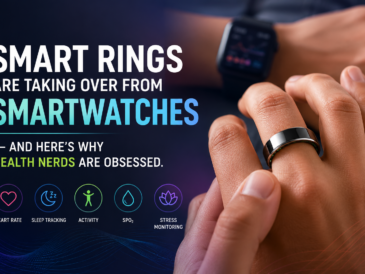
If you’re choosing a device mainly for overnight HRV and sleep, our look at why smart rings are taking over from smartwatches covers the trade-offs.
Frequently Asked Questions
What is heart rate variability?
Heart rate variability is the natural variation in time between one heartbeat and the next, measured in milliseconds. It mainly reflects how active the “rest and recover” part of your nervous system is. Higher HRV at rest is generally a sign of good recovery, while HRV tends to fall with stress, illness, poor sleep, hard training and alcohol.
What is a good HRV for my age?
There isn’t a single good number. HRV varies widely between healthy people and falls with age, and different devices calculate it differently. Your own trend over weeks, measured on the same device, is far more meaningful than comparing yourself with an age chart or another person.
Is HRV from a smart ring or watch accurate?
Overnight averages from reputable devices can be quite accurate. One study found the Oura Ring’s whole-night HRV closely matched a simultaneous ECG in healthy adults. Readings taken during the day, or over short periods while you’re moving, are much less reliable.
Why is my HRV different on my Apple Watch and my Oura Ring?
They use different measures and measure at different times. Apple Health has historically reported SDNN, while Oura and most other devices report RMSSD, which usually gives smaller numbers. Both can be valid, but they aren’t interchangeable, so compare each device only with itself.
Should I skip my workout if my HRV is low?
Not automatically. A single low reading often has an obvious cause such as alcohol, a hard session or a poor night. If you feel fine, a normal workout is usually OK. If HRV stays low for several days and you also feel tired or unwell, go easier or rest, and see a doctor if symptoms persist.
Key Takeaways
- HRV is the beat-to-beat variation in your heart rhythm. Higher resting HRV generally reflects better recovery.
- Overnight HRV from a good ring or watch can be reasonably accurate. Daytime spot readings are much rougher.
- Low HRV is associated with higher cardiovascular risk in large ECG studies, but a single low tracker reading isn’t a diagnosis.
- HRV varies widely between people and falls with age. Compare yourself only with your own trend, on one device.
- Alcohol, hard training, illness and poor sleep commonly lower HRV for a night or two. A dip that lasts a week or more is more informative.
- Readiness scores are proprietary nudges. Use them alongside how you feel, not instead of it.
For an overview of what smartwatches, heart alerts, step counters and other health gadgets can and can’t do, see our full guide to fitness trackers and health gadgets.