Most fitness trackers ship with the same default goal: 10,000 steps a day. Hit it and your wrist buzzes. Miss it and the ring stays open. That number has become so familiar that most people assume a study somewhere found it. Nobody did. It started as a slogan for a pedometer, and it was only properly tested decades later. The research we now have is more useful than the slogan: the biggest health gains come well below 10,000, and the amount that’s “enough” depends on your age.
This article is part of our complete guide to fitness trackers and health gadgets, which covers what the evidence says each type of device is good for. It’s general information from published research, not medical advice. If you have a heart, lung or joint condition, check with your doctor before making a big jump in activity.
The Short Answer
- Every step above a very low baseline counts. The steepest drop in risk comes when someone moves from around 2,000–4,000 steps a day up to 5,000–7,000.
- For adults 60 and over, the benefit levels off at roughly 6,000–8,000 steps a day.
- For adults under 60, it levels off at roughly 8,000–10,000 steps a day.
- Going past 10,000 isn’t harmful, and it may help fitness, but the extra benefit for lifespan in these studies is small.
- Walking pace matters less than the total once you account for how many steps you take, according to two large studies.
Where 10,000 Steps Came From
The usual account goes back to Japan in 1965. A company called Yamasa sold a pedometer named the manpo-kei, which translates as “10,000-step meter”, riding the interest in fitness that followed the 1964 Tokyo Olympics. The number was a round, memorable target for an advertising campaign. It wasn’t the result of a study, and the details of the early history are mostly known from press and popular accounts rather than primary records.
That doesn’t make 10,000 a bad goal. It’s a perfectly reasonable amount to walk. The problem is that it was treated as a threshold for decades: anything below it felt like failure, and people who managed 5,000 a day were told, implicitly, that they weren’t doing enough. The research that eventually tested the number says the opposite.
What the Big Studies Found
The good evidence comes from studies where thousands of people wore an accelerometer for about a week and researchers then followed them for years to see who died or developed disease. These are observational studies. They can’t prove that walking more causes the lower risk, because people who are already ill tend to walk less. The better studies adjust for that and exclude early deaths, and the pattern holds up across many countries and populations.
Older women: the benefit levelled off at about 7,500 (Lee 2019)
One of the first studies to test the 10,000 figure directly was published in JAMA Internal Medicine in 2019 by I-Min Lee and colleagues at Harvard. They followed 16,741 women with an average age of 72 for a little over four years. Women who averaged about 4,400 steps a day had lower death rates than women who averaged about 2,700. Risk kept falling as step counts rose, up to about 7,500 steps a day, and then stopped falling. These women were mostly older and white, so the result can’t be stretched to everyone, but it was an early sign that the benefit curve flattens well before 10,000.
US adults over 40: 8,000 vs 4,000 steps (Saint-Maurice 2020)
A study in JAMA in 2020 by Pedro Saint-Maurice and colleagues at the US National Cancer Institute used accelerometer data from a nationally representative sample of US adults aged 40 and over. Compared with taking 4,000 steps a day, taking 8,000 was linked to a 51% lower risk of dying from any cause during follow-up. Taking 12,000 was linked to a lower risk still. Once total steps were accounted for, walking faster wasn’t linked to any extra reduction in risk.
15 studies pooled: the age split (Paluch 2022)
The clearest answer to “how many” comes from a 2022 meta-analysis in The Lancet Public Health led by Amanda Paluch, which pooled 15 cohort studies from four continents. Adults in the highest quarter of daily steps had about half the risk of death of those in the lowest quarter. And the point where the benefit levelled off depended on age:
- adults 60 and over: roughly 6,000–8,000 steps a day
- adults under 60: roughly 8,000–10,000 steps a day
So 10,000 isn’t wrong for a younger adult. It’s at the top of the useful range, not the start of it.
Even 4,000 counts (Banach 2023)
A 2023 meta-analysis in the European Journal of Preventive Cardiology, led by Maciej Banach, pooled 17 cohort studies with 226,889 people. Lower risk of death from any cause showed up from about 4,000 steps a day, and lower risk of death from heart disease from about 2,300. Each extra 1,000 steps a day was linked to about a 15% lower risk of death from any cause. The authors pointed out that the studies didn’t all count steps the same way, which is worth remembering whenever you see a precise threshold like these.
The newest large review: 7,000 as a realistic target (Ding 2025)
The most recent large review, published in The Lancet Public Health in 2025 by Melody Ding and colleagues, looked beyond death rates at outcomes such as dementia. Compared with 2,000 steps a day, 7,000 was linked to 47% lower all-cause mortality and 38% lower risk of dementia. The authors suggested 7,000 as a realistic, evidence-based target for most people, with 10,000 still a fine goal for people who are already active.
Does Walking Speed Matter?
Faster walking feels like it should count for more, and for fitness it often does. Researchers measure pace as cadence, in steps per minute. Lab work from the CADENCE-Adults study (Tudor-Locke and colleagues, 2019) found that about 100 steps a minute is a reasonable rule of thumb for “moderate intensity” in adults aged 21 to 40, which is the level exercise guidelines refer to. A follow-up in adults over 60 put the best cut-off a little higher, at about 105.
But when it comes to lifespan, two of the studies above (Lee 2019 and Saint-Maurice 2020) found that cadence didn’t add much once total steps were known. The likely reason is that people who walk briskly also tend to walk a lot, so the two are hard to separate. The practical takeaway: get the total up first. If you want more for your heart and lungs, add some brisk walking on top. Our article on VO2 max and exercise intensity covers why harder efforts help cardiorespiratory fitness in ways step counts don’t capture.
How Accurate Is Your Step Count?
Steps are among the more reliable numbers a tracker gives you, but they aren’t exact. Reviews of Fitbit studies found that trackers tend to undercount in controlled lab tests and overcount in everyday life, where arm movements can be mistaken for steps. Slow walking and pushing a pram or shopping trolley, where your wrist doesn’t swing, are known weak spots. Our article on how accurate fitness trackers are goes through the evidence in detail.
This matters less than it sounds. The studies above used research-grade accelerometers, usually worn on the hip, and your wrist device won’t match them exactly. What it’s good at is telling you whether today was more or less active than your usual. Compare yourself with your own average, not with a study threshold to the nearest hundred.
Do Trackers Actually Help You Walk More?
They seem to, at least for a while. A 2022 umbrella review in The Lancet Digital Health (Ferguson and colleagues, 39 reviews covering about 164,000 people) found that people using activity trackers walked about 1,800 more steps a day on average, roughly 40 extra minutes of walking. That’s close to the size of jump the mortality studies associate with real benefit. The main pillar guide covers the limits of that evidence, including how much of the effect lasts once the novelty wears off.
How to Set a Goal That Works for You
- Find your baseline. Wear your tracker normally for a week without trying to change anything, and take the average.
- Add 1,000–2,000 steps a day to that average, rather than jumping straight to 10,000. If you average 3,500, a goal of 5,000 is a big health gain and much easier to keep.
- Raise it every few weeks until you’re in the range for your age: about 6,000–8,000 if you’re 60 or over, or 8,000–10,000 if you’re younger.
- Change the default goal on your device. Most apps let you set your own target. A goal you hit most days helps more than one you miss most days.
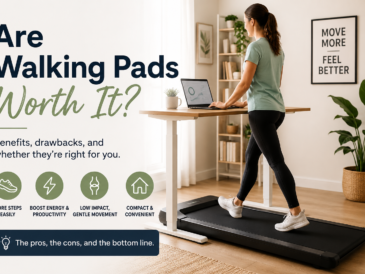
- Look for easy extra steps. A 10-minute walk after meals adds roughly 1,000 steps. A walking pad under your desk can add several thousand on a work-from-home day.
If you’re starting from very low activity because of tiredness, our article on low-intensity exercise for fatigue explains how to build up gently without making things worse.
Frequently Asked Questions
Is 10,000 steps a day necessary?
No. The 10,000 figure came from a 1960s Japanese pedometer marketing campaign, not a study. Large pooled studies find the benefit for lifespan levels off at about 6,000–8,000 steps a day in adults 60 and over, and about 8,000–10,000 in younger adults.
Is 5,000 steps a day enough?
It’s much better than 2,000–3,000. Pooled studies link roughly 4,000 steps a day with measurably lower risk of death, and each extra 1,000 steps with a further drop of about 15%. But most people get more benefit by building up towards 7,000 or more.
How many steps a day should a 60-year-old take?
The 2022 Lancet Public Health meta-analysis found that for adults 60 and over, the benefit for lifespan levelled off at about 6,000–8,000 steps a day. Steps above that are fine, but the extra gain in these studies was small.
Do fast steps count more than slow steps?
For fitness, brisk walking (about 100 steps a minute or more) helps more. For lifespan, two large studies found that walking pace didn’t add much once total daily steps were taken into account. Focus on the total first.
Does walking on a treadmill or walking pad count?
Yes. Steps are steps. Wrist trackers can undercount on a walking pad if you hold the handrail or type while walking, because your arm isn’t swinging. A tracker clipped to your waistband or in your pocket is more reliable there.