Here’s a number that predicts how long you’ll live better than your blood pressure does, and your doctor probably never checks it: how hard you can squeeze your hand. Grip strength sounds almost too simple to matter. A handshake, a jar lid, a pull-up bar. But researchers who study aging keep coming back to it, because the strength in your hands turns out to be a quiet readout of how the rest of your body is doing.
And the data is hard to argue with. A landmark study following nearly 140,000 adults across 17 countries found that every 5-kilogram drop in grip strength was linked to a 16% higher risk of dying from any cause. That’s a stronger predictor than systolic blood pressure. Let that sink in for a second.
Why Your Hands Know Something Your Mirror Doesn’t
You can’t see aging happening inside a muscle cell. You can’t feel your mitochondria slowing down or your nervous system losing a few connections each year. But grip strength catches all of it at once, because squeezing hard is a full-body event in disguise.
When you grip something with force, you’re firing motor neurons, recruiting fast-twitch muscle fibers, and relying on the same systems that keep you upright, balanced, and resilient. As those systems fade with age, your grip fades with them. So a weak grip isn’t really about your hands. It’s a symptom of something broader called sarcopenia, the gradual loss of muscle and power that starts creeping in around your mid-30s and accelerates after 60 if you do nothing about it.
This is also why grip strength tracks so closely with brain health. Several studies have linked weaker grip to faster cognitive decline and even smaller brain volume on scans. The muscle and the mind, it turns out, age on the same timeline more often than we’d like.
The Two-Minute Test You Can Do This Week
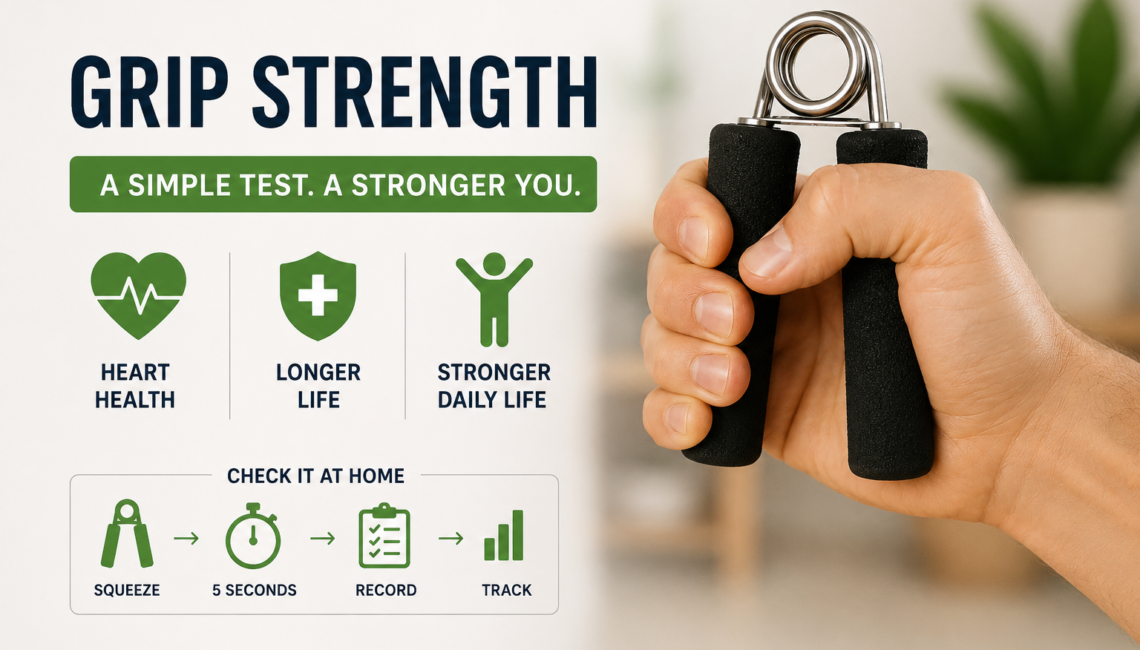
You don’t need a lab. The clinical tool is a hand dynamometer, a cheap gadget you can buy online for the price of a couple of coffees, and it gives you a number in kilograms you can track over months. Squeeze it three times with each hand, rest between tries, and take your best reading.
No gadget handy? There are rougher home checks that still tell you something:
- Hang from a sturdy pull-up bar and time it. Most healthy adults under 50 should manage at least 30 seconds. Struggling to hit 15 is a flag worth paying attention to.
- Carry a heavy grocery bag in each hand and walk. If your hands give out long before your legs do, your grip is the weak link.
- Open a stubborn jar without reaching for a rubber pad or running it under hot water. Small thing, but you’ll notice the trend over the years.
Rough benchmarks from research: men under 40 often grip in the 45-55 kg range per hand, women in the 27-35 kg range, with numbers sliding downward each decade. But honestly, the absolute number matters less than the direction it’s heading. Test yourself now, write it down, and check again in six months. Are you holding steady or quietly slipping?
How to Build a Grip That Outlasts You
The good news is that grip responds fast, and you don’t need anything fancy. The mistake most people make is treating grip as a tiny isolated thing, doing endless hand-squeezer reps while ignoring the bigger lifts that actually drive the gains.
What works better is loaded carrying. Pick up something heavy and walk with it. The farmer’s carry, grabbing a heavy dumbbell or kettlebell in each hand and walking 30 to 40 meters, hits your grip, your core, your shoulders, and your posture all at once. Do a few rounds twice a week and you’ll feel the difference in a month.
Dead hangs are the other quiet winner. Just hanging from a bar for as long as you can decompresses your spine, stretches your shoulders, and forces your forearms to hold your entire bodyweight. Start with whatever you can manage, even 10 seconds, and add a little each week. Rows, deadlifts, and pull-ups feed grip too, because you physically can’t lift the load if your hands won’t hold it.
One specific tip that pays off: stop using lifting straps for every set. Straps let your hands off the hook so your grip never has to grow. Save them for your heaviest work and let your bare hands do the rest. Your forearms will thank you in a way no hand-gripper gadget ever delivers.
What This Really Means for Staying Young
It’s easy to read all this as one more thing to worry about, one more metric to obsess over. That’s not the point. The point is that grip strength is one of the rare aging markers you can actually move. You can’t reverse your birthday. You can absolutely get stronger hands, and in doing so, drag a whole cascade of related systems along for the ride.
Think about what a strong grip protects in real life. It’s the difference between catching yourself on a railing and taking the full fall down the stairs at 70. It’s carrying your own luggage, lifting a grandchild, opening your own jars, staying independent instead of relying on someone else for the small physical tasks that quietly define a good life. Frailty doesn’t arrive overnight. It arrives one ungripped jar at a time.
So treat your grip as a longevity dashboard you can check for free. Squeeze hard, carry heavy things, hang from bars like a kid on a playground. The body keeps a remarkably honest record of how you’ve been treating it, and your hands, of all places, are where it shows up first. Start squeezing today, and your future self gets to keep doing the things that make a long life worth living.