In 2019, I was “successful” by most external metrics. Good salary, promotions arriving on schedule, a reputation for reliability that meant my phone buzzed through weekends and evenings. I was also exhausted in a way I couldn’t articulate — not tired from exertion, but depleted in some deeper way that sleep didn’t fix.
My doctor called it burnout. I called it Tuesday.
What followed was a forced reckoning with how I’d constructed my life — not just my work hours, but my entire relationship with time, attention, and identity. The phrase “work-life balance” had always sounded to me like something HR posters said. It took a full collapse of my health to understand it was describing something real and urgent.
I want to share what I’ve learned since then — both from rebuilding my own life and from the research that helped me understand why what I was doing was unsustainable.
First, Let’s Challenge the Balance Metaphor Itself
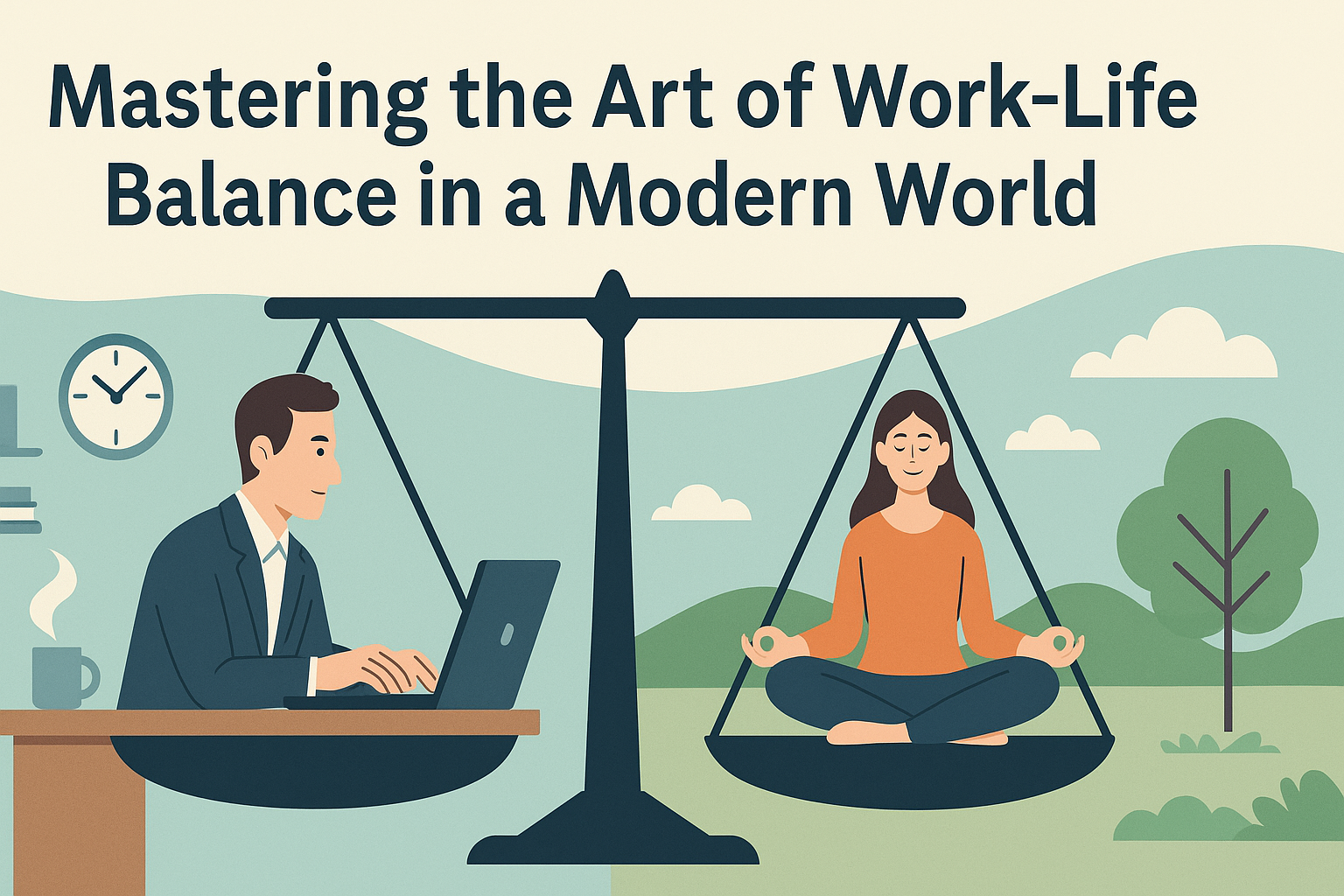
The “balance” framing — equal weight on both sides of a scale — is misleading and sets people up for failure. It implies you should spend equal time on work and life, or that the goal is some static equilibrium that, once achieved, stays put.
The reality is that work-life integration is dynamic. There are seasons of intense work — a product launch, a difficult project, a critical client — and seasons where you deliberately pull back. There are life events — illness, a new child, a family crisis — that legitimately require more of your non-work hours. Balance isn’t a fixed state; it’s an ongoing process of recalibration.
The better question isn’t “am I balanced?” but “am I sustainable?” Can you keep doing what you’re doing for the next five years without something breaking — your health, your relationships, your mental state, your creativity?
The Neuroscience of Overwork
Understanding why chronic overwork is physically damaging — not just unpleasant — changes how you relate to the problem.
A landmark study by Marianna Virtanen and colleagues, published in The Lancet (2015), followed 600,000 workers across 25 years. Workers putting in 55+ hours per week had a 33% higher risk of stroke and a 13% higher risk of coronary heart disease compared to those working 35-40 hours — independent of other lifestyle factors. The risk was dose-dependent: more hours, more cardiovascular damage.
The mechanism involves chronically elevated cortisol (the stress hormone), which over time damages the cardiovascular system, suppresses immune function, and impairs the prefrontal cortex — the brain region responsible for good decision-making, emotional regulation, and creative thinking. The cruel irony of overwork is that it eventually makes you worse at the very thing you’re sacrificing your health for.
In India, the culture of “log on early, leave late, always be reachable” is particularly entrenched in certain industries. The assumption that long hours signal commitment — rather than poor time management or inefficient systems — costs organisations and individuals enormously.
What Actually Creates Imbalance
Before fixing a problem, it helps to name its actual source. In my experience and in the research, chronic work-life imbalance usually stems from one or more of these:
Identity Fusion
When your sense of self-worth is entirely tied to professional performance — when being seen as “the hardest worker” is core to your identity — slowing down feels existentially threatening. This is especially common in people who were praised heavily for academic or professional achievement from childhood. The overwork isn’t really about the work; it’s about who you believe you are when you’re working hard.
Unclear Boundaries — External and Internal
External: your organisation has no clear norms around after-hours communication. Your manager messages at 10 PM and expects a prompt reply. Colleagues cc you on everything. There’s no culture of protecting non-work time.
Internal: even when no one is demanding your attention, you check email anyway. You feel guilty reading a novel when there are tasks undone. You can’t be fully present at a family dinner because your mind is partially somewhere else. This is what psychologists call “psychological detachment failure” — the inability to mentally disengage from work during off-hours — and it’s as damaging as the physical hours themselves.
Technology Without Boundaries
Smartphones made everyone reachable everywhere always. This was sold as convenience; it became invasion. The expectation of instant response collapsed the previously natural separation between work time and personal time. You need to actively reconstruct that separation because the technology won’t do it for you.
Practical Changes That Actually Work
Define Your “Hard Stop” and Communicate It
Pick a time after which you will not work — 7 PM is a common choice, 8 PM for people with long commutes. Block it in your calendar. Tell your team. Then honour it consistently. The first few weeks, you’ll feel anxious about emails going unanswered until morning. After a month, your anxiety level drops and your team adjusts.
The research on this is clear: a predictable end to the work day is associated with significantly better recovery and lower burnout risk than having a “soft” end time that regularly extends. The unpredictability of “I’ll leave when I’m done” is itself stressful — your brain never gets to disengage.
Separate Your Devices or Your Apps
The most effective intervention I know: remove work email from your personal phone. Use a separate work device if possible; if not, set work apps to go silent after your hard stop with an autoresponder that says you’ll reply in the morning. The physical separation of “this device is work, this one is personal” creates a tangible psychological boundary that pure willpower rarely sustains.
If your organisation requires you to be on-call, create an explicit protocol: specific on-call hours, a separate notification channel for genuine emergencies, and the clear understanding that non-emergency messages don’t require off-hours response. Many managers who send late-night messages don’t actually expect a reply until morning — they’re just processing their own anxiety. You don’t have to match that anxiety.
Schedule Recovery Deliberately
Rest doesn’t happen automatically in modern life — it gets displaced by the infinite availability of stimulation (social media, news, entertainment) and the guilt of unfinished tasks. You need to schedule it.
This means putting “no-meeting blocks” in your work calendar to protect focused work time. It means scheduling a walk, a meal away from screens, or time with family the way you’d schedule a meeting — as a commitment you don’t casually displace. It means taking your weekends and annual leave as if your long-term performance depends on them (it does).
Learn to Negotiate Workload, Not Just Manage It
Much advice on work-life balance focuses on personal habits — morning routines, meditation, time management techniques. These matter but they don’t address the underlying issue when the problem is a genuinely excessive workload.
If you consistently have more work than can be done in reasonable hours, the solution isn’t to become more efficient — it’s to negotiate scope. This means learning to say “I can do X or Y in this timeframe, not both — which is the priority?” rather than agreeing to everything and then working nights to deliver it. This is a skill that most high-performers are never taught and desperately need.
Protect One or Two Non-Negotiable Personal Commitments
In the most imbalanced periods of my career, I’d let go of everything personal if work demanded it. Exercise, hobbies, time with friends — all negotiable, all sacrificed. What I’ve learned since is that having one or two completely non-negotiable commitments — activities that are scheduled, recurring, and not displaced by work — provides an anchor.
For me, it’s a morning walk. The rule is simple: it happens unless I’m physically unwell. Work doesn’t preempt it. This single protected hour is where I think most clearly, where I’ve processed most of my difficult decisions, and where my mental health is most consistently maintained. Find your equivalent.
The Cultural Dimension in Indian Workplaces
Work-life balance conversations in India have specific cultural textures that Western frameworks often miss.
The startup culture glorification of 80-hour weeks — “hustle culture” imported wholesale from Silicon Valley — collides with a reality that Indian employees face: longer commutes (often 2-3 hours daily in major cities), joint family responsibilities including elderly parents and children’s educational demands that can’t be easily outsourced, and fewer household support systems than their Western counterparts.
The result is that work-life pressure in urban India can be particularly acute. A professional in Bengaluru or Mumbai may be commuting 3 hours, working 10 hours, and then managing family expectations in the remaining time — with essentially no margin for rest.
Acknowledging this reality matters. Work-life balance for an Indian professional often requires more systemic thinking — negotiating commute-work arrangements, setting firmer family boundaries around non-emergency demands, and recognising that saying no is a culturally counter-normative act that is nonetheless necessary for survival.
Frequently Asked Questions
My boss sends messages at 10 PM. What do I do?
First, check whether a reply is actually expected immediately or just when you’re next at work. Many people send messages when they think of things without expecting an instant reply. Clarify this explicitly: “I’m signing off for the night — is this urgent or can I pick it up in the morning?” Most managers will say “morning is fine” — and then you have their explicit permission to not respond after hours, which makes the boundary much easier to hold.
I feel guilty taking time off because my colleagues don’t. How do I manage this?
This is social comparison anxiety — and it’s very common. The colleagues who seem to never take time off are often either performing busyness, genuinely heading toward burnout, or have different life circumstances than you. Your need for rest is not a character flaw. Taking your entitled leave is also not optional from a health perspective — research consistently shows that workers who use their annual leave have lower burnout rates, better long-term performance, and greater job satisfaction. You’re not taking time away from work; you’re investing in your capacity to do it well.
How do I achieve work-life balance when I’m self-employed or a freelancer?
Self-employment removes the external structures (office hours, clear separation of work and home) that provide some natural boundaries for salaried workers. You need to create artificial ones: a dedicated workspace (even if it’s just a corner of a room), work hours that you treat as fixed, a ritual that marks the start and end of your work day. The psychological separation matters even when the physical separation doesn’t exist. Many successful freelancers also deliberately over-schedule personal time to prevent work from filling every available space.
Balance as a Practice, Not a Destination
Five years after that burnout, I work roughly the same number of hours I did before — but differently. I have a hard stop. I don’t check email after 8 PM. I walk every morning. I negotiate scope instead of just absorbing more. I’ve taken time off without guilt.
My productivity has not decreased. By most measures, it’s better — because I’m no longer making decisions from a depleted, stress-saturated brain. The research had been telling me this all along. I just had to break down badly enough to finally listen.
Work-life balance is not a reward you earn after proving yourself. It’s the precondition for performing well and living well simultaneously. Treat it accordingly.