This site has published at least four separate “flat belly exercises” listicles over the years — a different set of moves each time, no citations, no acknowledgment that any of the others existed. None of them answered the actual question: of all the exercises people do for their abs, which ones are backed by real measurement, and which are filler? This article replaces those old posts with one answer, grounded in the actual research on core exercise effectiveness.
This is one piece of our complete evidence-based guide to flat-stomach exercise and yoga claims, which also covers why spot reduction doesn’t work and how long real results actually take. This article is general information, not medical advice.
How Do You Even Measure Which Ab Exercise “Works Best”?
Before ranking anything, it’s worth being clear about what “best” can mean here. It doesn’t mean “burns the most belly fat” — as the pillar guide covers, no ab exercise does that; fat loss is a whole-body process driven by overall calorie balance, not local muscle activity. What research can actually measure is muscle activation: how hard a given exercise makes the rectus abdominis (the “six-pack” muscle) and obliques work, using electromyography (EMG) sensors that record electrical activity in the muscle during movement. Higher activation generally means more effective strength and endurance training for that muscle over time — which is the honest goal of a core routine: a stronger, more functional core, not a fat-loss shortcut.
What the Research Actually Ranks
The most frequently cited source for this is a study commissioned by the American Council on Exercise (ACE) and conducted at San Diego State University’s Biomechanics Lab, led by researcher Peter Francis. Thirty healthy adults performed 13 common abdominal exercises while EMG sensors measured rectus abdominis and oblique activation for each one. The results ranked bicycle crunches, captain’s chair leg raises, and crunches performed on an exercise ball as the top three for overall activation — the bicycle crunch activated the rectus abdominis at close to 2.5 times the level of a standard floor crunch, while also ranking near the top for oblique engagement. The plain floor crunch, by contrast, landed well down the list — and exercises using ab-specific gym equipment (ab rollers, “torso track” machines) generally performed worse than free-bodyweight moves, despite being marketed on the promise of superior results.
The practical takeaway isn’t “only ever do bicycle crunches.” It’s that a few well-chosen bodyweight movements — bicycle crunches, captain’s chair (or a hanging/supported leg raise if no chair apparatus is available), and stability-ball crunches — do more work per rep than a long list of low-activation filler exercises, which is useful information if you’re building a short, sustainable routine rather than a 45-minute ab circuit.
Why Planks and “Anti-Movement” Exercises Still Belong in a Core Routine
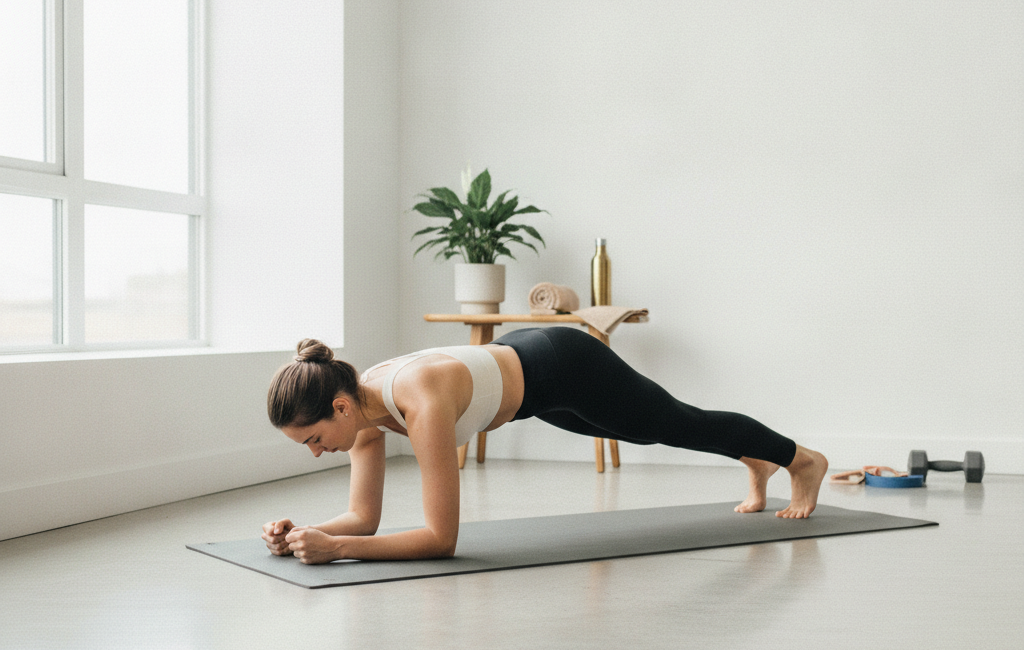
EMG activation isn’t the only lens worth applying. Crunches and leg raises train the core through movement (flexion), which is useful, but a resilient core also needs to resist unwanted movement — the job your abdominal and lower-back muscles do every time you lift something, twist awkwardly, or catch your balance. Planks, side planks, and the “dead bug” exercise (lying on your back, slowly extending opposite arm and leg while keeping the lower back pressed to the floor) train exactly that: bracing and spinal stability rather than repeated flexion. The deepest abdominal layer, the transverse abdominis, wraps around the torso like a corset and is engaged primarily through this kind of bracing work rather than through crunching motions — which is why a well-rounded routine mixes both types rather than picking one camp.
Does Combining Core Work With Cardio Actually Matter?
This is the question the old listicles never touched, and it connects directly to the spot-reduction discussion in the pillar guide. A 2021 systematic review and meta-analysis of randomized controlled trials, pooling 43 trials and more than 3,500 participants, compared aerobic training, resistance training, and combined aerobic-plus-resistance training for their effect on subcutaneous abdominal fat. Combined training produced the largest reduction (a weighted mean difference of about −28.8 cm² in abdominal fat area), notably larger than aerobic training alone (about −13.1 cm²) or resistance training alone (about −5.4 cm²). None of the groups in that analysis were doing isolated ab exercises without other training — this is evidence for pairing whole-body resistance work with cardio, not for adding crunches to a cardio routine and expecting a similarly sized effect.
That said, it lines up with the more targeted finding covered in the pillar guide: a 2023 randomized controlled trial found that adding targeted abdominal endurance exercise on top of regular aerobic training produced a modest additional reduction in trunk fat compared to aerobic training alone. Read together, the two studies point the same direction — core work is a reasonable addition to a fat-loss program built on aerobic and resistance training, not a replacement for one, and not something that does much in isolation.
A Simple, Evidence-Grounded Core Routine
Based on the activation research above, a short routine that covers both movement-based and bracing-based core training, without turning into a 20-exercise circuit:
- Bicycle crunches — highest measured rectus abdominis and oblique activation among common bodyweight moves.
- Captain’s chair leg raises (or supported leg raises) — second-highest activation in the same study; also engages hip flexors.
- Stability-ball crunch — third-highest; the unstable surface recruits more stabilizing muscle than a floor crunch.
- Plank or side plank — bracing/anti-movement work the flexion-based exercises above don’t cover.
- Dead bug — deep transverse abdominis engagement with the lower back protected, useful for people with lower-back sensitivity who find planks uncomfortable.
Two to three sets of each, two to three times a week, is enough for most people — more volume than that doesn’t reliably improve results faster, since the muscle still needs time to recover between sessions like any other. As covered in the pillar guide, pair this with the aerobic and resistance training, calorie balance, sleep, and consistency that actually drive visible change, and give it weeks to months rather than days.
If you’re wondering whether targeted training can shrink fat specifically around your midsection, the evidence on that question is covered in depth in our spot-reduction myth piece, which looks at 13 controlled studies on the subject.
Frequently Asked Questions
What is the single most effective ab exercise, according to research?
In the most commonly cited EMG study (ACE/San Diego State University, 13 exercises tested), the bicycle crunch produced the highest rectus abdominis activation — roughly 2.5 times that of a standard floor crunch — with captain’s chair leg raises and stability-ball crunches close behind.
Are ab machines like the ab roller worth using?
The same research found ab-specific equipment like ab rollers and torso-track machines generally activated the target muscles less than simple bodyweight exercises like bicycle crunches, despite heavier marketing.
Do I need both crunches and planks, or just one type?
Both, ideally. Crunch-style exercises train the core through movement (flexion), while planks and the dead bug train it to resist movement (bracing) — they work different aspects of core function, not the same one twice.
Will doing more ab exercises make my stomach flatter faster?
Not on its own. Research on combined training shows the biggest reductions in abdominal fat come from pairing aerobic and resistance training with a calorie deficit — targeted ab work adds a modest benefit on top of that, not a replacement for it.
How often should I train my core?
Two to three sessions a week of two to three sets per exercise is enough for most people; core muscles need recovery time between sessions just like any other muscle group.