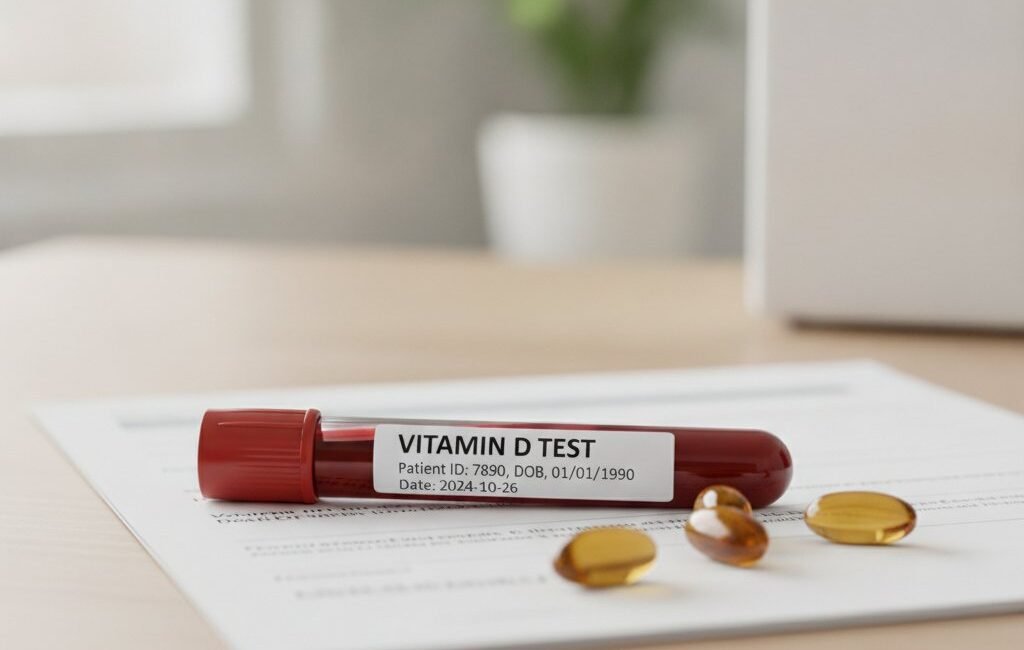
Vitamin D tests have become one of the most commonly ordered blood tests, often added to a routine health check whether or not there’s a reason for it. Then the result arrives with a number, a unit you may not recognise and sometimes a “low” or “insufficient” flag that sends people straight to the pharmacy for high-dose sachets.
This article explains when a vitamin D test is actually worth doing, what the numbers on your report mean, and why two labs (or two guidelines) can label the same result differently. It’s part of our complete guide to vitamin D: deficiency, dose and supplements.
This article is for general information and isn’t medical advice. A test result should always be read alongside your symptoms, medical history and other blood results, ideally by your doctor.
In this article:
- Which Test Measures Vitamin D?
- Should You Get Tested at All?
- Who Should Get Tested
- How to Read Your Result: ng/mL vs nmol/L
- Why the Cut-Offs Disagree
- Why Two Labs Can Give Different Numbers
- What to Do With Your Result
- Frequently Asked Questions
- Key Takeaways
Which Test Measures Vitamin D?
The standard test measures 25-hydroxyvitamin D, written 25(OH)D. This is the form your liver makes from the vitamin D you get from sunlight, food and supplements. It circulates in the blood for weeks, so it reflects your overall vitamin D supply rather than what you ate yesterday. Lab-medicine guidance describes it as the preferred test for assessing vitamin D status.
There’s a second test, for 1,25-dihydroxyvitamin D, the active hormone form. It sounds more important, but it’s the wrong test for checking whether you’re deficient. Your body tightly controls this form through parathyroid hormone, calcium and phosphate. When vitamin D runs low, parathyroid hormone rises and pushes the kidneys to make more of the active form, so 1,25-dihydroxyvitamin D is often normal or even high in people who are deficient. Laboratory guidelines say it shouldn’t be ordered to assess vitamin D status. It’s reserved for specific conditions, such as kidney disease and certain rare disorders of calcium or vitamin D metabolism.
If your report says “Vitamin D, 25-hydroxy” or “25(OH)D”, that’s the right test. If it says “1,25” and you were only checking for deficiency, ask your doctor why.
Should You Get Tested at All?
For most healthy adults without symptoms, the major guidelines say no.
- US Preventive Services Task Force (2021): concluded that the evidence is insufficient to weigh the benefits and harms of screening adults who have no signs of deficiency. Its review found that treating vitamin D deficiency picked up on screening had no benefit on cancer, type 2 diabetes, death, or fractures in people not at high fracture risk.
- Endocrine Society (2024): its updated guideline suggests against routine 25(OH)D testing in the general population, including healthy adults under 75, people with darker skin, and people with obesity. It also concluded that the evidence couldn’t support any specific blood level as a target.
- Choosing Wisely: the campaign, run by medical societies to cut low-value care, recommends against population-wide vitamin D screening and against routinely testing adults at low risk.
Why would a cheap blood test be a bad idea? Partly because acting on the result hasn’t been shown to make healthy people healthier. Large trials such as VITAL gave vitamin D to tens of thousands of adults and found little or no benefit for most outcomes. Partly because a test can start a chain of further appointments and treatment. A 2020 study in one US health system found that patients had on average 1.6 extra health services in the two years after a vitamin D test that wasn’t indicated. And partly because, as the sections below explain, the “normal” line itself is disputed.
Who Should Get Tested
Testing does make sense when the result could change your care. The Endocrine Society and Choosing Wisely both recognise testing for people at genuinely high risk of abnormal levels or their complications, including:
- symptoms that suggest real deficiency, such as bone pain, muscle weakness or difficulty climbing stairs (see which vitamin D deficiency symptoms are real)
- low blood calcium (hypocalcaemia)
- osteoporosis or unexplained fractures
- conditions that interfere with absorption, such as inflammatory bowel disease or gastric bypass surgery
- parathyroid or calcium disorders
- moderate or advanced chronic kidney disease
If you’re tired all the time, vitamin D may come up alongside other tests. Our guide to blood tests to ask for when you’re always tired puts it in context with iron, thyroid and B12, which are more common culprits.
What about the many people who are told they’re probably low, such as older adults, people who rarely go outside, or people with darker skin living far from the equator? For most of them, guidelines suggest simply taking a modest daily supplement rather than testing first. The Endocrine Society, for example, suggests empiric supplementation for adults 75 and over, and the NHS advises everyone in the UK to consider 10 micrograms (400 IU) a day in autumn and winter without a test.
How to Read Your Result: ng/mL vs nmol/L
Results come in one of two units:
- ng/mL (nanograms per millilitre), used mostly in the US and India
- nmol/L (nanomoles per litre), used mostly in the UK, Europe and Australia
To convert, multiply ng/mL by 2.5 to get nmol/L, or multiply nmol/L by 0.4 to get ng/mL. So 20 ng/mL is 50 nmol/L, and 30 ng/mL is 75 nmol/L. Mixing up the units is a common source of alarm: a UK result of “40” is 16 ng/mL, which is lowish, while a US result of “40” is 100 nmol/L, which is plentiful.
The US National Institutes of Health’s Office of Dietary Supplements summarises the levels set out by the US Institute of Medicine (now the National Academy of Medicine) in 2011:
- Below 12 ng/mL (30 nmol/L): associated with vitamin D deficiency, which can lead to rickets in children and osteomalacia (soft bones) in adults.
- 12–20 ng/mL (30–50 nmol/L): generally considered inadequate for bone and overall health in some people.
- 20 ng/mL (50 nmol/L) and above: adequate for bone and overall health in at least 97.5% of healthy people.
- Above 50 ng/mL (125 nmol/L): can be associated with potential adverse effects, particularly above 60 ng/mL (150 nmol/L).
Even the NIH notes that the exact level that defines deficiency hasn’t been definitively identified. These are reference points, not a diagnosis on their own.
Why the Cut-Offs Disagree
If your report flags 25 ng/mL as “insufficient”, it’s probably using a different rulebook from the one above.
In 2011, the same year as the Institute of Medicine report, the Endocrine Society published a guideline led by Michael Holick that set higher lines: below 20 ng/mL as deficiency, 21–29 ng/mL as insufficiency, and 30 ng/mL or more as sufficient. Many labs adopted these ranges, and they’re still printed on reports today. The Institute of Medicine committee, by contrast, argued that cut-offs above 20 ng/mL had probably overestimated how many people were deficient.
Which one you’re judged by makes a huge difference. A level of 25 ng/mL is “adequate” by the Institute of Medicine’s standard and “insufficient” by the 2011 Endocrine Society standard. Under the higher cut-off, a large share of perfectly healthy people get a red flag.
The Endocrine Society’s own 2024 update stepped back from this. Its panel concluded that the trial evidence wasn’t strong enough to set any blood-level thresholds for adequacy, and it suggests against routine follow-up testing to adjust doses towards a target number.
The debate is particularly live in India, where reviews have reported deficiency in roughly 70–90% of apparently healthy people. A 2025 systematic review argued that applying cut-offs developed in Western populations has inflated that figure, and that India needs its own population-specific reference ranges. If you’re in India and your lab flags a mildly low result, that context is worth knowing before you reach for a 60,000 IU sachet. Our guide to how much vitamin D to take a day explains doses and those sachets in detail.
Why Two Labs Can Give Different Numbers
Measuring 25(OH)D accurately is harder than it looks. Labs use two broad methods:
- Immunoassays, automated tests used by many busy labs because they’re fast and cheap.
- LC-MS/MS (liquid chromatography–tandem mass spectrometry), a more technical method generally regarded as more accurate.
In 2010, the NIH set up the Vitamin D Standardization Program to bring results into line. Its performance targets are a variation of no more than 10% and a bias of no more than 5% against a reference method. In one of its comparison studies, 15 laboratories measured the same 50 samples. Nearly all of the LC-MS/MS results met those targets, but only half of the immunoassays met the variation target and only three of eight met the bias target. In another study, some immunoassays were off by as much as 30% in samples containing a lot of vitamin D2, the plant-derived form found in some supplements and prescriptions.
In practice, this means a result of 18 ng/mL in one lab and 23 ng/mL in another may not reflect any real change in your body. If you’re tracking your level over time, try to use the same lab each time, and don’t read too much into small differences.
What to Do With Your Result
A rough guide to talking it through with your doctor:
- Clearly low (below about 12 ng/mL or 30 nmol/L): this is the range linked with real bone problems. Your doctor may recommend a treatment course, and may also check your calcium and other markers. Follow their dosing plan rather than improvising with high-dose products.
- In-between (roughly 12–20 ng/mL or 30–50 nmol/L): a modest daily supplement in line with official advice is usually sensible, especially in winter or if you get little sun. See whether you can get enough vitamin D from the sun in winter.
- 20 ng/mL (50 nmol/L) or more: adequate for most people by the Institute of Medicine’s standard, even if your lab flags anything under 30 ng/mL.
- Above 50 ng/mL (125 nmol/L): more isn’t better. If you’re taking high-dose supplements, review the dose with your doctor.
When to retest: not too soon. After you start or change a supplement, your level keeps rising for weeks as your body’s stores fill up. UK clinical guidance suggests a new steady level is reached after about three months and possibly not until six, so retesting before three months mostly measures a moving target. Many people who start a standard daily dose for a clear reason, such as the UK winter, don’t need a repeat test at all. If you do get one, our checklist of things to know before a blood test covers the practical side. And if hair fall prompted the test, see whether low vitamin D can cause hair loss.
Frequently Asked Questions
What is a normal vitamin D level?
The US Institute of Medicine considers 20 ng/mL (50 nmol/L) or more adequate for bone and overall health in nearly everyone. Some labs use the older 2011 Endocrine Society ranges and label anything below 30 ng/mL (75 nmol/L) as insufficient. The Endocrine Society’s 2024 guideline concluded that the evidence can’t support any specific target level.
How do I convert vitamin D from nmol/L to ng/mL?
Multiply nmol/L by 0.4 to get ng/mL, or multiply ng/mL by 2.5 to get nmol/L. For example, 50 nmol/L equals 20 ng/mL, and 75 nmol/L equals 30 ng/mL.
Should I get my vitamin D level checked every year?
Not if you’re a healthy adult without symptoms or risk conditions. The US Preventive Services Task Force found insufficient evidence for screening, and the Endocrine Society suggests against routine testing. Testing makes sense for people with symptoms of deficiency, osteoporosis, absorption problems, kidney disease or calcium disorders.
How long after starting vitamin D should I retest?
Usually no sooner than about three months, because levels take that long to settle at a new steady state, and some guidance suggests waiting up to six months. Many people taking a standard daily dose don’t need a repeat test at all.
Key Takeaways
- The right test is 25-hydroxyvitamin D. The 1,25-dihydroxy test doesn’t show whether you’re deficient.
- Major guidelines advise against routine vitamin D testing for healthy adults without symptoms or risk conditions.
- Multiply ng/mL by 2.5 to get nmol/L. 20 ng/mL (50 nmol/L) is adequate for most people by the Institute of Medicine’s standard.
- Cut-offs differ between guidelines, and results differ between labs, so a mildly “low” flag isn’t a reason to start high-dose supplements on your own.
- If you do supplement, wait at least three months before retesting.