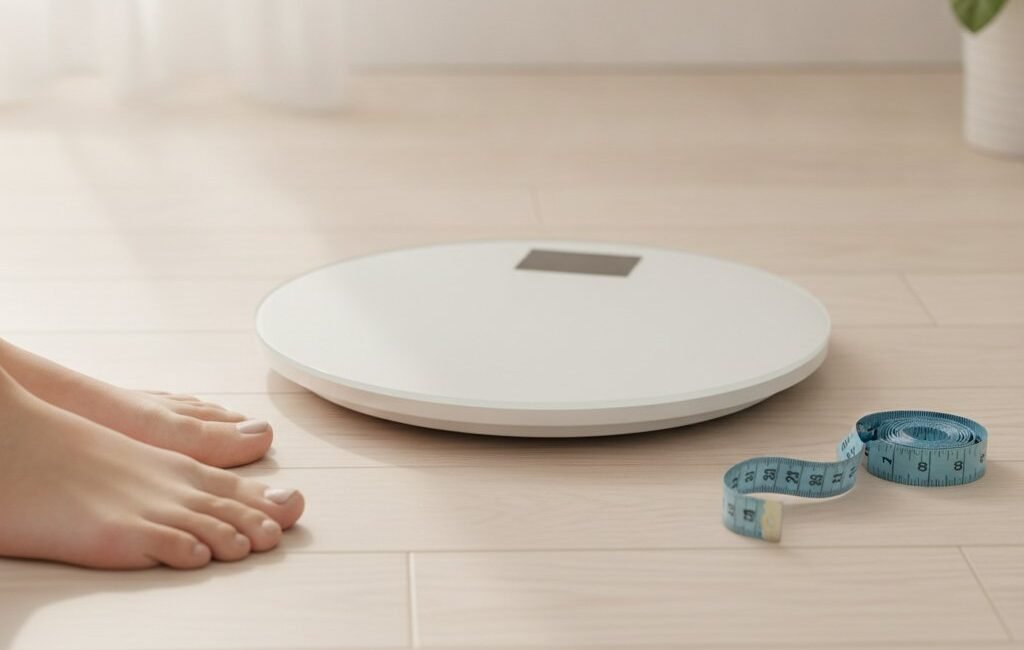
You step on your smart scale in the morning and it says 24% body fat. That evening, after a few glasses of water and a workout, it says 22%. You didn’t lose two points of fat in a day, so which number is right? Probably neither, exactly. Smart scales are very good at one job, weighing you, and much less reliable at the job most people buy them for: telling you how much of that weight is fat.
This article covers how these scales estimate body fat, what independent studies have found when they tested them against a hospital body-composition scan, why your reading jumps around, and how to use one so the numbers actually help. It’s part of our complete guide to fitness trackers and health gadgets, which looks at which devices are worth it overall.
This article is for general information and isn’t medical advice. If you have a medical condition, an implanted device, or concerns about your weight, talk to your doctor.
In this article:
- How a Smart Scale Estimates Body Fat
- What the Validation Studies Found
- Why Your Body Fat Reading Jumps Around
- Are Smart Scales Useful for Tracking Trends?
- How to Get More Consistent Readings
- Who Shouldn’t Use the Body Fat Feature
- Better Ways to Track Body Composition
- Frequently Asked Questions
- Key Takeaways
How a Smart Scale Estimates Body Fat
A smart scale doesn’t see fat. It sends a tiny, harmless electrical current through your body, usually in through one foot and out through the other, and measures how much the body resists it. This is called bioelectrical impedance analysis, or BIA.
The idea is simple. Water conducts electricity well, and lean tissue such as muscle holds a lot of water. Fat holds very little. So a body with more lean tissue lets the current through more easily. The scale combines that resistance reading with what you entered in the app (height, age, sex, sometimes an “athlete” setting) and runs it through a prediction equation to estimate fat and lean mass.
Two things follow from this, and they explain most of the problems below:
- The scale is really measuring water, then guessing. Anything that changes how much water is in your body, or where it is, changes the reading.
- A foot-to-foot scale only “sees” your lower body. The current takes the easiest route, up one leg and down the other. Your trunk and arms, where a lot of fat and muscle sit, are mostly estimated from the equation rather than measured. Some scales add a handle with electrodes for your hands to get around this.
What the Validation Studies Found
To test a smart scale, researchers compare it with a reference method, usually a DXA (or DEXA) scan, a low-dose X-ray that separates fat, lean tissue and bone. DXA isn’t perfect, but it’s far more precise than a bathroom scale.
Weight: accurate
The good news first. In a 2021 study published in JMIR mHealth and uHealth, Frija-Masson and colleagues at a French hospital tested three consumer smart scales (Téfal Body Partner, Terraillon DietPack and Nokia Withings Body Cardio) on patients who were already having a DXA scan, with roughly 50 patients per scale. All three gave accurate body weights, with a median difference from DXA of less than a kilogram.
Body fat: not accurate for individuals
Body composition was a different story. In the same study, all three scales underestimated body fat overall, and the size of the error depended on the person, which led to very large errors for some people. The authors’ conclusion was blunt: smart scales are not accurate for body composition and shouldn’t replace DXA in patient care. One caveat is that these were hospital patients, many referred for obesity or chronic conditions, so the results may not match a healthy, average-weight adult exactly.
An earlier study points the same way. Bosy-Westphal and colleagues (Obesity Facts, 2008) compared consumer BIA devices with whole-body MRI and DXA in 106 healthy adults of normal weight, overweight and obesity. Every foot-to-foot device had a systematic bias in body fat percentage. A device with electrodes for both hands and feet did better. It had no systematic bias, but even its 95% limits of agreement ran from about 6.6 percentage points too low to 4.6 points too high. In plain terms, even the better device could be several points off for a given person. The authors recommended the hand-and-foot design for individual use and said foot-to-foot devices are mainly useful for group averages in research.
A 2019 study in Health and Technology by Hood and colleagues tested the Fitbit Aria scale in 43 healthy adults against underwater weighing, another reference method. Its body fat estimates didn’t agree closely enough to be used interchangeably with the reference. The error fell outside the ±3.5% range the authors used as acceptable.
So what does that mean in practice? If your scale says 25% body fat, your true figure could reasonably be a few points either side, and for some people more. That’s a big range when you’re hoping to see a change of one or two points.
Why Your Body Fat Reading Jumps Around
Because BIA works through body water, normal day-to-day changes in hydration can move the number even when your actual fat hasn’t changed.
- Drinking a lot of water. In a 2023 study in The Journal of Sports Medicine and Physical Fitness, Jeong and colleagues measured 39 adults before and after drinking 2 litres of water. A multi-frequency BIA device’s body fat percentage went up by about 2 points in men and about 2.5 in women. DXA picked up the water as extra lean mass, as you’d expect. The BIA device read a lot of it as extra fat. The authors said hydration needs to be standardised before BIA measurements.
- Sweating and exercise. Saunders and colleagues (Medicine & Science in Sports & Exercise, 1998) dehydrated and then over-hydrated 15 endurance athletes by about 3% of body weight and compared BIA with underwater weighing. They concluded BIA wasn’t a valid way to track body composition changes from training in athletes, because even small fluid shifts could be misread as changes in body fat.
- Other everyday factors. A meal, alcohol, a salty dinner, the menstrual cycle, cold or damp feet, and how you stand can all shift water or change the contact with the electrodes. None of these change how much fat you carry, but they can all change the reading.
This is why a body fat number from a single morning shouldn’t worry you or please you much. It’s one noisy estimate.
Are Smart Scales Useful for Tracking Trends?
This is the claim manufacturers lean on most: even if the number isn’t exactly right, it’s consistent, so you can watch the trend. There’s some truth to it. The Fitbit Aria study above found that the scale gave consistent readings across three separate days, even though it wasn’t accurate against the reference. A consistent scale can still be useful if its error stays about the same for you over time.
But there are limits. The hydration studies show that consistency depends heavily on measuring under the same conditions. And if you change your body a lot, for example by building muscle, losing a lot of weight or changing how much you train, the scale’s built-in equation may not keep up. We didn’t find good independent studies showing that consumer smart scales track changes in body fat over months as well as DXA does. Treat trend claims as plausible but not proven.
What a smart scale does track well is your weight trend, and that’s genuinely useful. Research on weight loss has repeatedly linked regular self-monitoring with better results (we cover this in our article on whether fitness trackers help you lose weight). Logging your weight automatically and seeing a weekly average is the strongest reason to own one.
How to Get More Consistent Readings
If you want the body fat figure to mean anything, reduce the noise:
- Same time, same conditions. First thing in the morning, after using the toilet, before eating or drinking, and before exercise works best for most people.
- Bare, dry feet. Socks stop the body fat measurement working, and very dry or wet skin changes contact. Stand still, centred on the electrodes.
- Keep the scale in one place. A hard, flat floor, not a rug.
- Check your profile settings. Height, age and sex feed the equation. An “athlete” mode changes the equation too, so use it only if it fits you, and don’t switch back and forth.
- Look at weekly or monthly averages. Ignore single days. A steady change over several weeks is much more meaningful than a jump overnight.
- Avoid the obvious disruptors before a reading. A hard workout, a sauna, a lot of alcohol or a very salty meal the night before can all skew the result.
Who Shouldn’t Use the Body Fat Feature
Manufacturers themselves warn some people away from the body composition feature. Philips, for example, says its body analysis scale should not be used by anyone with a pacemaker or implanted defibrillator, and other makers, including some Withings models, give similar warnings for pacemakers and other implanted electronic devices. Several brands let you switch off the electrical measurement and use the scale for weight only. If you have an implanted device, check your scale’s manual and ask your cardiologist.
Pregnancy is another case. Body water changes a lot during pregnancy, and some manufacturers say their body fat estimates aren’t designed or validated for pregnant users. Weight-only mode is the sensible choice.
It’s also worth being careful if you have a history of disordered eating, or if you notice that daily body fat numbers are making you anxious. The numbers are too noisy to be worth that stress, and weighing less often, or not at all, is a perfectly reasonable choice.
Better Ways to Track Body Composition
If what you really care about is fat around your middle, a few low-tech measures are worth combining with (or using instead of) your scale:
- Waist circumference. A tape measure around your waist is cheap and directly tracks the abdominal fat most linked to health risk. We explain why belly fat matters in why belly fat is a sign of inflammaging.
- How your clothes fit, and progress photos. Crude, but not fooled by a glass of water.
- Strength and fitness. If you’re training, getting stronger is a better sign that you’re keeping muscle than a scale’s “muscle mass” number.
- A DXA scan. If you need a precise figure, for example for a medical reason, DXA is the better tool. It’s available in some clinics and sports-science centres, but it costs money and involves a small dose of radiation, so it isn’t something to repeat often for curiosity.
For practical advice on losing abdominal fat, see our evidence-based guide to getting a flatter stomach. And if you’re wondering about weight and health risk more broadly, our article on obesity symptoms and causes covers the basics.
The same lesson applies to other gadgets. In our look at how accurate fitness trackers are, the pattern is similar: devices are good at the thing they measure directly (steps, heart rate, weight) and much weaker at the thing they estimate from equations (calories, body fat).
Frequently Asked Questions
How accurate are smart scales for body fat?
Not very, for any one person. Independent studies comparing consumer scales with DXA scans have found systematic biases and errors of several percentage points for individuals. Smart scales are accurate for body weight, though.
Why does my smart scale show a different body fat percentage every day?
Mostly because of changes in body water. Smart scales estimate fat from how easily a small current passes through your body, and drinking, sweating, eating and exercise all change that. In one study, drinking 2 litres of water raised the body fat reading by about 2 percentage points.
Are smart scales good for tracking progress?
They’re good for tracking your weight trend. For body fat, they can give consistent readings if you measure under the same conditions every time, but there’s little independent evidence that they track real changes in body fat over months as well as a DXA scan. Use weekly averages, not single days.
Is it safe to use a body fat scale with a pacemaker?
Many manufacturers advise against using the body fat feature if you have a pacemaker or other implanted electronic device. Some scales let you turn it off and use weight only. Check your scale’s manual and ask your cardiologist.
Are scales with hand electrodes more accurate?
Probably somewhat. A 2008 study found that a device with hand and foot electrodes had no systematic bias in body fat percentage, unlike the foot-to-foot devices tested, but individual readings could still be several points off.
Key Takeaways
- Smart scales measure weight accurately, and a weight trend is the most useful thing they give you.
- Body fat is estimated from how a small current passes through your body, which mainly reflects body water, plus an equation.
- Studies against DXA show body fat estimates can be several percentage points off for an individual, and foot-to-foot scales tend to show systematic bias.
- Hydration, exercise and meals can move the body fat number by a couple of points with no real change in fat.
- If you use the body fat feature, measure under the same conditions every time and watch weekly averages. A tape measure around your waist is a useful cross-check.
- Don’t use the body fat feature with a pacemaker or other implanted device, or during pregnancy, unless your doctor and the manufacturer say it’s fine.
For an overview of which health gadgets are worth buying, from step counters and smartwatches to blood pressure monitors, see our full guide to fitness trackers and health gadgets.