Most hair shedding is ordinary. The average scalp sheds 50 to 100 hairs a day as part of a normal growth cycle, and stress, seasonal changes, or a rough haircut can all cause temporary thinning that resolves on its own. But a smaller share of hair loss is a visible symptom of an underlying medical condition — and catching it early can mean treating the actual cause instead of just the hair. This article is part of our complete guide to hair growth and hair loss; it focuses specifically on three conditions that commonly show up first as hair loss: thyroid disease, polycystic ovary syndrome (PCOS), and alopecia areata.
This article is for general education and is not medical advice. If you’re experiencing unexplained or worsening hair loss, see a doctor for proper testing and diagnosis.
Thyroid disease: diffuse shedding with a hormonal cause
The thyroid gland produces hormones that regulate metabolism in nearly every cell in the body, including the cells that drive hair growth. Both an underactive thyroid (hypothyroidism) and an overactive one (hyperthyroidism) can push large numbers of hair follicles out of their growth phase and into the shedding phase at once — a pattern called telogen effluvium, which we cover in more mechanistic detail in our article on postpartum and stress-related hair loss.
A 2024 retrospective study of 500 female patients with telogen effluvium, published in Medicine, found that 150 had hypothyroidism and 102 had hyperthyroidism, with the remainder euthyroid (normal thyroid function). Notably, the hypothyroid group showed significantly more severe hair loss than either the euthyroid or hyperthyroid groups — supporting the recommendation that thyroid function testing (TSH, and free T4 if TSH is abnormal) should be part of the standard diagnostic workup whenever someone presents with diffuse, unexplained shedding.
What makes thyroid-related shedding different
Unlike pattern hair loss, which concentrates at the crown or hairline, thyroid-related shedding is typically diffuse — thinning evenly across the whole scalp rather than in a specific zone. It’s also usually accompanied by other thyroid symptoms: unexplained fatigue, weight changes, feeling unusually cold or hot, changes in heart rate, or dry skin. Hair loss that shows up alongside any of these is a reasonable prompt to ask a doctor for thyroid labs, even if hair is the symptom that made you notice something was wrong.
PCOS: hair loss driven by androgen excess
Polycystic ovary syndrome is a hormonal condition affecting the ovaries, marked by elevated androgens (male-pattern hormones like testosterone), irregular periods, and — in many cases — visible androgen-related changes to hair, skin, and weight. One of those changes is androgenetic (pattern) hair loss, the same underlying process we cover in depth in our article on androgenetic hair loss and DHT, except here it’s being driven by an underlying endocrine condition rather than genetics alone.
A report from the Androgen Excess and PCOS Society, published in the Journal of Clinical Endocrinology & Metabolism, and other clinical reviews put the prevalence of androgenetic alopecia among women with PCOS at roughly 20% to 30% for clearly diagnosed female pattern hair loss, with some studies reporting visible thinning in as many as 40-70% of PCOS patients depending on diagnostic criteria and population studied — notably, some show the pattern as early as their teens. Clinically, it tends to present as diffuse thinning concentrated at the crown and mid-frontal scalp, with the frontal hairline itself usually preserved — a distinguishing feature from other forms of hair loss.
Other signs that point to PCOS specifically
Hair loss alone doesn’t diagnose PCOS. What raises suspicion is hair thinning appearing together with irregular or absent periods, new or worsening acne, excess facial/body hair growth (hirsutism), or difficulty managing weight. If several of these appear together, it’s worth requesting hormone testing — typically including testosterone, DHEA-S, and a pelvic ultrasound — rather than treating the hair loss in isolation.
Alopecia areata: an autoimmune cause, not a hormonal one
Alopecia areata is different in kind from the first two: it’s an autoimmune disease in which the body’s own T cells attack hair follicles, causing them to stop producing hair. It’s considered the most prevalent autoimmune disorder overall and the second most common cause of hair loss after androgenetic alopecia, with a lifetime risk of roughly 2% in the general population. It can affect anyone, but onset peaks between ages 15 and 29, and around 44% of cases begin before age 20.
The hallmark presentation is one or more well-circumscribed, round or oval bald patches with a sharp, distinct border against otherwise normal hair — quite different from the diffuse thinning of thyroid disease or the crown-concentrated pattern of PCOS-driven hair loss. In more extensive cases it can progress to alopecia totalis (loss of all scalp hair) or alopecia universalis (loss of all body hair), though most cases stay limited to one or a few patches.
Why the distinction matters
Because alopecia areata is autoimmune rather than hormonal, the workup and treatment path are different — a dermatologist will typically diagnose it by exam (sometimes with a scalp biopsy or dermoscopy to confirm) rather than blood hormone panels, and treatment options include topical or injected corticosteroids and, for more severe or widespread cases, newer JAK-inhibitor medications specifically studied for this condition.
Red flags: when to actually see a doctor
Everyday shedding doesn’t need a doctor’s visit. These patterns do:
- Sudden, patchy bald spots with a clean, round border — possible alopecia areata
- Diffuse thinning across the whole scalp, especially alongside fatigue, weight change, or temperature sensitivity — possible thyroid involvement
- Crown/mid-scalp thinning with a preserved hairline, especially alongside irregular periods, acne, or excess facial hair — possible PCOS or another androgen-excess condition
- Hair loss with scalp pain, itching, redness, or scarring — needs prompt dermatology evaluation to rule out scarring alopecia, which can cause permanent follicle loss if untreated
- Rapid, significant loss over weeks rather than a gradual thinning over months or years
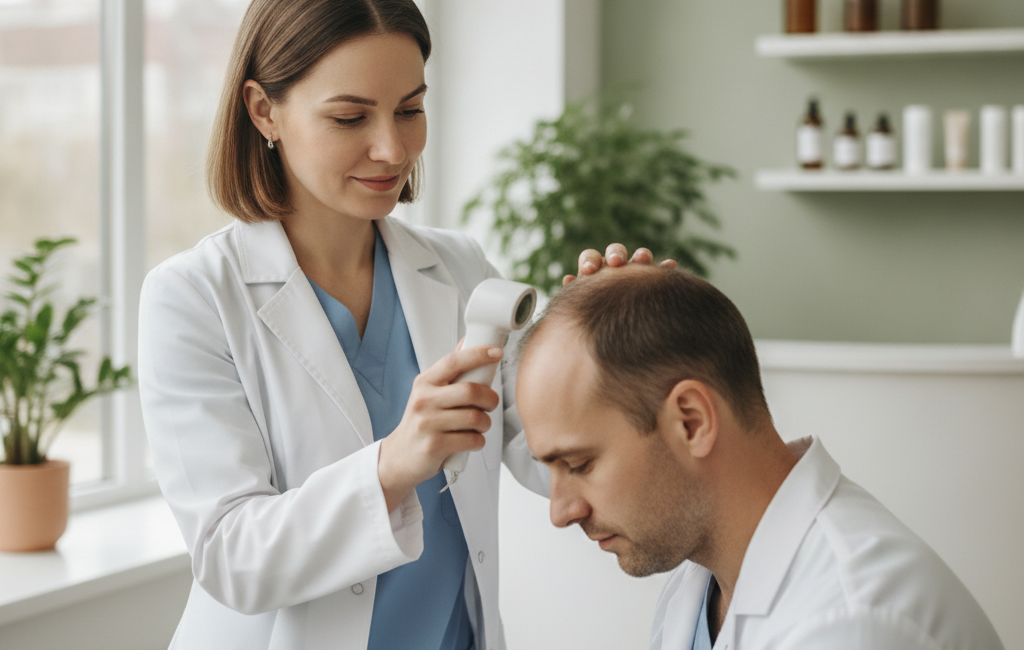
A reasonable starting workup for unexplained hair loss typically includes TSH, ferritin (iron stores — see our article on iron deficiency and hair fall if this applies to you), and, when androgen excess is suspected, testosterone and DHEA-S. A dermatologist can also examine the scalp directly (trichoscopy) to distinguish between these patterns before ordering labs.
Frequently Asked Questions
Can hair loss be the first sign of thyroid disease?
Yes. Diffuse hair shedding can appear before other thyroid symptoms become obvious, which is why doctors often include TSH testing in the standard workup for unexplained hair loss, even without other symptoms yet present.
Does PCOS-related hair loss grow back with treatment?
It can improve with treatments that address the underlying androgen excess (such as anti-androgen medications or hormonal birth control, prescribed by a doctor), plus the same topical treatments used for androgenetic hair loss generally. Results take months, since hair growth cycles are slow, and existing miniaturized follicles don’t always fully reverse.
Is alopecia areata permanent?
Not necessarily. Many people with limited patchy alopecia areata regrow hair spontaneously within a year, sometimes without treatment, though recurrence is common. More extensive cases (totalis/universalis) are less likely to resolve on their own and are more likely to need medical treatment.
Should I see a dermatologist or an endocrinologist for hair loss?
Start with a primary care doctor or dermatologist. They can run initial hormone and iron labs and examine the scalp pattern; if results point to a hormonal condition like thyroid disease or PCOS, they’ll typically refer you to an endocrinologist or gynecologist for ongoing management while continuing to manage the hair loss itself.