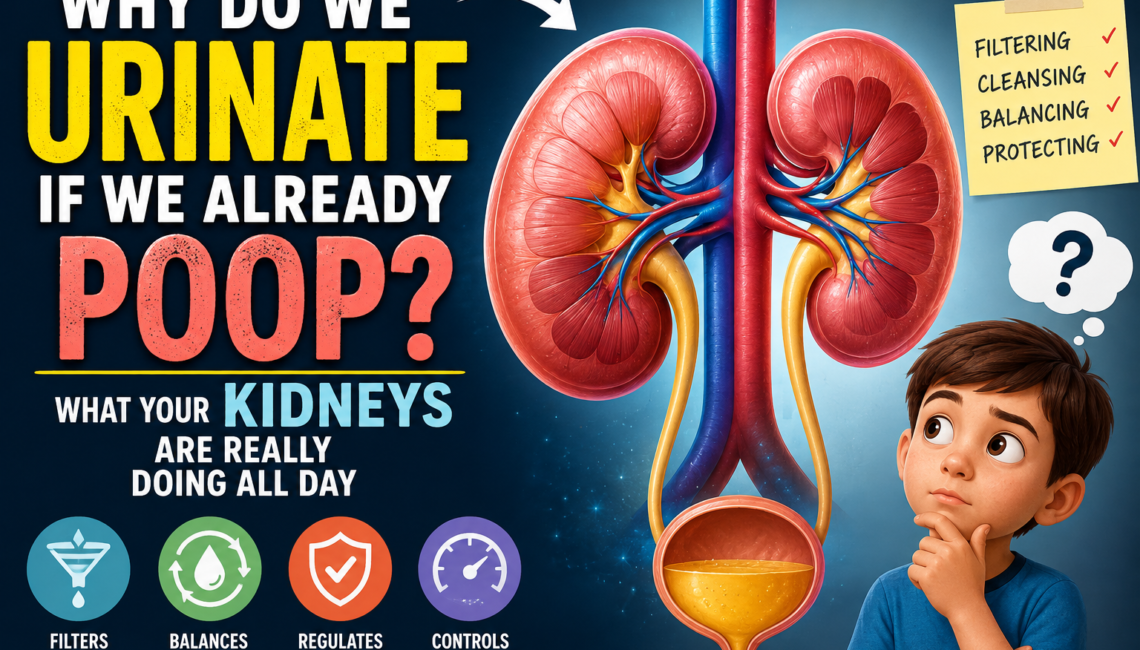
Right now, as you read this, roughly a quarter of everything your heart pumps is heading toward two organs the size of your fists. Not your brain. Not your legs. Your kidneys. They filter something like 180 litres of fluid a day and quietly hand almost all of it back to you. The litre or so you actually see in the toilet is the leftover.
So why do we urinate at all, if pooping already gets rid of waste? It’s a genuinely good question, and most of us were never taught the answer. Pee and poop are not two versions of the same process. They’re not even collecting garbage from the same building.
Poop Is Leftovers. Pee Is What Was Actually Inside You.
Think of your digestive tract as a long tunnel running through your body. Food travels through that tunnel, and your intestines pull out what they want — sugars, fats, amino acids, vitamins, minerals, water. Whatever they don’t pull out keeps moving and eventually leaves. That’s stool: fibre your body can’t digest, billions of dead gut bacteria, bile pigments (the reason poop is brown), and bits of food that never made it past the intestinal wall.
Which leads to something odd. Almost nothing in your stool was ever inside your bloodstream. It passed through you. That tunnel is technically the outside world, just tucked neatly inside your torso.
Urine is the opposite story. Every single thing in your urine was, minutes earlier, dissolved in your blood, circulating through your heart and brain and fingertips. Your cells are constantly burning fuel and breaking down old proteins, and that metabolism produces chemical trash that can’t just sit there. Stool can’t touch that trash, because it’s on the wrong side of the wall. You need a completely separate exit — one that plugs directly into your bloodstream. That’s the kidneys.
Why Do We Urinate? Your Blood Needs Round-the-Clock Housekeeping
When your body breaks down protein, one of the byproducts is ammonia, which is genuinely toxic. Your liver converts it into urea, which is far safer but has one important property: it dissolves in water. Same for creatinine from muscle turnover, uric acid from cell breakdown, leftover medicines, extra potassium, and the extra salt from last night’s biryani.
All of it is water-soluble, and that’s exactly why you can’t poop it out. Water-based waste needs a water-based flush, so your body has to spend fluid to carry it away.
Can’t you just sweat it out? No. Sweat carries traces of urea, but you’d have to lose impossible volumes to clear one day’s metabolic load, and you’d wreck your electrolytes trying. The kidneys do this job or nobody does.
What’s remarkable is how much they hand back. Your kidneys filter blood indiscriminately at first — glucose, amino acids, sodium, water, all of it gets dumped in. Then, along a series of microscopic tubes, they reclaim about 99% of the fluid and nearly every useful molecule, leaving the waste behind in a concentrated stream. Each kidney has roughly a million of these filtering units, and the whole sorting operation runs every second of your life without a single instruction from you.
What Your Kidneys Do Besides Making Urine
Calling kidneys “filters” undersells them badly. Filtering is the headline job, but they’re also running several systems you’d never connect to a bathroom trip:
- They control your blood pressure. Kidneys decide how much salt and water stays in your bloodstream, and they release an enzyme called renin that tightens or relaxes your blood vessels. This is why so many blood pressure medicines act on the kidneys, and why failing kidneys and high BP feed each other in a nasty loop.
- Red blood cells get built because your kidneys ask for them, via a hormone called erythropoietin. When kidneys fail, people turn anaemic and exhausted — not from lack of iron, but because the order to build red cells stopped going out.
- Vitamin D is useless until your kidneys activate it. You can sit in the sun for hours or swallow capsules daily, but the final conversion step happens in the kidney. Weak kidneys means weak bones, by a route almost nobody expects.
- Your blood’s acidity is held in a narrow band, with excess acid dumped into urine. Drift too far either way and enzymes across your whole body start misbehaving.
- Potassium is managed with obsessive precision, because too much of it stops your heart. Literally. That’s one reason kidney failure can turn into an emergency within days.
Two fist-sized organs, about half a percent of your body weight, running your fluid balance, blood pressure, red cell production, bone health, and blood chemistry. And they never mention it.
Your Urine Is a Daily Report Card — Actually Read It
Be honest: when did you last glance at your urine before flushing? Most people never do, and it’s free information.
Pale straw or light yellow is the target. Dark amber usually means concentrated urine and not enough water, though certain vitamins and medicines can also darken it. Completely clear all day long isn’t a gold star either — it can mean you’re drinking more than you need. Pink or brown, persistent foam, or a burning sensation are worth a doctor’s attention rather than a Google search.
That foam point deserves emphasis. A bit of froth from the force of the stream is normal. Urine that consistently looks like the head of a beer can mean protein is leaking through your filters — one of the earliest detectable signs of kidney damage, often years before you feel anything.
Because that’s the cruel thing about kidneys. You can lose half their function and feel completely fine. No pain, no swelling, no warning. By the time symptoms show up loudly, a lot of ground has already been lost.
Two Habits Worth Changing This Week
First: if you have diabetes, high blood pressure, or a family history of kidney disease, ask your doctor for two specific tests at your next visit — serum creatinine with eGFR, and a urine albumin-to-creatinine ratio. The second one is the sensitive early-warning test, and it gets skipped constantly in routine checkups. Ask for it by name — a plain “kidney function test” often skips it.
Second: look at your painkiller habit. Popping ibuprofen or diclofenac for every headache, backache, or period cramp — for years — is one of the more common self-inflicted kidney injuries out there, especially if you’re dehydrated or on blood pressure medication. Occasional use is fine for most people. A default reflex is not. And cut the salt while you’re at it, because your kidneys are the ones cleaning up after every packet of namkeen.
If you remember one thing, make it this: pooping deals with what you never absorbed, and urinating deals with what your own cells produced. Two kinds of waste, two separate exits, and only one of them plugs straight into your bloodstream. Your kidneys have run that second system flawlessly since before you were born, asking for nothing except water and some restraint with the salt shaker.
Drink a glass of water. Look before you flush. It’s the cheapest health check you’ll ever do.