Most diet advice is about nutrients: cut sugar, cut fat, eat more fibre. Over the last decade, researchers have started asking a different question: does it matter how a food is made? Ultra-processed food (packaged snacks, sugary cereals, soft drinks, ready meals, most fast food) now makes up more than half of what many people eat. A growing body of research suggests it also makes it easier to eat more than you need without noticing.
This article covers what “ultra-processed” actually means and what the landmark NIH feeding study found. It also looks at what newer trials and large population studies add, where the evidence is still debated, and how to use it without turning your kitchen upside down. It’s part of our complete guide to how to lose weight, based on the evidence.
This article is for general information and isn’t medical advice. If you have a medical condition, take medication that affects appetite or blood sugar, or have a history of disordered eating, talk to your doctor or a registered dietitian before changing how you eat.
In this article:
- What Counts as Ultra-Processed Food?
- The NIH Study: 500 Extra Calories a Day
- Why Might Ultra-Processed Food Make Us Eat More?
- The 2025 UK Trial: Same Healthy Guidelines, Different Results
- What Large Population Studies Show
- The Limits and the Critics
- How to Eat Less Ultra-Processed Food Without Going to Extremes
- Frequently Asked Questions
- Key Takeaways
What Counts as Ultra-Processed Food?
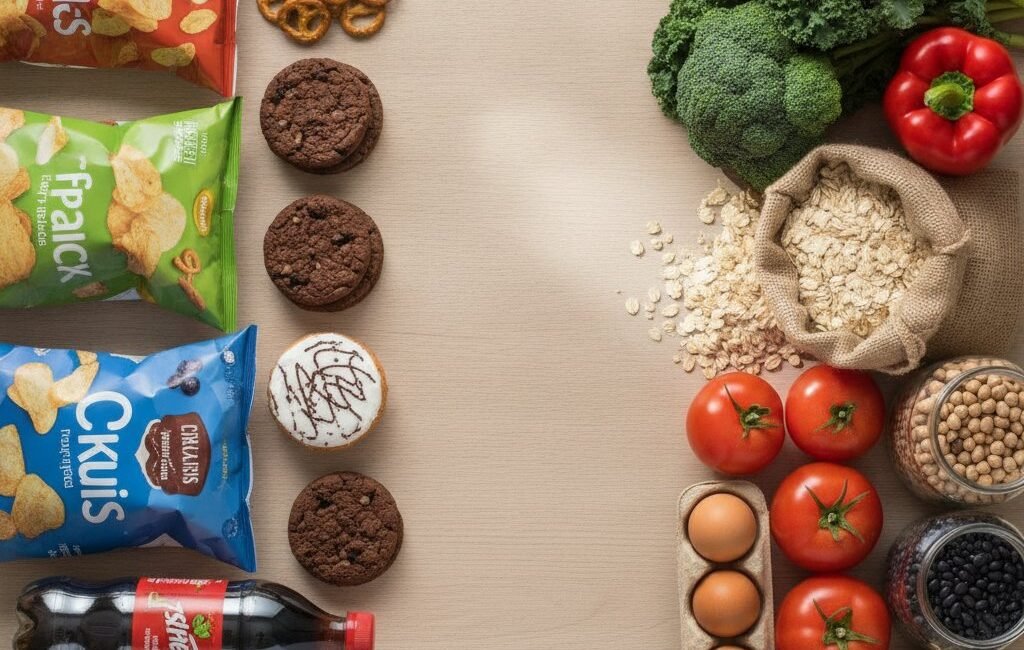
Almost all food is processed to some degree. Washing, freezing, chopping, pasteurising and cooking all count. So researchers needed a way to tell a bag of frozen peas apart from a packet of flavoured crisps. The most widely used system is NOVA, proposed in 2009 by Carlos Monteiro’s team at the University of São Paulo in Brazil. It sorts food into four groups:
- Unprocessed or minimally processed foods: fresh or frozen fruit and vegetables, eggs, milk, plain meat and fish, rice, oats, beans, nuts.
- Processed culinary ingredients: oils, butter, sugar, salt. You use these to cook group 1 foods.
- Processed foods: simple products made by adding group 2 ingredients to group 1 foods, such as tinned vegetables, cheese, freshly baked bread and smoked fish.
- Ultra-processed foods: industrial formulations made mostly from ingredients you wouldn’t find in a home kitchen. Think modified starches, protein isolates, hydrogenated oils, flavourings, emulsifiers, colours and sweeteners. Examples include soft drinks, packaged snacks, sweetened breakfast cereals, instant noodles, reconstituted meat products and many supermarket breads and ready meals.
One important point: NOVA classifies food by its processing, not its nutrient content. It isn’t designed to tell you whether a food is high in sugar or salt. A wholegrain supermarket loaf with emulsifiers can count as ultra-processed, while homemade cake doesn’t. That’s both the strength of the idea and the source of a lot of the criticism (more on that below).
How much of this do we eat? In the US, a 2025 CDC data brief (NCHS Data Brief No. 536, covering August 2021 to August 2023) found that people aged 1 and over got about 55% of their daily calories from ultra-processed foods. For children and teenagers it was 61.9%, and for adults 53.0%. Among adults, sandwiches and burgers, sweet bakery products and sweetened drinks were the biggest contributors.
The NIH Study: 500 Extra Calories a Day
For years, the link between ultra-processed food and weight was based only on observational data. Then in 2019, Kevin Hall and colleagues at the US National Institutes of Health ran the first randomised controlled trial on it, published in Cell Metabolism.
They admitted 20 weight-stable adults (average age around 31, average BMI 27) to the NIH Clinical Center. Each person spent two weeks eating an ultra-processed diet and two weeks eating an unprocessed diet, in random order. The meals were matched on paper for calories, sugar, fat, fibre, carbohydrate and sodium. The key detail: participants could eat as much or as little as they liked.
The results:
- On the ultra-processed diet, people ate an average of 508 more calories a day, mostly from extra carbohydrate and fat. Protein intake didn’t change.
- They gained about 0.9 kg (roughly 2 lb) during the two ultra-processed weeks.
- They lost about 0.9 kg during the two unprocessed weeks.
Nobody was told to eat more or less. Simply changing the type of food on offer changed how much people ate, and their weight moved with it. That’s what made this study so influential: it was the first real evidence that ultra-processed food may cause overeating, rather than just being linked to it.
It also had real limits, which the NIH itself pointed out. It was small and short. People were living in a clinic, not their own homes. And the protein content of the two diets differed slightly, which the NIH said could explain up to half of the difference in calorie intake. The authors called for further studies to test whether reformulated ultra-processed diets would produce the same effect.
Why Might Ultra-Processed Food Make Us Eat More?
The NIH study measured some clues about why people ate more, though it couldn’t prove the mechanism.
- Eating speed. Participants ate faster on the ultra-processed diet, both in grams and in calories per minute. Hall suggested that eating quickly may not give the gut enough time to signal fullness to the brain. Soft, easy-to-chew food that needs little effort tends to go down faster.
- Appetite hormones. On the unprocessed diet, levels of PYY (a gut hormone that suppresses appetite) were higher, and ghrelin (a hormone that drives hunger) was lower. On the ultra-processed diet, that pattern didn’t appear.
- Calorie density. Many ultra-processed foods pack a lot of calories into a small volume, so you can eat a lot of energy before your stomach feels full.
None of these is fully settled. Researchers are still testing which features of ultra-processed food matter most, and whether some products are much worse than others.
The 2025 UK Trial: Same Healthy Guidelines, Different Results
A common objection to the NIH study is that the ultra-processed diet was also just a less healthy diet. A 2025 trial from University College London, led by Samuel Dicken and published in Nature Medicine, tested that directly.
Fifty-five adults in England with a BMI between 25 and 40, who normally got at least half their calories from ultra-processed food, each followed two diets for 8 weeks each, in random order. Every meal, snack and drink was provided. Crucially, both diets followed the UK’s official healthy-eating guidance (the Eatwell Guide). One was built from minimally processed food, and the other from ultra-processed versions such as ready meals, breakfast bars and packaged wholegrain products. People could eat as much as they wanted.
- People lost weight on both diets, which suggests that following healthy-eating guidelines helps either way.
- But the minimally processed diet produced roughly twice the weight loss: an average of 2.06% of body weight, compared with 1.05% on the ultra-processed diet.
- The extra loss came from fat mass and body water, not muscle.
- People also reported better control over food cravings on the minimally processed diet.
The authors estimated that, if the trends continued for a year, the gap could be much bigger. That figure is an extrapolation, not something they measured. Still, the trial adds something the NIH study couldn’t: even when the nutrient profile looks healthy, the degree of processing may still matter.
What Large Population Studies Show
Trials are short. For the long view, researchers follow large groups of people over years.
- The SUN cohort (Spain). Published in 2016 in the American Journal of Clinical Nutrition, this study followed over 8,000 Spanish university graduates who started out without overweight. Those in the highest quarter of ultra-processed food intake had a 26% higher risk of developing overweight or obesity than those in the lowest quarter, after adjusting for other factors.
- The 2024 BMJ umbrella review. Lane and colleagues pooled 45 meta-analyses covering almost 10 million people. They found direct links between ultra-processed food and 32 health outcomes, including cardiovascular deaths, type 2 diabetes and common mental health conditions. The strength of evidence varied a lot between outcomes, from convincing for some to limited for others.
These studies show association, not cause. People who eat a lot of ultra-processed food may differ in income, sleep, stress and activity too. Researchers adjust for what they can, but they can’t rule everything out. That’s why the controlled trials above matter so much: they point in the same direction.
The Limits and the Critics
Ultra-processed food is a genuinely debated topic, and it’s worth knowing why.
- The category is broad. NOVA lumps together fizzy drinks, flavoured yoghurt, packaged wholegrain bread and plant-based milks. They’re unlikely to all have the same effect. Some critics argue the definition is too vague to guide individual choices.
- The trials are small. The NIH study had 20 people and lasted four weeks. The UCL trial had 55 people over 16 weeks of eating. Both were well designed, but neither tells us what happens over years.
- Nutrients still matter. Much ultra-processed food is high in sugar, salt and fat and low in fibre. Separating “processing” from “poor nutrition” isn’t easy, and the UCL trial is one of the few to try.
The fair summary: the evidence that a diet high in ultra-processed food makes overeating easier is growing and fairly consistent. Exactly which products and which features are responsible is still being worked out.
How to Eat Less Ultra-Processed Food Without Going to Extremes
You don’t need to eliminate every packaged food. Both trials suggest that shifting the balance helps, so start where you’ll get the biggest return.
- Start with drinks. Sugar-sweetened drinks are one of the biggest sources of ultra-processed calories and they barely register as food. See our review of what sugary drinks do to your body.
- Swap your most frequent foods first. Breakfast cereal, snack bars and crisps are usually eaten daily. Oats, fruit, plain yoghurt and nuts are easy minimally processed swaps.
- Cook a few base meals in bulk. Rice, beans, roasted vegetables and a simple protein cover most of a week’s lunches and cut reliance on ready meals.
- Read the ingredient list, not just the label. A long list of ingredients you wouldn’t use at home is a fair sign a product is ultra-processed, even when it’s marketed as healthy.
- Slow down. Eating speed was one of the clearest differences in the NIH study. Sitting down, chewing properly and not eating straight from the packet all help.
- Don’t chase perfection. Some ultra-processed products, such as wholegrain breads and fortified foods, can still fit into a balanced diet. The goal is to change the overall pattern, not to fear specific foods.
Many ultra-processed foods are also the ones linked to chronic inflammation. Our article on the worst foods for inflammation covers that side. If you’re also trying time-restricted eating, see what the trials say about intermittent fasting for weight loss. And if your weight loss has stalled despite your best efforts, our guide to weight-loss plateaus explains what’s usually going on.
Frequently Asked Questions
Does ultra-processed food cause weight gain?
The best evidence suggests it makes weight gain more likely. In a 2019 NIH trial, people ate about 500 more calories a day and gained about 0.9 kg in two weeks on an ultra-processed diet, compared with losing about 0.9 kg on an unprocessed diet. Large population studies point the same way, though they can’t prove cause on their own.
What is the difference between processed and ultra-processed food?
Processed foods are simple products made by adding things like salt, sugar or oil to whole foods. Examples are tinned vegetables, cheese and fresh bread. Ultra-processed foods are industrial formulations that use ingredients you wouldn’t find in a home kitchen, such as emulsifiers, flavourings, modified starches and protein isolates.
Can you lose weight eating ultra-processed food?
Yes. In a 2025 UK trial, people lost weight on both a minimally processed and an ultra-processed diet when both followed healthy-eating guidelines. But the minimally processed diet produced roughly twice the weight loss over 8 weeks: about 2% of body weight compared with 1%.
Why do ultra-processed foods make you eat more?
It isn’t fully understood. In the NIH study, people ate faster on the ultra-processed diet, and appetite hormones shifted in a direction that favoured eating more. Many of these foods are also calorie-dense and easy to eat quickly, which may let you take in more energy before you feel full.
How can I tell if a food is ultra-processed?
Check the ingredient list. If it includes several items you wouldn’t use when cooking at home, such as emulsifiers, flavourings, colours, sweeteners or hydrogenated oils, it’s probably ultra-processed. Long ingredient lists on packaged snacks, drinks, cereals and ready meals are the usual giveaway.
Key Takeaways
- “Ultra-processed” is about how food is made, not its nutrient content. In the US it makes up about 55% of calories.
- In the 2019 NIH trial, people ate about 500 more calories a day on an ultra-processed diet and gained weight without trying.
- In a 2025 UK trial, a minimally processed diet produced about twice the weight loss of an ultra-processed one, even when both followed healthy-eating guidelines.
- Faster eating, appetite-hormone changes and high calorie density are likely explanations, but the mechanism isn’t settled.
- The trials are small and short, and the category is broad, so focus on shifting your overall pattern rather than banning foods.
- Start with drinks and your most frequently eaten packaged foods, cook simple base meals, and slow down when you eat.
For the full picture on diets, exercise, sleep, medication and keeping weight off, see our complete guide to how to lose weight.