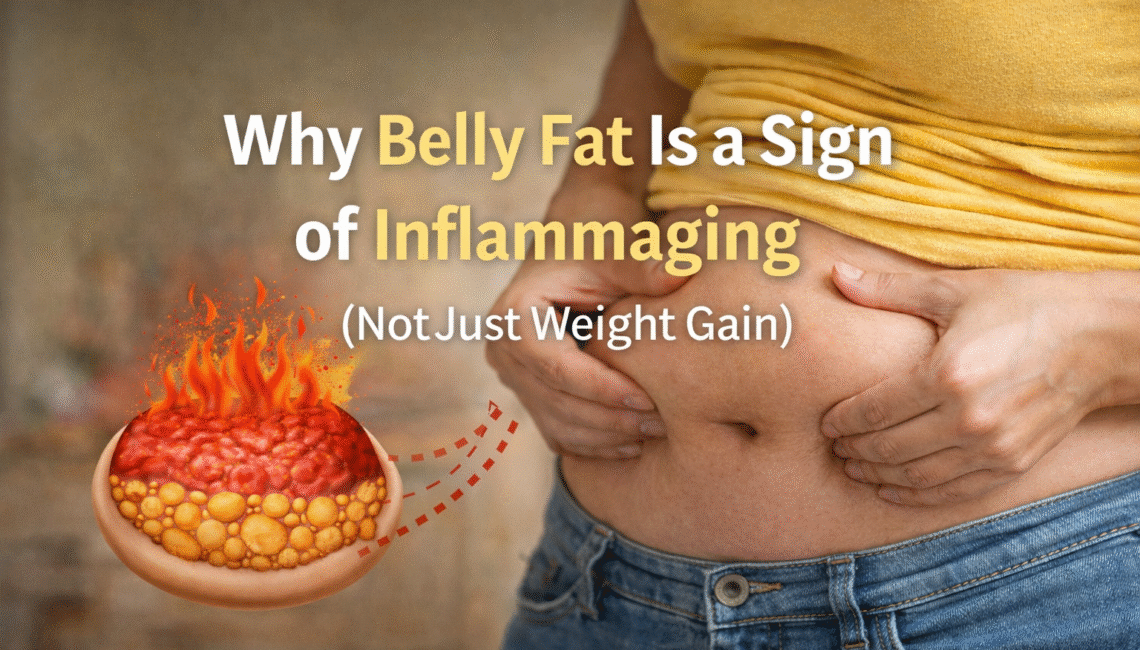
There is a difference between subcutaneous fat — the fat you can pinch under your skin — and visceral fat, the fat that sits deep in your abdominal cavity, surrounding your internal organs. Most people who want to “lose belly fat” are focused on the former, the visible layer. The visceral fat — the truly dangerous kind — is not visible in a mirror and does not respond to sit-ups.
What makes visceral fat different is not cosmetic. It is metabolic. Visceral fat is not an inert energy store. It is a hormonally and immunologically active tissue that continuously secretes inflammatory molecules — and in doing so, ages every organ it comes near.
Why Visceral Fat Drives Inflammation
Visceral fat cells (adipocytes) are far more metabolically active than subcutaneous fat cells. They continuously release free fatty acids into the portal circulation — the blood supply going directly to the liver — and secrete adipokines: signalling molecules that include tumour necrosis factor-alpha (TNF-α), interleukin-6 (IL-6), and resistin, all of which are pro-inflammatory.
A landmark study published in Circulation (Fontana et al., 2007) directly measured the inflammatory output of visceral versus subcutaneous fat in humans and found that visceral fat produced significantly higher levels of IL-6 and CRP. The researchers described visceral fat as “a metabolically active endocrine organ with inflammatory properties.”
This continuous low-grade inflammatory output contributes directly to insulin resistance (the liver, bathed in pro-inflammatory fatty acids, becomes insulin-resistant first), cardiovascular disease (arterial inflammation promotes atherosclerosis), and cognitive decline (systemic inflammation eventually affects the brain).
Why Indians Are Particularly Vulnerable
South Asians develop visceral fat at lower BMIs than Western populations — a phenomenon well-documented in research and increasingly recognised in clinical guidelines. A person with a “normal” BMI of 23–24 may carry dangerous amounts of visceral fat if they are Indian, while a European at the same BMI might not.
The reason appears to be genetic: South Asians have a higher propensity to store fat viscerally (around organs) rather than subcutaneously (under skin). This is compounded by traditional dietary patterns high in refined carbohydrates (rice, roti in large quantities), low in protein relative to caloric intake, and a cultural tendency toward lower physical activity in urban settings.
The clinical implication: waist circumference is a better risk marker for Indians than BMI. The WHO South Asia cut-offs are waist above 90 cm for men and above 80 cm for women as metabolically significant — lower than Western guidelines.
The Inflammaging Connection
Inflammaging — the chronic, age-associated rise in inflammatory markers — is significantly amplified by visceral fat accumulation. Every decade after 30, visceral fat tends to increase, particularly in the absence of resistance exercise. This increase drives a corresponding increase in inflammatory cytokines, which in turn accelerate the biological ageing process: telomere shortening, cellular senescence, mitochondrial dysfunction.
People with high visceral fat at 40 show biological ageing markers (telomere length, inflammatory cytokine levels) consistent with people 5–10 years older. This is not just a health risk — it is accelerated biological ageing in a measurable, real sense.
How to Measure Visceral Fat
You cannot directly see or feel visceral fat. However:
- Waist circumference is the simplest proxy: measured at the navel level, with the result interpreted against South Asian thresholds (above 90 cm men / 80 cm women = significant risk)
- Waist-to-height ratio (waist circumference divided by height) above 0.5 is associated with significant visceral fat across populations
- DEXA scan (dual-energy X-ray absorptiometry) accurately measures body composition including visceral fat — available at many diagnostic centres in Indian cities
- CT or MRI can directly image visceral fat — typically used in clinical research and specialist settings
What Actually Reduces Visceral Fat
Visceral fat responds to systemic changes, not local exercises. Sit-ups and crunches build abdominal muscles but do not selectively burn visceral fat. What works:
- Sustained caloric deficit with adequate protein. Visceral fat is mobilised preferentially in a caloric deficit. Maintaining protein intake (1.2–1.6 g per kg of body weight) during a deficit prevents muscle loss while visceral fat is reduced.
- Resistance training. Muscle tissue produces anti-inflammatory myokines and improves insulin sensitivity — reducing the metabolic drivers of visceral fat accumulation. Two sessions per week of strength training consistently reduces visceral fat in studies independent of diet changes.
- Aerobic exercise. High-intensity interval training (HIIT) has been shown in multiple trials to reduce visceral fat more effectively per time unit than steady-state cardio. Even brisk walking, if sustained consistently, measurably reduces visceral fat over 3–6 months.
- Reducing refined carbohydrates. The liver converts excess carbohydrates to triglycerides and stores them viscerally. Reducing refined carbohydrate intake — not necessarily going low-carb, but reducing excess maida and sugar — is one of the most effective dietary interventions for visceral fat specifically.
- Sleep quality. Insufficient sleep elevates cortisol, which specifically promotes visceral fat deposition. Protecting sleep quality is not peripheral to this issue — it is central.
Frequently Asked Questions
Can I be thin and still have dangerous visceral fat?
Yes — this is the TOFI (thin outside, fat inside) phenotype, and it is particularly common in South Asians. People with normal or even low BMI can carry significant visceral fat, particularly if they are sedentary, have a family history of diabetes, or have a high waist-to-height ratio. Waist circumference is more informative than weight alone.
How quickly can visceral fat be reduced?
Visceral fat responds relatively quickly to lifestyle interventions compared to subcutaneous fat. Studies consistently show measurable reductions in visceral fat within 8–12 weeks of consistent caloric deficit combined with exercise. Waist circumference often decreases before the scale shows significant weight change, which is a useful early indicator.
The Bottom Line
Belly fat is not a vanity issue. It is a visceral inflammatory organ that ages you from the inside. For South Asians specifically, the risk threshold is lower than Western guidelines suggest — you do not need to be obese for visceral fat to be affecting your cardiovascular and metabolic health. Waist circumference matters. Resistance training matters. Sleep matters. Refined carbohydrates matter. This is not about appearance. It is about the biology of how you age.
Consult a physician or dietitian before making significant dietary or exercise changes, particularly if you have existing metabolic conditions.