Protein is often called the most useful macronutrient for weight loss. You’ll hear that it keeps you fuller, burns more calories to digest, and protects your muscle while you diet. Some of that holds up well in research. Some of it is real but smaller than the marketing suggests. And the most common question, “how much should I actually eat?”, has a more sensible answer than the 200-gram shakes you see on social media.
This article goes through what the trials show about protein and appetite, body composition during a diet, and keeping weight off, plus how much protein is reasonable and who should be careful. It’s part of our complete guide to how to lose weight, based on the evidence.
This article is for general information and isn’t medical advice. If you have kidney disease, diabetes, or another medical condition, or you’re pregnant, talk to your doctor or a registered dietitian before significantly changing how much protein you eat.
In this article:
- How Much Protein Do You Need Normally?
- Protein and Appetite: The Fullness Effect
- Protein and Calorie Burn
- Protecting Muscle While You Lose Fat
- Does Protein Help Keep Weight Off?
- How Much Protein for Weight Loss?
- Is a High-Protein Diet Safe?
- Practical Ways to Eat More Protein
- Frequently Asked Questions
- Key Takeaways
How Much Protein Do You Need Normally?
The official Recommended Dietary Allowance (RDA) for adults, set by the US National Academies, is 0.8 grams of protein per kilogram of body weight per day. For a 70 kg (about 154 lb) adult, that’s roughly 56 grams a day. The same guidance says protein can reasonably make up anywhere from 10% to 35% of your daily calories.
It’s worth knowing what the RDA is and isn’t. It’s the amount that covers the basic needs of nearly all healthy adults: enough to avoid deficiency. It was not designed as the best intake for someone who is eating fewer calories and trying to lose fat while keeping muscle. That’s where the weight-loss research comes in.
Most adults in wealthy countries already eat more than the RDA. Analyses of US national survey data put typical adult intake at roughly 1.2–1.3 g/kg, with older adults tending to eat less. So for many people the question isn’t “am I getting enough to be healthy?” but “would a bit more help while I’m in a calorie deficit?”
Protein and Appetite: The Fullness Effect
The main reason protein is linked to weight loss is appetite. Gram for gram, it tends to be more filling than carbohydrate or fat.
One of the best-known studies is a 2005 trial by David Weigle and colleagues at the University of Washington, published in the American Journal of Clinical Nutrition. Nineteen adults went through three diet phases in sequence. First they ate a weight-maintaining diet with 15% of calories from protein. Then they ate the same number of calories with 30% from protein, for two weeks. Finally, they stayed on a 30% protein diet for 12 weeks but could eat as much as they wanted. Carbohydrate stayed at 50% of calories throughout, so the extra protein replaced fat.
When protein went up with calories held the same, people reported feeling much fuller. And in the final phase, when they could eat freely, they spontaneously ate about 441 fewer calories a day. Over 12 weeks they lost an average of 4.9 kg, 3.7 kg of it fat, without being told to cut back.
That’s a striking result, but it has limits. The study was small, it had no separate control group, and the phases always ran in the same order rather than being randomised. The authors suggested the brain’s response to the hormone leptin might explain the effect, but that part is a hypothesis, not a proven mechanism.
A 2015 review in the same journal, led by Heather Leidy and written for a protein research summit, pulled the wider evidence together. It found that higher-protein meals reliably make people feel fuller and raise satiety hormones in the short term. But the effect on how much people eat at the next meal is less clear. In other words, protein’s fullness effect is real, but it isn’t a magic off-switch for hunger.
Protein and Calorie Burn
Your body uses energy to digest, absorb and process food. This is called diet-induced thermogenesis, or the thermic effect of food. On a typical mixed diet, it accounts for roughly 5–15% of your daily energy expenditure, according to a 2004 review by Klaas Westerterp in Nutrition & Metabolism.
Protein has a higher thermic effect than carbohydrate or fat. Of everything we eat and drink, only alcohol ranks higher. So shifting some calories from fat or carbohydrate to protein means slightly more of those calories are used up in processing.
This is often overstated online. The difference is real but modest: it might add up to a small number of calories a day, not enough to undo overeating. It’s best thought of as a small bonus on top of protein’s bigger effects on appetite and muscle, not a reason to eat protein by itself.
Protecting Muscle While You Lose Fat
When you lose weight, you don’t only lose fat. Some of what you lose is lean mass, which includes muscle. Losing too much muscle isn’t ideal: it can affect strength and physical function, especially as you get older. This has become a bigger topic with GLP-1 medications, where some of the weight lost is lean tissue (we cover that in our article on Ozempic, Wegovy and Mounjaro).
This is where protein has some of its most consistent evidence. A 2012 meta-analysis by Thomas Wycherley and colleagues, published in the American Journal of Clinical Nutrition, combined 24 randomised trials. Each compared a higher-protein, low-fat diet with a standard-protein, low-fat diet at the same calorie level. Compared with standard protein, the higher-protein diets led to:
- About 0.8 kg more weight loss and about 0.9 kg more fat loss
- About 0.4 kg less loss of fat-free mass (the part of your body that includes muscle)
- A smaller drop in resting energy expenditure
- A larger drop in blood triglycerides
The authors themselves described these benefits as “modest”, and that’s the right word. Most of the trials lasted around three months. But the direction is consistent: when calories are held equal, more protein tilts your weight loss a little more towards fat and a little less towards muscle.
A 2016 trial at McMaster University in Canada (Longland and colleagues, also in the American Journal of Clinical Nutrition) took this further. Forty young men ate about 40% fewer calories than they needed for four weeks, while doing intense resistance and interval training six days a week. Half ate 1.2 g/kg of protein a day and half ate 2.4 g/kg. The higher-protein group lost more fat (4.8 kg vs 3.5 kg), and the study team reported they also gained more lean mass. This was an extreme setup (a big deficit, heavy training, young men, one month) so it doesn’t translate directly to most dieters. But it shows how protein and exercise work together.
That combination matters. Protein gives your body the raw material for muscle, but resistance training is the signal to keep it. Eating more protein without doing any strength work gives you only part of the benefit.
Does Protein Help Keep Weight Off?
Keeping weight off is usually harder than losing it, partly because the body adapts to weight loss (see our guide to weight-loss plateaus for why). There is some evidence protein helps here too.
In a 2004 trial published in the International Journal of Obesity, Margriet Westerterp-Plantenga and colleagues at Maastricht University followed moderately obese adults after they had lost 5–10% of their body weight. For the next three months, one group ate 18% of calories from protein and the other 15%. The higher-protein group regained about half as much weight, and what they did regain was fat-free mass rather than fat. The authors linked this to greater fullness.
That’s an encouraging result from a fairly small change, but it’s one short trial. The Leidy review noted that longer-term studies of high-protein diets have given mixed results, and that the main reason seems to be adherence: people who actually kept eating more protein saw benefits, while people who drifted back to their old habits didn’t. That’s a familiar story in diet research. The best diet is usually the one you can keep doing.
Protein doesn’t cancel out extra calories
A 2012 study in JAMA by George Bray and colleagues is a useful reality check. In a tightly controlled trial, 25 healthy adults were overfed by about 950 calories a day on a low-protein (5%), normal-protein (15%) or high-protein (25%) diet. Everyone gained body fat, and fat gain was similar across all three diets. The difference was that the normal- and high-protein groups also gained lean mass, while the low-protein group didn’t. The authors concluded that calories alone accounted for the fat gain. Protein affects what kind of weight you gain or lose. It doesn’t override the overall calorie balance.
How Much Protein for Weight Loss?
The 2015 Leidy review concluded that higher-protein diets providing roughly 1.2 to 1.6 g of protein per kg of body weight per day improve appetite, body weight management and cardiometabolic risk factors. It also suggested aiming for at least 25–30 grams of protein per meal, rather than eating most of it at dinner.
Here’s what that looks like in practice:
- 60 kg (132 lb) person: roughly 72–96 g a day
- 70 kg (154 lb) person: roughly 84–112 g a day
- 90 kg (198 lb) person: roughly 108–144 g a day
If you carry a lot of excess weight, using your current weight can overestimate what you need. Many dietitians base the calculation on a healthier target weight instead. A registered dietitian can help you pick the right number for you.
Very high intakes, like the 2.4 g/kg in the McMaster trial, were tested in young men doing intense daily training. There’s no good evidence that most people dieting at home need anything like that. And because protein is filling, pushing intake very high can crowd out vegetables, fruit, whole grains and other foods that matter for health.
Is a High-Protein Diet Safe?
For healthy adults, intakes in the 1.2–1.6 g/kg range appear safe. The most common worry is kidney damage. A 2018 meta-analysis by Michaela Devries and colleagues at McMaster University, published in The Journal of Nutrition, pooled 28 studies with 1,358 participants. It found that higher-protein diets (at least 1.5 g/kg a day, or 20% of calories, or 100 g a day) did not change kidney function, measured by glomerular filtration rate, any differently from normal- or lower-protein diets in healthy adults.
People with kidney disease are different. The 2024 KDIGO international kidney guidelines suggest about 0.8 g/kg a day for adults with moderate-to-advanced chronic kidney disease, and advise against going above 1.3 g/kg a day in people whose kidney disease is at risk of getting worse. If you have kidney disease, or diabetes (a common cause of it), check with your doctor before raising your protein intake.
The source of the protein matters for long-term health, too. A high-protein diet built mainly on processed meats is not the same as one built on fish, eggs, dairy, beans, lentils, tofu and poultry. It also helps to watch out for heavily processed protein bars and snacks, which can be easy to overeat (see our article on ultra-processed food and weight gain).
Practical Ways to Eat More Protein
You don’t need supplements to hit these targets. Some simple approaches:
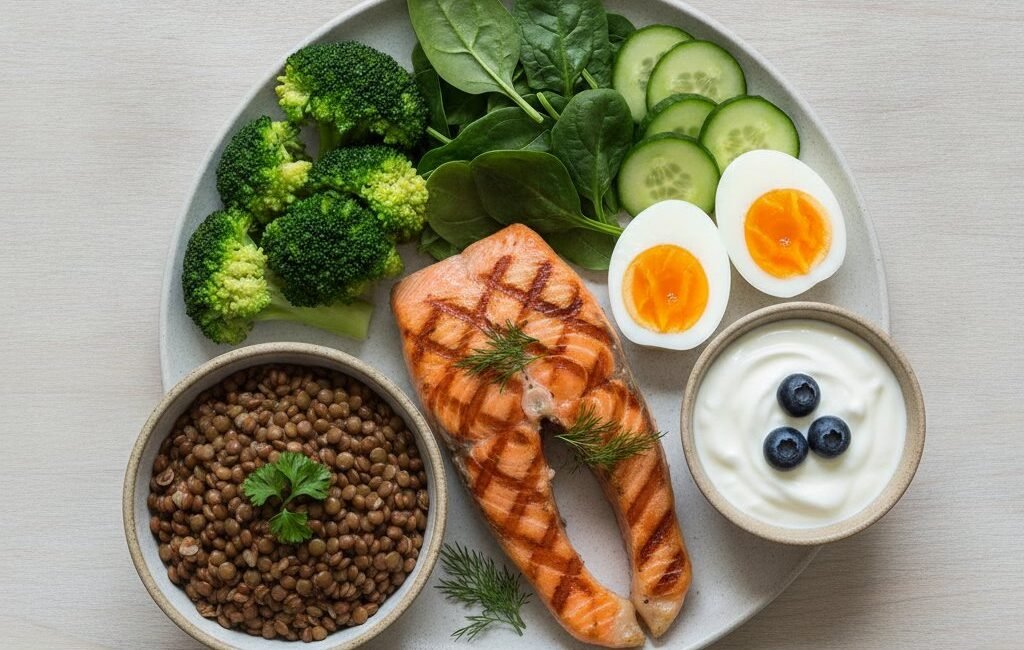
- Fix breakfast first. Breakfast is often the lowest-protein meal. Eggs, Greek yogurt, cottage cheese, paneer, or oats made with milk can get you to 20–30 g.
- Build each meal around a protein source. Start with chicken, fish, eggs, tofu, dal, beans or lentils, then add vegetables and a carbohydrate.
- Use lentils and beans. They give you protein and fibre together, and both help with fullness. They’re also cheap.
- Choose higher-protein swaps. Greek yogurt instead of regular yogurt, a glass of milk or soy milk instead of a sugary drink (our comparison of plant milk vs cow milk covers which ones actually contain protein).
- Pair it with strength training. Two or more sessions a week help make sure the protein goes towards keeping muscle.
- Track your body, not just your weight. If you’re tracking progress, waist measurements and how your clothes fit can tell you more than the scale alone.
Protein powder can be convenient if you struggle to get enough from food, especially for older adults with smaller appetites. But it’s a convenience, not a requirement.
Frequently Asked Questions
Does eating more protein help you lose weight?
It can help a little. In trials where calories are held the same, higher-protein diets lead to slightly more fat loss and slightly less muscle loss. Protein also tends to make you feel fuller, which can make it easier to eat less. But it doesn’t cancel out eating more calories than you need.
How much protein should I eat a day to lose weight?
A 2015 research review suggested about 1.2 to 1.6 grams per kilogram of body weight per day, with at least 25 to 30 grams at each meal. For a 70 kg person, that’s roughly 84 to 112 grams a day. If you have a lot of weight to lose, a dietitian may base this on a target weight instead.
Is a high-protein diet bad for your kidneys?
In healthy adults, a 2018 meta-analysis of 28 studies found that higher-protein diets did not change kidney function differently from lower-protein diets. People with chronic kidney disease are a different case. Kidney guidelines suggest around 0.8 grams per kilogram a day for them, so check with your doctor first.
Why does protein make you feel full?
Higher-protein meals raise the levels of hormones linked to fullness and make people report feeling more satisfied. In one 2005 study, people who switched to a 30% protein diet ate about 441 fewer calories a day without being asked to. The exact mechanism in the brain is still being studied.
Do I need protein shakes to lose weight?
No. Most people can reach a higher protein intake from ordinary foods like eggs, yogurt, milk, fish, chicken, tofu, beans and lentils. Protein powder can be a convenient option if you struggle to eat enough, but it offers no special weight-loss benefit over food.
Key Takeaways
- The RDA of 0.8 g/kg prevents deficiency, but weight-loss research supports more: around 1.2–1.6 g/kg a day, with 25–30 g per meal.
- Protein is more filling than carbohydrate or fat, which can make it easier to eat less. In one study, people ate about 441 fewer calories a day on a 30% protein diet.
- When calories are matched, higher-protein diets give modestly more fat loss and help preserve lean mass. The effect is real but small.
- Protein works best alongside strength training, which signals your body to keep muscle.
- Protein doesn’t override calories. Overeating leads to fat gain regardless of how much protein you eat.
- Higher protein appears safe for healthy kidneys, but people with kidney disease should follow their doctor’s guidance.
Protein is one useful tool among several. For the full picture on diets, exercise, sleep, medication and keeping weight off, see our complete guide to how to lose weight.