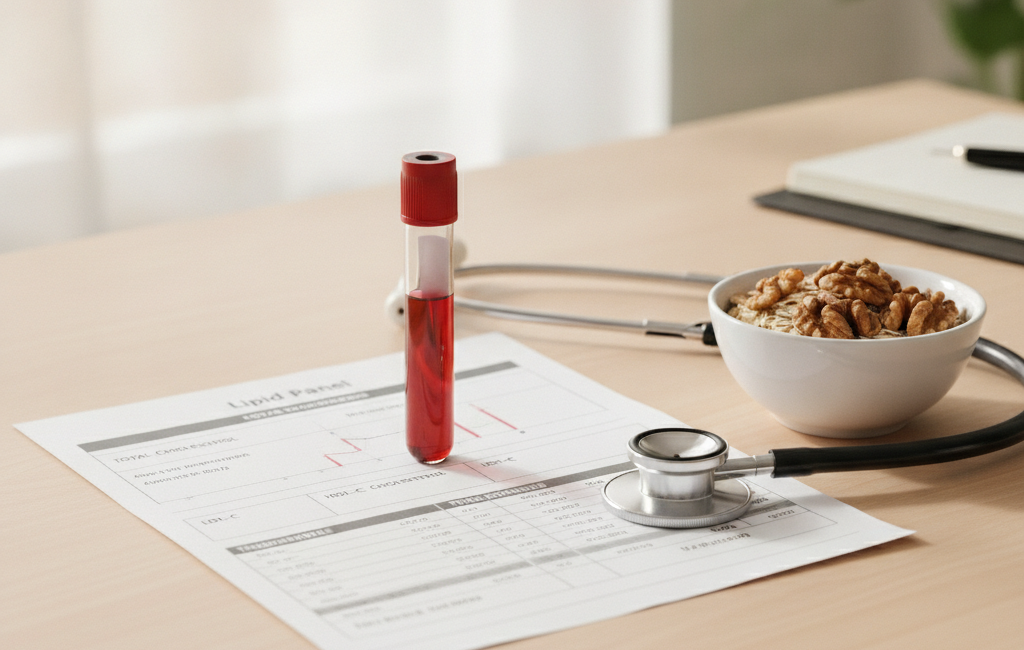
A cholesterol test result is a short list of numbers: total cholesterol, LDL, HDL, triglycerides, and sometimes a few more. Most people only check whether any are flagged in red. But each number says something different, one matters far more than the others, and one people feel good about matters less than they think.
This article is part of our complete, evidence-based guide to heart health. It explains each line of a lipid panel, what the latest guidelines count as “high”, and what the evidence shows about lowering cholesterol, including statins.
This is general information, not medical advice. Only your doctor can interpret your results and decide whether you need treatment.
Why Cholesterol Matters for Your Heart
Your body needs cholesterol to build cells and make hormones. The problem is having too many cholesterol-carrying particles in the blood. Some get into artery walls and slowly build up into plaque. If a plaque cracks, a clot can form and block blood flow, causing a heart attack or stroke.
The INTERHEART study (The Lancet, 2004) compared about 15,000 first heart attack patients with similar people who hadn’t had one, across 52 countries. Abnormal blood lipids were among the strongest of the nine modifiable risk factors it found, accounting for roughly half of the population’s heart attack risk.
Reading Your Lipid Panel, Line by Line
Figures below are in mg/dL (US units). If your lab reports mmol/L, multiply cholesterol values by about 38.7 and triglycerides by about 88.5 to convert.
LDL cholesterol (the one that matters most)
LDL (low-density lipoprotein), the “bad” cholesterol, is the main particle that carries cholesterol into artery walls. For most adults, below 100 mg/dL is desirable, according to the US National Library of Medicine’s MedlinePlus. Higher-risk people have lower targets (see below).
The evidence that LDL actually causes heart disease is unusually strong. Observational studies, genetic studies, and dozens of drug trials all point the same way: the lower your LDL and the longer it stays low, the lower your risk.
HDL cholesterol (the “good” one, with a catch)
HDL (high-density lipoprotein) helps carry cholesterol away from the arteries. People with higher HDL tend to have fewer heart attacks. MedlinePlus lists 40 mg/dL or higher for men and 50 mg/dL or higher for women as the recommended range.
The catch: raising HDL doesn’t seem to protect your heart. In a 2012 Lancet study, Benjamin Voight and colleagues examined a gene variant (in LIPG) that naturally raises HDL. Carriers should have had about 13% fewer heart attacks. Across 20 studies with over 20,000 heart attack cases, they didn’t. A score built from 14 other HDL-raising variants gave the same result.
So low HDL is a useful warning sign, often of inactivity, excess weight, or smoking. But high HDL doesn’t cancel out high LDL.
Triglycerides
Triglycerides are the main fat in the blood. They rise with sugar, refined carbohydrates, alcohol, excess weight, and poorly controlled diabetes. Below 150 mg/dL is normal. The 2026 ACC/AHA dyslipidemia guideline defines severe hypertriglyceridemia as 500 mg/dL or higher, where the risk of pancreatitis becomes a concern too.
Total cholesterol and non-HDL cholesterol
Total cholesterol (desirable: below 200 mg/dL) includes HDL, so it’s a blunt measure. Non-HDL cholesterol (total minus HDL) is more useful, because it captures every particle that can clog arteries. If your report doesn’t print it, work it out yourself.
Lipoprotein(a): the test most people have never had
Lipoprotein(a), or Lp(a), is an LDL-like particle whose level is mostly set by your genes. Diet and exercise barely change it. A high Lp(a) raises heart attack and stroke risk even if your other numbers look fine.
The 2026 ACC/AHA guideline now recommends that all adults have Lp(a) measured at least once, in line with the European Atherosclerosis Society’s 2022 consensus statement. According to summaries of the guideline, 125 nmol/L (or 50 mg/dL) or higher counts as high, linked to about 1.4 times the long-term risk of heart attack or stroke; at 250 nmol/L the risk is at least doubled. Because the level is stable through life, one test is usually enough.
Do You Need to Fast Before the Test?
Usually not. A 2016 joint consensus statement from the European Atherosclerosis Society and the European Federation of Clinical Chemistry and Laboratory Medicine (Nordestgaard and colleagues, European Heart Journal) concluded that fasting isn’t routinely needed. Eating changes most lipid values very little, and fasting may be considered only if non-fasting triglycerides are above about 440 mg/dL. Follow your own lab’s instructions, though.
What “Normal” Means Depends on Your Risk
There isn’t one “good” LDL number for everyone. The ACC/AHA dyslipidemia guideline published in March 2026 brought back specific LDL targets, which the 2018 guideline had largely dropped, and ties them to your estimated risk from a newer calculator called PREVENT.
Based on published summaries of the guideline:
- People without heart disease at borderline or intermediate 10-year risk have an LDL goal below 100 mg/dL. Those at high risk (10% or more) have a goal below 70 mg/dL.
- People who already have heart disease have a goal below 70 mg/dL. Those at very high risk, such as people who’ve had more than one heart attack or stroke, have a goal below 55 mg/dL.
- People with very high LDL (190 mg/dL or above) or an inherited condition called familial hypercholesterolaemia have their own, more aggressive treatment approach. The guideline also says treatment can be considered from age 30 in some higher-risk groups.
The guideline’s message is “lower, earlier, for longer”: how long your arteries are exposed to LDL matters, not just today’s number. Your doctor will weigh your results alongside blood pressure, smoking, diabetes, and family history.
How Much Does Lowering LDL Actually Help?
The best evidence comes from the Cholesterol Treatment Trialists’ (CTT) Collaboration, which pools individual data from large statin trials. Their 2010 analysis in The Lancet covered about 170,000 people in 26 randomised trials. It found that each 1 mmol/L (about 39 mg/dL) reduction in LDL cut major vascular events, such as heart attacks, strokes, and the need for artery-opening procedures, by about 22%. All-cause mortality fell by about 10% per 1 mmol/L.
Lifestyle First: What Moves Your Numbers
Lifestyle changes lower LDL modestly for most people, and they help nearly everything else on the panel. The main levers are:
- Swap saturated fat for unsaturated fat. A 2020 Cochrane review (Hooper and colleagues) found that cutting saturated fat lowered the risk of combined cardiovascular events by about 17%, based on 12 trials with 53,758 people. Replacing butter, ghee, fatty meat, and coconut oil with olive oil, nuts, seeds, and oily fish is the most reliable dietary change for LDL.
- Eat more fibre. Oats, beans, lentils, and other foods high in soluble fibre help lower LDL. Our guide to fibre and why it matters has practical ways to get more.
- Cut back on sugar, refined carbs, and alcohol. These have the biggest effect on triglycerides.
- Move more. Regular exercise improves triglycerides and HDL, and supports weight control. See the best exercise for heart health and how much you need.
- Stop smoking, which lowers HDL and damages artery walls directly.
For people with genetically high LDL or Lp(a), lifestyle alone often isn’t enough. That isn’t a personal failure, just a reason to discuss medication with a doctor.
When Statins Come Up, and What the Evidence Says About Side Effects
If your risk is high, your doctor may suggest a statin. That decision is one to make with them, based on your own numbers. What we can do is set out the evidence on the side effect people worry about most: muscle aches.
A 2022 CTT analysis in The Lancet pooled 19 double-blind trials with 123,940 people. Over a median of about 4 years, 27.1% of people on a statin reported muscle pain or weakness, compared with 26.6% on placebo. In the first year, statins raised reports of muscle symptoms by about 7%, which means only about 1 in 15 of the muscle complaints reported by statin users was actually caused by the statin.
The SAMSON trial, reported in the New England Journal of Medicine in 2020, tested this in 60 people who had already stopped statins because of side effects. Each rotated blindly through months of statin, placebo, and no tablets. About 90% of the symptoms they felt on the statin also appeared on the placebo. Six months after the trial, half of them had gone back on statins.
That doesn’t mean side effects are imaginary. Real muscle problems happen, though serious ones are rare. If you have symptoms, tell your doctor rather than stopping on your own. A different dose or drug often works, and the 2026 guideline lists alternatives such as ezetimibe, bempedoic acid, and PCSK9 inhibitors.
Know Your Numbers, Then Know Your Risk
Cholesterol is one of the “silent” risk factors. You won’t feel high LDL until it has already done damage. The same is true of blood pressure, which we cover in our heart health guide. For one family’s experience of how a hidden artery blockage can turn into an emergency, read what my father’s heart emergency taught me.
Get your lipid panel checked, ask for an Lp(a) test at least once, and ask your doctor what your results mean for your overall risk, not just whether anything is flagged.
Frequently Asked Questions
What is a good LDL cholesterol level?
For most adults without heart disease, below 100 mg/dL (about 2.6 mmol/L) is considered desirable. People at higher risk have lower goals. Under the 2026 ACC/AHA guideline, the goal is below 70 mg/dL for people at high risk or with existing heart disease, and below 55 mg/dL for those at very high risk. Your doctor will tell you which applies to you.
Is high HDL cholesterol protective?
People with higher HDL tend to have fewer heart attacks, but genetic studies suggest that raising HDL itself doesn’t lower risk. In a 2012 Lancet study, people born with a gene variant that raises HDL had no fewer heart attacks. High HDL doesn’t offset high LDL.
Do I need to fast before a cholesterol test?
Usually not. A 2016 European consensus statement concluded that non-fasting tests are fine for most people. Fasting may be needed if your triglycerides are very high, so follow your lab’s instructions.
What is lipoprotein(a), and should I get it tested?
Lipoprotein(a) is a cholesterol-carrying particle whose level is mostly inherited. High levels raise heart attack and stroke risk even when other numbers are normal. The 2026 ACC/AHA guideline recommends that all adults have it measured at least once. Because it barely changes over life, one test is usually enough.
Do statins cause muscle pain?
Sometimes, but much less often than people think. In a 2022 analysis of 19 placebo-controlled trials with nearly 124,000 people, only about 1 in 15 muscle complaints among statin users was caused by the drug. Talk to your doctor before stopping.