When one of my readers from Chennai first wrote to me about her hair fall, she had already done everything right — at least everything she knew about. She oiled her hair three times a week, avoided heat styling, ate a protein-rich diet, and had recently started taking biotin. Yet her hair kept thinning. A full iron panel came back normal. Thyroid was fine.
What her doctor had never tested: Vitamin D. Her level was 11 ng/mL — severely deficient. Within six months of supplementation and more deliberate sun exposure, her shedding had reduced dramatically.
In a country where we have sunshine almost every day of the year, Vitamin D deficiency should be rare. Instead, it affects an estimated 70–100% of the Indian population to some degree. The reasons are more surprising than you’d think.
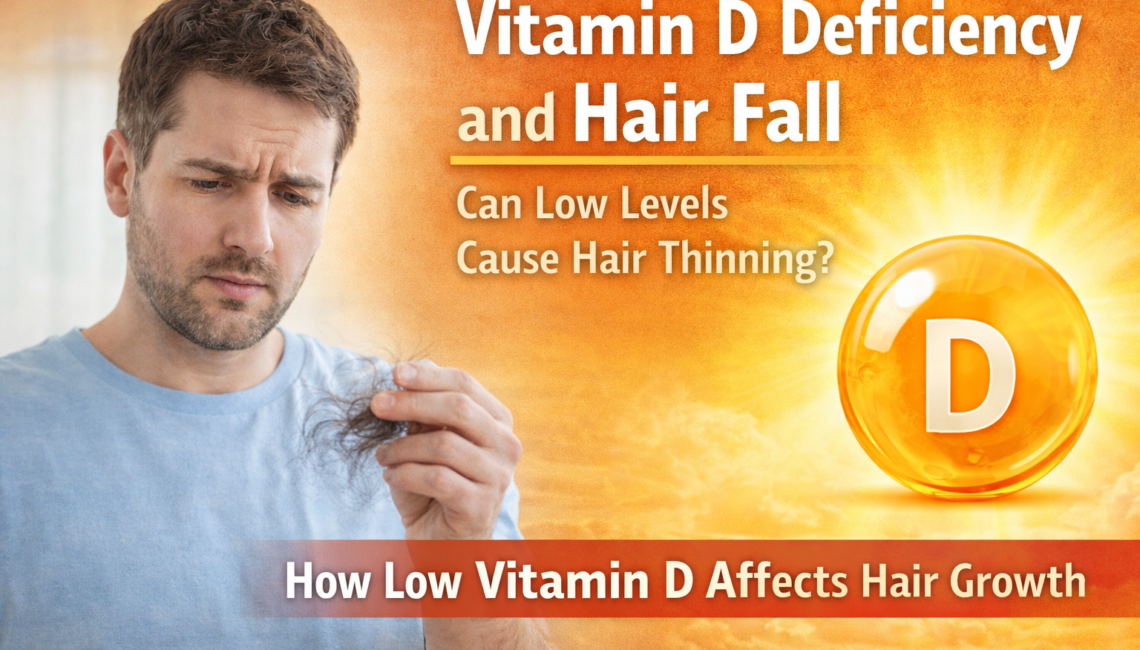
How Vitamin D Affects Hair Growth
Vitamin D is not just a vitamin — it functions as a hormone in the body. It regulates hundreds of biological processes, and hair follicle cycling is one of them.
Hair follicles contain Vitamin D receptors (VDRs). These receptors help drive the anagen (growth) phase of the hair cycle. Research published in the Proceedings of the National Academy of Sciences found that mice lacking a functional Vitamin D receptor fail to re-enter the hair growth cycle after their first coat, eventually developing near-total hair loss — demonstrating that VDR signalling itself, not just circulating Vitamin D, is essential for the follicle to keep cycling. (Read the study)
When Vitamin D is low, this receptor activation slows. Follicles spend more time in the resting (telogen) phase, new hair growth stalls, and diffuse thinning develops gradually — so gradually that most people assume it is normal ageing or stress-related.
Why Indians Are Deficient Despite Abundant Sunshine
This is the paradox that confuses most people. India sits between 8° and 37° latitude — ideal for sun-based Vitamin D synthesis. And yet deficiency is rampant. Here is why:
- Melanin blocks UV conversion. Darker skin requires 3–5 times more sun exposure to produce the same amount of Vitamin D as lighter skin. Most Indians have higher melanin levels, which is protective against skin cancer but significantly reduces Vitamin D synthesis per hour of sun exposure.
- We cover up. Cultural norms, workplace environments, and beauty standards (fair skin being valued) mean most Indians avoid direct sun exposure. Long sleeves, dupattas, umbrellas, and sunscreen all reduce skin-based synthesis.
- We eat indoors and work indoors. Glass windows filter out the UVB rays needed for Vitamin D production. Sitting near a sunny window does not help.
- Plant-based diets are low in Vitamin D. Vitamin D3 (the active form) is found almost exclusively in animal foods — fatty fish, egg yolks, liver. Most vegetarians get very little through food alone.
What Levels Should You Aim For
Most laboratories flag deficiency below 20 ng/mL. Research on hair specifically suggests it’s worth aiming higher. A 2016 study in the International Journal of Trichology compared Vitamin D3 levels in patients with diffuse hair fall against healthy controls and found deficiency was significantly more common and more severe in the hair-loss group. (Read the study)
Ask your doctor for a 25-hydroxyvitamin D (25-OH D) blood test — this is the correct test for checking Vitamin D status. A basic “Vitamin D test” from some labs measures the active form and gives misleading results.
Common ranges to know:
- Below 20 ng/mL — deficient
- 20–29 ng/mL — insufficient
- 30–60 ng/mL — adequate
- Above 60–80 ng/mL — a range some dermatologists target specifically for hair health, though this is a clinical guideline rather than a universally agreed cutoff
How to Improve Vitamin D Levels in India
There are three routes, and you likely need a combination of all three if your levels are significantly low.
1. Sunlight — Done Correctly
The key is midday sun on large skin areas. Between 11 am and 2 pm, UVB rays are strong enough in most Indian cities for skin synthesis. Expose arms, legs, and face for 20–30 minutes, 3–4 times a week. Morning walks before 9 am — despite being better for comfort — do not provide effective UVB for most of the year in India.
Some clinicians suggest waiting a period after sun exposure before showering to allow Vitamin D precursors formed in the skin to be absorbed, though the exact time needed is debated and not firmly established by controlled research.
2. Dietary Sources
For non-vegetarians, the best food sources available in India are:
- Surmai (king mackerel) and bangda (mackerel) — among the richest sources
- Hilsa (ilish) — excellent source, particularly popular in eastern India
- Egg yolks — modest amounts, but regular consumption adds up
- Chicken liver — both iron and Vitamin D in one food
Vegetarian options are very limited. Mushrooms exposed to sunlight (gills up, 20 minutes) produce Vitamin D2. Fortified milk is available from some brands but absorption varies.
3. Supplements
If your levels are below 30 ng/mL, supplementation is usually necessary given the dietary limitations. Vitamin D3 (cholecalciferol) is generally considered more effective than D2 at raising blood levels. Common dosing in India for deficiency correction ranges from 60,000 IU weekly (sachet form, widely prescribed) for 8–12 weeks, followed by daily maintenance doses of 1,000–2,000 IU — but dosing should always be set by your doctor based on your test results, not a generic online figure.
Crucially, take Vitamin D with your largest meal of the day — it is fat-soluble and needs dietary fat for absorption. Taking it on an empty stomach reduces uptake significantly.
Do not self-prescribe high doses without testing. Vitamin D toxicity is real and causes hypercalcaemia — excess calcium in the blood — which has serious consequences. Test first, then supplement accordingly.
How Long Before Hair Improves
Correcting Vitamin D deficiency does not produce overnight results. The timeline is similar to iron (see our article on iron deficiency and hair fall):
- Blood levels typically normalise within 3 months of correct supplementation
- Hair shedding begins to reduce within 2–4 months
- Visible regrowth and improved density usually takes 6–12 months
The delay exists because you are correcting a deficiency that took months or years to develop. The hair cycle needs time to shift back toward the growth phase.
Frequently Asked Questions
Can Vitamin D deficiency cause hair loss on its own, or does it need other deficiencies?
It can cause hair loss independently, but in practice, many people with Vitamin D deficiency also have low iron or low B12 — particularly in India. It is worth testing all three simultaneously rather than correcting one and waiting to see if the hair improves before checking the others.
Does applying Vitamin D oil to the scalp help?
The evidence for topical Vitamin D on the scalp is very weak. Blood levels are what matter for follicle receptor activation. Focus on raising your serum 25-OH D through sun exposure and supplementation rather than topical products.
Can Vitamin D deficiency cause permanent hair loss?
In most cases, no. Telogen effluvium from Vitamin D deficiency is reversible. However, if deficiency is severe and prolonged over many years, some follicle miniaturisation may occur. Early correction gives the best chance of full recovery.
I live in a sunny city. Can I still be deficient?
Absolutely, for the reasons explained above — skin tone, clothing, indoor lifestyle, and diet all override geography. A blood test is the only reliable way to know your actual status.
The Bottom Line
If you have unexplained hair thinning and your iron levels are normal, a Vitamin D test should be the next thing you ask for. In India, where dark skin, vegetarian diets, and sun avoidance combine to create widespread deficiency, this is a commonly missed piece of the hair loss puzzle.
The Chennai reader I mentioned at the start had sunshine outside her window every single day of her life. She was still severely deficient. Testing revealed what all the oils and supplements in the world could not.
Get the test. The answer might be simpler — and more correctable — than you think.
For other common, testable causes of hair fall, see our articles on iron deficiency and low ferritin, and for a look at a popular but unproven home remedy, our honest review of balayam yoga.
This article is for educational purposes only. Please consult a qualified healthcare professional before starting any supplementation.