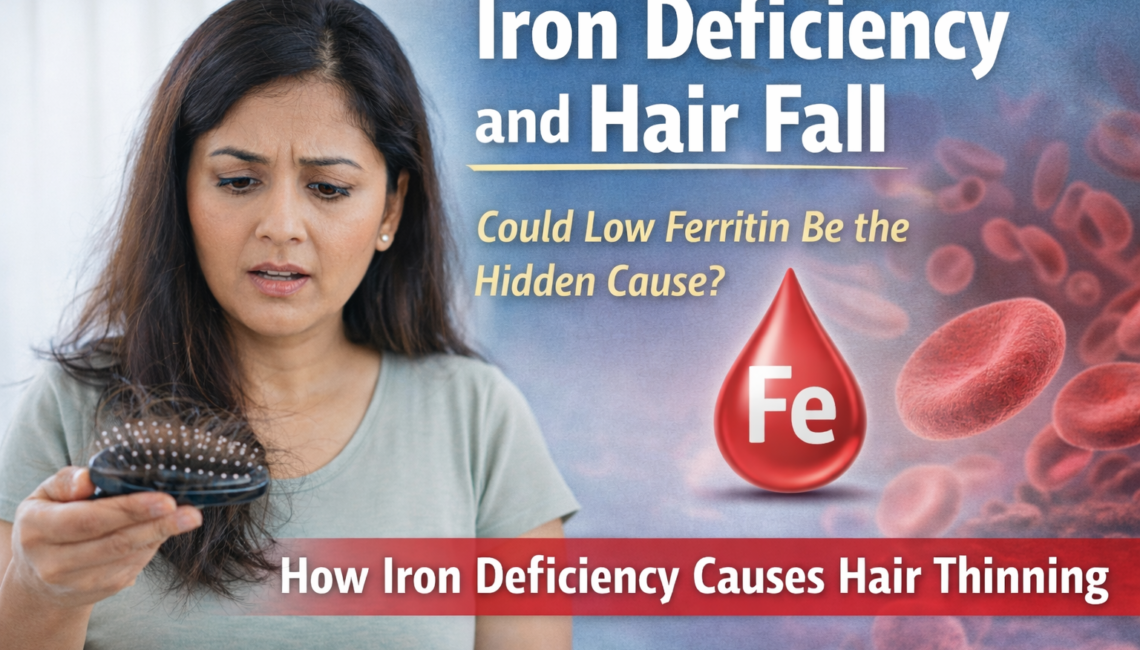
A few months ago, I received a message from a reader — a 34-year-old woman from Pune. She had been losing hair in alarming amounts for over a year. She had tried every oil, every shampoo, every home remedy her mother suggested. Nothing worked. Her doctor had checked her haemoglobin. It was 11.8 g/dL — slightly low, but not dramatically so. She was told she was “fine.”
She wasn’t fine. Her ferritin was 9 ng/mL.
Within four months of iron supplementation and dietary changes, her hair fall had reduced by more than half. This story is more common than most people realise — and it is almost always missed because doctors check haemoglobin but not ferritin.
If you are losing hair and cannot figure out why, iron deficiency — specifically low ferritin — may be the answer nobody has checked for yet.
Why Iron Is So Critical for Hair Growth
Hair follicles are among the fastest-growing tissues in the human body. That speed comes at a metabolic cost — follicles need a constant, reliable supply of oxygen and nutrients to stay in the active growth phase (called the anagen phase).
Iron is essential to this process because it is what makes haemoglobin work. Haemoglobin carries oxygen through the blood. When iron drops, oxygen delivery to hair follicles drops with it. The follicles respond by shutting down — shifting prematurely from the growth phase into the resting phase (telogen). Two to three months later, the hair attached to those resting follicles falls out in large numbers.
This 2–3 month delay is why iron-related hair fall is so confusing. By the time you notice heavy shedding, the trigger — iron dropping — happened weeks earlier. You rack your brain trying to identify what changed, and you come up empty.
Ferritin vs Haemoglobin: The Test Most Doctors Skip
Here is the most important thing I want you to take from this article:
Normal haemoglobin does not rule out iron deficiency as a cause of hair fall.
Ferritin is a protein that stores iron in your body. Think of it as your iron reserve tank. Haemoglobin is the active iron currently working in your blood. Your body is smart — it will drain your ferritin stores to keep haemoglobin levels normal for as long as possible. So by the time haemoglobin drops, ferritin has often been low for months or even years.
A widely cited review by Trost, Bergfeld, and Calogeras, published in the Journal of the American Academy of Dermatology in 2006, examined the relationship between iron deficiency and hair loss in depth (find the paper). Notably, the authors found the evidence available at the time insufficient to broadly recommend iron supplementation for hair loss in the absence of anaemia. Since then, clinical practice in dermatology has increasingly moved toward using a ferritin target above 70 ng/mL as a working benchmark for hair regrowth — well above the standard lab “normal” cutoff of 12–15 ng/mL — though this specific threshold is a clinical guideline drawn from accumulated practice rather than a single settled trial result.
This gap between “medically normal” and what’s increasingly used as an optimal target for hair is where most women fall through the cracks.
When you get tested, ask specifically for:
- Serum Ferritin
- Serum Iron
- Total Iron Binding Capacity (TIBC)
- Complete Blood Count (CBC)
Do not accept a haemoglobin test alone as a full iron assessment.
Who Is Most at Risk in India
Iron deficiency is the most common nutritional deficiency in India — and the dietary patterns here make it particularly easy to develop without realising it.
You are at higher risk if you:
- Follow a vegetarian or vegan diet (plant-based iron is absorbed at only 2–20% efficiency versus 15–35% for meat-based iron)
- Drink tea or coffee with meals (tannins in chai can meaningfully reduce iron absorption — something most Indian households do without knowing)
- Have heavy menstrual bleeding
- Are pregnant, postpartum, or breastfeeding
- Have recently followed a crash diet or very low-calorie eating plan
- Have a gut condition like IBS, celiac disease, or a history of gut infections
The chai habit deserves special mention. Tea’s tannins bind to non-heme iron in the digestive tract and block its absorption. The size of the effect varies by study and by how strong the tea is and how close to the meal it’s consumed — a controlled trial in the American Journal of Clinical Nutrition found roughly a 37% reduction when tea was taken alongside a meal, while older and stronger-tea studies have found reductions of 60% or more (see the research). The exact number varies, but the direction is consistent: if you have chai with every meal — as many Indian families do — this habit could be quietly reducing how much iron you actually absorb over years.
Recognising Iron-Related Hair Fall
Not all hair fall looks the same. Iron deficiency typically causes what dermatologists call diffuse telogen effluvium — meaning hair thins all over the scalp rather than in specific bald patches.
Signs that point toward iron as the cause:
- Hair thinning evenly across the scalp, especially noticeable at the crown
- Significantly more hair on your pillow, in the shower drain, or on your brush
- Hair that feels finer or more fragile than it used to
- Fatigue that feels disproportionate to your activity level
- Pale inner eyelids or pale nail beds
- Brittle nails or nails with ridges
- Feeling cold more often than others around you
- Brain fog or difficulty concentrating
If you have hair fall alongside fatigue and any of the above, the combination is a strong indicator. Please get your ferritin tested before spending more money on hair products.
How Iron Deficiency Triggers Telogen Effluvium — The Mechanism
Understanding the biology helps you understand why the fix takes time.
Hair grows in cycles. The anagen (growth) phase lasts 2–6 years. The catagen (transition) phase lasts about 2 weeks. The telogen (resting) phase lasts 2–3 months, after which the hair falls out and a new cycle begins.
Normally, about 85–90% of your hair is in the anagen phase at any time. When iron drops below the threshold your follicles need, that percentage shifts. More follicles enter telogen early. Two to three months later, when those hairs reach the end of their resting phase, they shed simultaneously — creating the alarming volume of hair fall that sends people to dermatologists.
This is also why patience is non-negotiable in treatment. Even after you correct your ferritin levels, the follicles need time to re-enter the growth phase and produce visible new hair. Most people see reduced shedding within 6–8 weeks of starting treatment, but visible regrowth takes 3–6 months, sometimes longer.
The Best Iron-Rich Foods for an Indian Diet
There are two types of dietary iron:
Heme iron — found in meat, poultry, and seafood. Absorbed at 15–35% efficiency. If you eat meat, chicken liver is one of the richest sources available and is affordable in India.
Non-heme iron — found in plant foods. Absorbed at only 2–20% efficiency, but can be significantly improved with the right food combinations.
For vegetarians and vegans, the best iron sources in an Indian kitchen include:
- Horse gram (kulthi dal) — one of the highest plant-based iron sources, commonly available in South India
- Rajma (kidney beans) and chana (chickpeas)
- Methi leaves (fenugreek) — excellent when cooked fresh
- Spinach (palak) — good source, but absorption improves significantly when cooked with lemon
- Jaggery (gud) — better iron source than white sugar, useful in small amounts
- Sesame seeds (til) — high in iron and easy to add to rotis or salads
- Amla (Indian gooseberry) — not high in iron itself, but extremely high in Vitamin C, which dramatically improves non-heme iron absorption
The absorption rule to remember: Always pair plant-based iron foods with Vitamin C. A squeeze of lemon on dal, amla chutney with your meal, or a small glass of fresh orange juice alongside iron-rich foods can meaningfully increase absorption. Conversely, avoid chai for at least an hour before and after iron-rich meals.
What to Expect from Iron Supplementation
If blood tests confirm low ferritin, your doctor will likely recommend iron supplements. A few things worth knowing:
Ferrous sulphate is the most commonly prescribed form in India and is effective, but causes constipation and nausea in many people. If that happens to you, ask about ferrous bisglycinate — a gentler, better-absorbed form that is easier on the stomach.
Iron supplements should be taken on an empty stomach with Vitamin C for best absorption. Do not take them with milk, tea, or calcium supplements, as all of these reduce absorption.
Do not self-prescribe iron supplements. Iron overload (hemochromatosis) is a real risk with excessive supplementation and can damage the liver and heart. Testing first, then supplementing under medical guidance, is the right sequence.
Common Mistakes That Slow Recovery
These are the mistakes I see most often among people trying to fix iron-deficiency hair fall:
- Stopping supplements too early. Ferritin levels are slow to rise. Most people need 3–6 months of consistent supplementation to reach a level associated with hair regrowth. Stopping after 6 weeks because “the blood test improved” is one of the most common errors.
- Continuing to drink chai with every meal. You can take supplements and eat well, but if chai tannins are blocking absorption at every meal, progress will be much slower.
- Relying on topical treatments. Minoxidil, onion oil, rice water — none of these will regrow hair that has stopped growing because of a nutrient deficiency. The root cause must be addressed first. (For what onion oil evidence actually shows, see our honest review of onion juice for hair.)
- Only testing haemoglobin. As discussed, this misses the ferritin story entirely. Insist on a full iron panel.
Frequently Asked Questions
How long does it take for hair to regrow after correcting iron deficiency?
Expect 3–6 months of consistent treatment before visible regrowth appears. Shedding typically reduces within 6–8 weeks of bringing ferritin levels up. Full recovery to pre-deficiency hair density can take up to a year in some cases.
Can iron deficiency cause permanent hair loss?
In most cases, no. Telogen effluvium caused by iron deficiency is reversible once the deficiency is corrected. However, prolonged, severe deficiency over many years can potentially cause follicle damage. Early treatment gives the best outcomes.
What ferritin level is needed for hair regrowth?
Many dermatologists now use ferritin above 70 ng/mL as a working target for hair regrowth, even though standard lab ranges often flag anything above 12–15 ng/mL as “normal.” Discuss the right target for you with your doctor.
Is hair fall from iron deficiency different from androgenetic alopecia?
Yes. Iron-deficiency hair fall is diffuse (all over the scalp), while androgenetic alopecia follows a pattern (receding hairline in men, widening parting in women). A dermatologist can distinguish between these with a physical examination and blood tests.
When to See a Doctor
Please consult a doctor — ideally a dermatologist or a physician who will order a full iron panel — if:
- Your hair fall has been ongoing for more than 2–3 months
- You notice thinning at the crown or widening of your parting
- You have any of the accompanying symptoms (fatigue, pale nails, cold intolerance)
- You have heavy periods or a history of gut problems
- You are vegetarian and have never had your iron levels checked
The Bottom Line
Iron deficiency — and specifically low ferritin — is one of the most common and most consistently missed causes of hair fall, particularly in women in India. The fix is not a new shampoo or a hair oil. It is understanding what your body is telling you, getting the right test, and giving your body the nutrients it has been starved of.
If the reader from Pune had known to ask for a ferritin test two years earlier, she would have saved herself considerable money, stress, and hair. You now have that knowledge.
Get tested. Get the full panel. And please — have your chai after your meals, not during.
Iron isn’t the only commonly missed deficiency behind hair fall — see our companion article on Vitamin D deficiency and hair loss for another test worth asking for.
The information in this article is for educational purposes only and is not a substitute for professional medical advice. Always consult a qualified healthcare professional before starting any treatment or supplement.