My father is 67. He walks every morning, does not smoke, rarely drinks, and eats home-cooked food almost exclusively. By every visible measure, he looked like a healthy man.
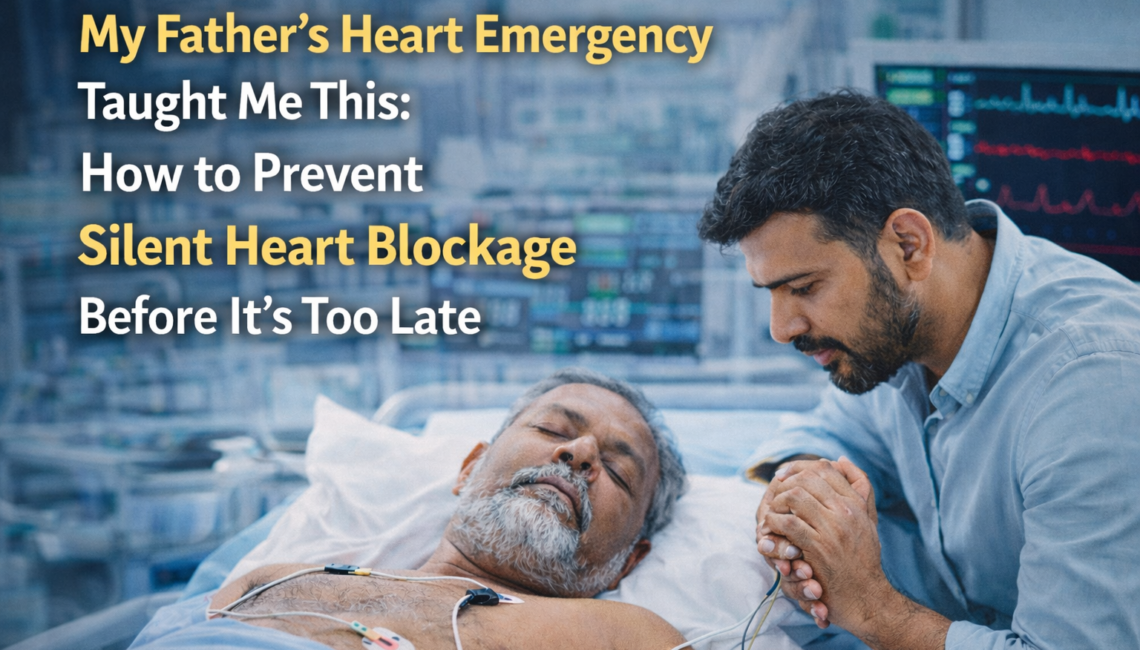
In October 2024, he collapsed at home with chest pain. His LAD (left anterior descending) artery — the one cardiologists call “the widow-maker” — was 90% blocked. He needed an emergency stent. The cardiologist told us afterwards: if he had waited another 30 minutes before reaching the hospital, we would have been having a very different conversation.
The thing that shook me most was not the emergency itself. It was what came before: nothing. No warning. No dramatic symptoms. Just the invisible, silent accumulation of plaque over years — and then, suddenly, a crisis.
I wrote this post because I know this story is not unique to my family.
What Is Silent Heart Blockage — And Why It Is Silent
Heart blockage — medically called coronary artery disease (CAD) — is the narrowing of the arteries that supply blood to the heart muscle. It develops through the gradual buildup of plaque: a combination of cholesterol, fat, calcium, and cellular debris that accumulates on artery walls over years and decades.
The reason it is “silent” is that arteries compensate remarkably well. The human body will continue functioning normally with 50%, 60%, even 70% blockage — the artery simply expands slightly to maintain blood flow. Symptoms often appear only when blockage exceeds 70–80%. In many people, the first “symptom” is a heart attack.
A landmark study — the INTERHEART study, published in The Lancet in 2004, spanning 52 countries and 30,000 participants — identified nine modifiable risk factors that account for over 90% of the risk of a first heart attack. The most significant: abnormal cholesterol ratio, smoking, diabetes, hypertension, abdominal obesity, and stress. All nine are modifiable. All nine can be assessed with basic tests.
The Warning Signs That Are Easy to Miss
Silent does not mean completely invisible. Looking back after my father’s event, there were signs we had explained away:
- Unexplained fatigue with exertion. He had been saying for a year that his morning walk “tired him out more than it used to.” We attributed it to age.
- Mild breathlessness on stairs. Dismissed as deconditioning.
- Occasional discomfort in the upper back and left shoulder. He mentioned this twice. He had it checked once — the doctor attributed it to his old shoulder injury.
- Indigestion that seemed unrelated to food. Cardiac discomfort very commonly presents as stomach discomfort in the upper abdomen. It is one of the most frequently missed signals, particularly in Indians.
In South Asians specifically, heart disease presents differently than in European populations. Indians tend to develop CAD a decade earlier, experience more diffuse disease (multiple vessels affected), and more often present with atypical symptoms — jaw pain, back pain, nausea — rather than the classic “crushing chest pain radiating to left arm” that everyone knows from TV.
Who Is at Higher Risk — And Why Indians Need to Pay Particular Attention
South Asians have a significantly elevated risk of coronary artery disease compared to other ethnic groups — and this is not simply explained by diet or lifestyle. Research from the Journal of the American College of Cardiology and multiple population studies have shown that South Asians:
- Develop CAD 5–10 years earlier than Western populations
- Have higher rates of insulin resistance even at normal weight (a condition called TOFI — thin outside, fat inside)
- Have elevated Lipoprotein(a) levels genetically — a particularly dangerous cholesterol particle not checked in standard lipid panels
- Experience higher mortality rates from first heart attacks
This means that a 45-year-old Indian man or woman with borderline risk factors deserves more aggressive screening than Western guidelines might suggest. The standard advice to “start worrying at 55 or 60” was developed for European populations. For us, the timeline is different.
The Tests That Actually Reveal Silent Blockage
Standard health checkups often miss developing heart disease. A basic lipid panel tells you your LDL and total cholesterol — but this is an incomplete picture. Here is what is worth asking about:
- Lipoprotein(a) [Lp(a)]: A genetically determined cholesterol particle that significantly elevates heart disease risk. Not part of standard panels. Elevated in a large percentage of Indians. Test once — it doesn’t change much over your lifetime.
- ApoB: A better marker of cardiovascular risk than LDL alone. Measures the number of dangerous cholesterol-carrying particles rather than just their volume.
- hs-CRP (high-sensitivity C-Reactive Protein): A marker of systemic inflammation. Chronic inflammation accelerates plaque buildup. Normal CRP tests are too insensitive — ask specifically for high-sensitivity CRP.
- HbA1c and fasting insulin: To detect insulin resistance and pre-diabetes, both of which dramatically accelerate arterial damage even before glucose is overtly elevated.
- Coronary CT Calcium Score (CAC Score): A 10-minute, low-radiation CT scan that measures calcium deposits in coronary arteries. A CAC score of zero in someone over 50 is reassuring. Elevated scores indicate existing plaque. This is arguably the single most informative test for silent coronary disease in an asymptomatic person.
Lifestyle Changes That Actually Move the Needle
My father made several changes after his stent procedure. I document them here not as prescription but as what the evidence supports:
- Eliminating refined carbohydrates and sugar — more impactful than reducing dietary fat for many Indians, given the high-carbohydrate nature of traditional diets and the Indian population’s genetic tendency toward insulin resistance
- Replacing refined vegetable oils with cold-pressed mustard oil, ghee, or olive oil — hydrogenated fats and refined seed oils contribute to inflammation
- Daily 30-minute brisk walking, not leisurely strolling — heart rate elevation matters
- Stress management — chronic psychological stress elevates cortisol and inflammatory markers, both of which accelerate plaque formation. This is not a soft recommendation; it is mechanistically proven
- Sleep quality — less than 6 hours of sleep per night is an independent risk factor for cardiovascular disease, equivalent in risk magnitude to several other established factors
Frequently Asked Questions
At what age should Indians start cardiac screening?
Most cardiologists who treat South Asian populations recommend baseline cardiac risk assessment starting at 35–40, particularly if you have a family history, diabetes, hypertension, or are overweight. A standard lipid panel and blood pressure check at every annual physical is a minimum.
Can heart blockage be reversed without surgery?
Established plaque cannot be fully reversed, but progression can be halted and in some cases partially reduced through aggressive lifestyle changes and medication. The goal is to prevent soft, unstable plaque from rupturing — which is what causes most heart attacks — rather than completely clearing already calcified blockages.
My father/mother had a heart attack. Does that mean I will?
Family history is a significant risk factor, not a destiny. It means you should start screening earlier and be more proactive about modifiable risk factors. Knowing your family history is actionable — it tells you to test Lp(a), get a CAC score, and work harder on lifestyle factors. It does not mean a heart attack is inevitable.
What I Wish We Had Known Earlier
If I could give one piece of advice to every Indian family reading this: do not wait for symptoms to prompt cardiac screening. Symptoms are often the last thing that appears — or the only thing that appears.
A ₹2,000 lipid panel and ₹500 blood pressure check every year. An Lp(a) test once in your lifetime. A CAC score at 45 if you have risk factors. These are small, accessible interventions. The cost of ignoring them, as my family learned, is measured in things money cannot buy back.
My father is well now. He walks every morning — this time with a more complete understanding of what his body needed all along.
This article is for educational purposes only. Please consult a qualified cardiologist or physician for personalised medical advice.